Building new-style rural areas in extremely difficult localities needs flexibility and creativity: Deputy PM
Deputy Prime Minister Trinh Dinh Dung recently directed concerned agencies to apply flexible policies in building new style rural areas in extremely difficult regions.
At a workshop reviewing the task of developing new-style rural areas in difficult regions between 2016 and 2020 held in the northern province of Yen Bai on December 3, Deputy PM Trinh Dinh Dung stressed that authorities and concerned agencies should continue to support localities, especially difficult regions to narrow down the gap in living standard and income between them and the rest of the country in the next five year period.
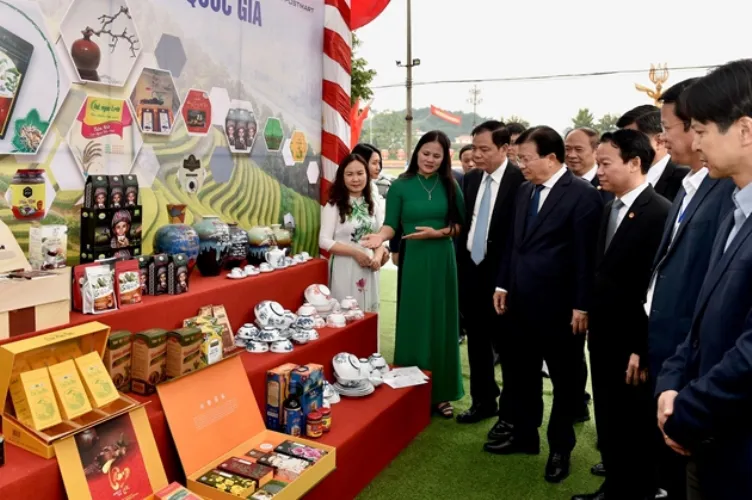
Deputy PM Trinh Dinh Dung (fourth from right) visits a stall displaying local delicacies and products at the event. Photo kinhtedothi.vn |
“It requires the whole political system, sectors at all levels and people joining hands,” he said.
During the period of 2016-2020, the National Assembly, Government and Prime Minister have issued various mechanisms and policies to give priority to extremely difficult regions to develop socio-economics and build new-style rural areas.
The total budget for the task reached over VND791,900 billion, which accounted for 38.1% of the whole capital budget mobilised all over the country.
After ten years, the national new-style rural area programme has achieved great success, the Deputy PM reviewed.
However, he expressed his concern on challenges in extremely difficult regions, where people have kept migrating illegally. Locals still lack residential land, electricity and fresh water.
Other issues include relocating people, preventing natural disasters, and responding to climate change in such regions.
He ordered concerned agencies to apply creative and flexible methods to implement the task of building new-style rural areas in extremely difficult regions, in which economic development should be the key task.
“Education and training quality should be enhanced, especially human resource training, together with health care for the local community, preventing and fighting against social evils, ensuring social security, political security and national sovereignty,” he noted.
He said authorities should persuade local people to understand that new-style rural building guidelines are set by the people, for the people, done by the people with the support of the State.
He expected each province to host at least a district meeting criteria for rural-style areas while all communes meeting at least five of the criteria.
He said the task implemented in extremely difficult areas should be incorporated in the development of the whole region.
The Deputy PM ordered the Ministry of Natural Resources and Environment to quickly review land planning in areas at risk of landslides to move locals out of dangerous sites.
Authorities should complete essential infrastructure including electricity, fresh water, irrigation system, health care, education to improve production and locals’ life.
He also suggested localities attract investors to extremely difficult regions and mountainous areas, with special attention paid to improving investment mechanisms and policies, infrastructure and human resources.
The Deputy PM ordered provinces to concentrate on preserving, bringing into full play traditional cultural values together with developing tourism, protecting the environment, enhancing people’s awareness of national sovereignty.
He asked the Ministry of Agriculture and Rural Development to co-ordinate with the Committee for Ethnic Affairs and Ministry of Labour, Invalids and Social Affairs to propose a plan for the national target programme in 2021-2025.