Developing digital government in Vietnam to better serve people
Since the launch of the national online services portal, over 3,000 online public services have been available for the public, which helps save VND8 trillion (US$352 million) per year on public spending.
Vietnam’s efforts to promote E- and Digital Government are aimed at ensuring better service for the people and businesses, ultimately taking a step towards a digital economy and society.
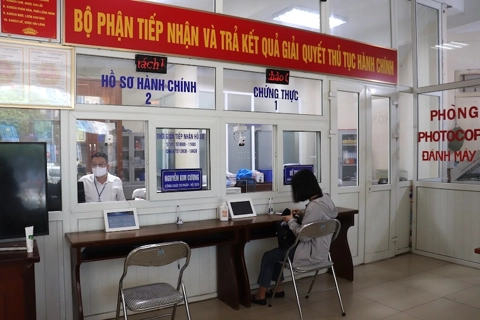
| Helping local realize administrative procedures at Soc Son District People's Committee. Photo: Pham Hung |

Vice Minister of Information and Communications Nguyen Hung Dung gave the remarks at a national conference on E-Government held today [September 9].
Dung mentioned a recent national strategy on digital transformation that was recently signed off by Prime Minister Pham Minh Chinh in June as the compass for Vietnam’s action towards the digital government in the next decade, which has been identified by the UN as the time for action to ensure sustainable development.
“The most significant task for 2021 is to take all online public services to stage 4 [the most advanced stage available],” Dung said.
While acknowledging this is quite challenging given the fact that currently, only 45% of the services have been online at stage 4, the goal remains feasible with dedication and commitments from the entire political system.
However, for online public services to truly become a useful instrument for businesses and people, Dung expected greater efforts from local authorities in raising public awareness on the benefits of online services, so that the use of services at stage four after one year should be at least 30%.
On this issue, Director-General of the Administrative Procedures Control Agency under the Government Office Ngo Hai Phan noted the national online services portal, which serves as a focal point for data sharing with provincial portals in handling administrative processes, is now providing 3,096 online public services since its launch in December 2019 and saves VND8 trillion (US$352 million) per year.
To date, the national portal recorded over one million accounts and processed 72 million documents, with 100% of ministries, provinces/cities, eight corporations, and 15 banks completing payment integration.
Phan added the number of transactions via the portal is estimated at 116,000 with a total of VND258 billion ($11.3 million), mainly focusing on payments for various fees, social or health insurances.
Humans stay center in every reform efforts
To further push for comprehensive digital transformation in processing administrative reform, Phan said drastic steps should be taken with humans as the center of every reform effort.
“Certain priorities are to develop sharing platforms on the national portal, including administrative database, online payment, and feedback functions,” Phan said.
A major issue at the moment is the lack of willingness from ministries or localities to share data, which requires closer supervision on how public servants handle administrative processes in real-time to timely address any shortcomings.
“The ultimate goal in digital transformation is to improve people’s lives, while public satisfaction on administrative services is the gauge to assess the digitalization success,” he added.
Vietnam has been ranked 86th out of 193 countries and territories in the UN’s 2020 E-Government Development Index (EGDI), up to two places against the previous ranking in 2018.
In Southeast Asia, however, the country remained at the sixth position, which has partially impacted its competitiveness in attracting investment capital.
Experts suggested Vietnam should further improve efficiency in E-Government for greater competitiveness, focusing on potential fields such as smart cities and e-commerce to boost economic recovery in the post-Covid-19 period.
Meanwhile, 38 out of 63 provinces/cities in Vietnam have been pursuing smart city projects by actively investing in digital infrastructure and pushing for full 4G coverage, which helps improve people’s accessibility to IT services.
In 2020 Vietnam’s e-commerce market grew by 16% year on year to US$14 billion, of which the online retail segment surged by 46%, ride-hailing, and food delivery services by 34%, online advertisement, and entertainment by 18%.
The market is set to average growth of 29% during the 2020-2025 period to reach $52 billion by 2025.
Hanoi targets to finalize the e-government framework by 2025 to stay atop the country and in the leading positions in the region in terms of e-government development, which is set to lay the foundation for digital government formation. Under the process of digital transformation, Hanoi would continue its rapid and sustainable development to become a green and smart city, capable of competing with other cities in the region. By 2030, the digital government is set to be the driving force for Hanoi to be green, smart and modern city that has strong competitiveness at regional and international levels. |