Effective development of urban agriculture on Hanoi's outskirts
Hanoi's urban agricultural development is geared towards a balanced, rational structure between the elements of the agricultural ecosystem, while making positive contributions to the environment.
Urban agriculture brings many benefits to Hanoi's suburbs, contributing to agricultural development, building new-style rural areas, and increasing green space, the Vietnam Government Portal quoted Prof. Dr. Tran Duy Quy, former Deputy Director of the Vietnam Agricultural Institute, as saying.
Quy said that urban agriculture has greatly contributed to solving the difficult problems of greening in the process of urbanization. "Urban agriculture will continue to be the solution and strategic direction for Hanoi's rapid and sustainable development."
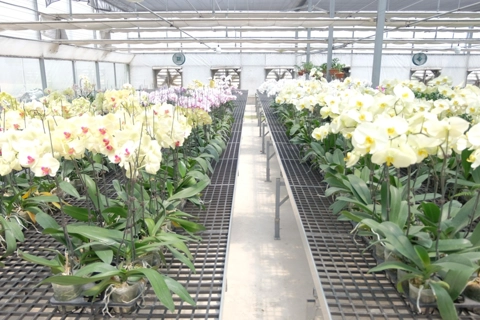
The flower and ornamental plant production model of Hong Van Cooperative in Thuong Tin District contributes to the development of organic agriculture in the capital. Photos: VGP |
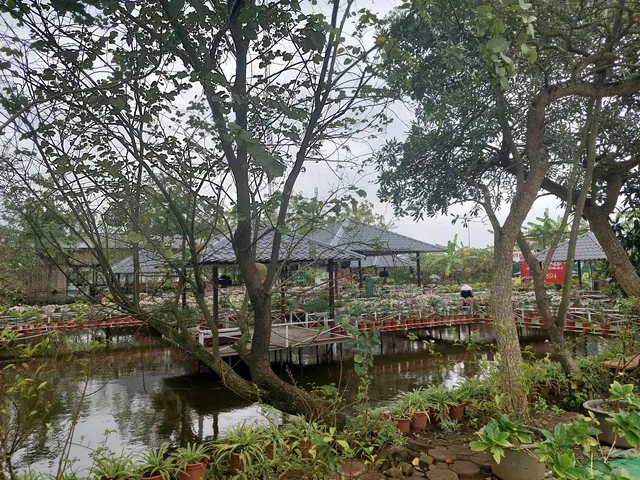
People have used urban agriculture solutions to green the space between residential areas and developments. For example, planting trees in parks or building rooftop gardens, Quy continued.
In the suburbs, the urban agricultural solution is to create green corridors based on farms of safe vegetables, ornamental flowers, ecological gardens, and suburban ecological villages.
"Typically, the value of agricultural production in Hoai Duc District is only 6.4% due to increasing urbanization, but the district is still focusing on building new-style rural areas, changing crop structure, and targeting trees with high economic value to increase people's income," Quy said.
Nguyen Sinh Sau, head of the horticulture team in Yen So Commune, Hoai Duc District, said that Yen So Commune has identified fruit trees as the main crop to increase farmers' income due to the small amount of arable land. "Farmers in the commune have formed a horticulture association to share experience in growing and consuming products."
Nguyen Trung Thuan, Vice Chairman of the Hoai Duc District People's Committee, told The Hanoi Times the locality has an area of 455 hectares for specialized fruit tree production. Some fruit trees have become key crops in the strategy to develop concentrated production areas, such as orange in Canh; grapefruit in Dac So and Yen So communes; late-ripening longan in An Thuong, Dong La, and Song Phuong communes; pomelo in Cat Que, Dong La communes; and others.
"At present, Hoai Duc District is focusing on using advanced technology in production to improve quality and productivity. They are also planning cultivation areas with links to consumption to increase the value of agricultural products. The district is specifically implementing a policy that is robust enough to attract businesses to make direct investments in the agricultural sector, which will help promote modern and sustainable urban agriculture in the future," Thuan said.
In the General Planning of Hanoi to 2030 with a vision to 2050, it is proposed to create a "green corridor, green belt" - the key to Hanoi's sustainable development - with 70% of Hanoi's natural land planned for green corridors. Of this, 40% will be reserved for high-yield agricultural areas and biodiversity protection areas, while the remaining 30% of the land will be set aside for conservation-based development areas, Thuan added.
According to Prof. Tran Duy Quy, urban agricultural development in Hanoi must be consistent with comprehensive socio-economic development and land use planning. The goal is to create a balanced, rational structure while making positive contributions to the environment.
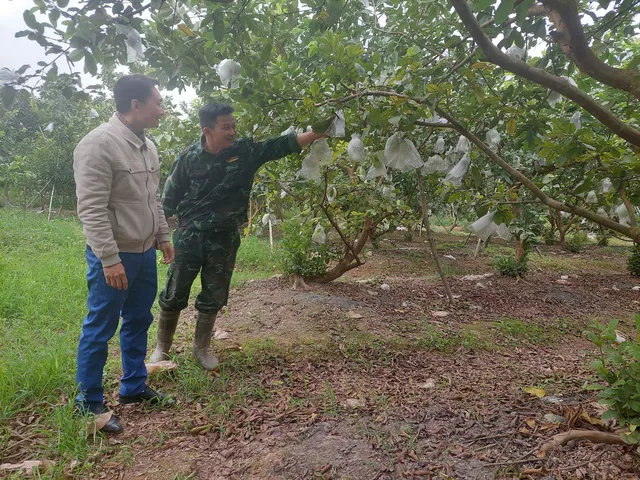
The VietGAP-certified guava plantation in Yen So Commune, Hoai Duc District contributes to the development of urban agriculture in the district. |
"Urban areas should focus on developing high-value crops such as flowers, ornamental plants, and safe vegetables," Quy said.
He noted that there is an urgent need to review and adjust land use planning. Hanoi needs to convert low-productivity farmland to higher-value uses, prioritizing concentration and specialized cultivation. This will optimize land use and ensure sustainable and effective urban agricultural development.
According to Truong Van Quang, Deputy Secretary General of the Vietnam Urban Planning and Development Association, Hanoi's urban agricultural areas continue to take up a significant portion of the total natural area in various configurations. Similar to urban agricultural land in urban districts, there is a trend of specialized conversion in the suburbs.
"The suburbs are constantly changing due to the direct impact of urbanization. Therefore, Hanoi needs to improve its urban agriculture with high-tech and ecological farming models, with efforts focused on concentrated production areas and planning for sustainable growth," Quang told The Hanoi Times.
The capital has converted nearly 40,300 hectares of rice land to other crops. In addition to more than 15,600 hectares of high-value rice, nearly 3,000 hectares have been allocated for safe vegetable production, about 7,400 hectares for fruit tree cultivation, and 285 high-tech agricultural production models.
High-tech agricultural models are mainly practiced in districts such as Me Linh, Gia Lam, Thuong Tin, Dong Anh, Thanh Oai, and Dan Phuong. Some models have initially achieved high economic efficiency, in line with the situation in Hanoi.
Quang said Hanoi must focus on restructuring crops, improving agricultural production efficiency, developing ecological and high-tech agriculture, and striving to become a leading locality in ecological agriculture and modern rural development while preserving and promoting traditional cultural and historical values.
"In addition, the city should give priority to building green belts to ensure a green living environment. Special attention should be paid to developing seed technologies, post-harvest preservation and processing technologies, and linking them with product market development," Quang said.