EVFTA drives Vietnam’s exports forward
Local companies could further improve their utilization rate of the trade agreement to gain a larger share of the EU market.
The EU-Vietnam Free Trade Agreement has been a driving force for Vietnam’s exports as local firms are now taking good advantage of the trade deal.
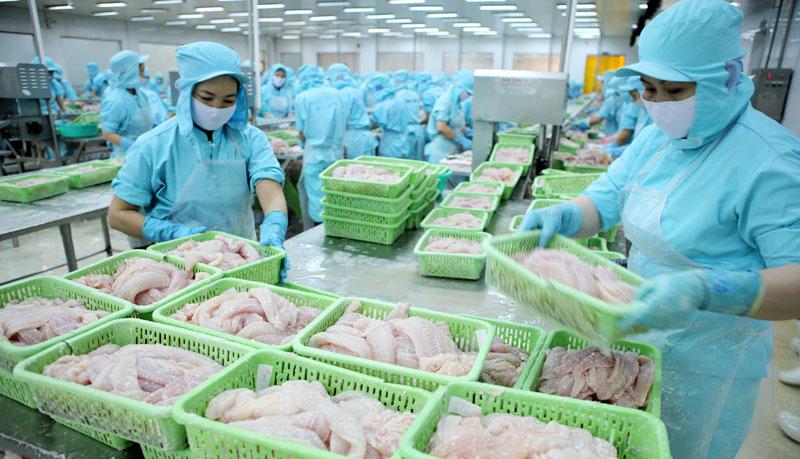
| Processing catfish for export at Cantho. Photo: Hung Thap |
Deputy Director of the Import-Export Department under the Ministry of Industry and Trade (MoIT) Tran Thanh Hai gave the assessment at a conference on the EVFTA on August 8.
In 2021, bilateral trade turnover between Vietnam and the EU rose by 14.5% year-on-year to US$57.01 billion, in which Vietnam exported goods and products worth $40.1 billion, or an increase of 14.2%; and imported $16.9 billion.
“This helped the country maintain a trade surplus of over $23.2 billion last year,” Hai said.
According to Hai, since the launch of the EVFTA on August 1, 2020, Vietnam’s exports to the EU rose by 15% to $83 billion.
Over the past two years, the majority of Vietnamese export products to the EU have seen high growth rates, especially steel (200%), coffee (75.2%), and pepper (55.8%), while traditional products continue to maintain steady growth of 10-15%, such as garment, footwear, and wooden products.
Hai suggested such positive results came from the fact that Vietnamese companies have now gained a better understanding of the rules of origin and other requirements in exporting to the EU market.
For the first six months of 2022, exports under the EUR.1 certificate of origin hit $5.8 billion, or 25% of Vietnam’s total exports to the EU during the period. Hai also noted this figure did not include the export items under the Generalized Scheme of Preferences (GSP, or developed countries’ preferential tax rate for developing partners).
In the agricultural sector, seafood, vegetables, and rice are among those with high export growth to the EU and with a high utilization rate of EUR.1, including rice at 100%.
Le Hang, the representative of the Vietnam Association of Seafood Exporters and Producers (VASEP), said the EU was once Vietnam’s largest market for seafood products, but then was relegated to fourth place behind Japan, China, and the US.
The situation, however, has changed since the EVFTA comes into force, Hang said, referring to Vietnamese shrimps’ exports to the EU now making up 40-50% of the total while catfish represents 10-16%, and other seafood products account for 35%.
By the end of the second quarter, the EU remained among Vietnam’s three largest seafood export markets, Hang said.
“Amid rising inflationary pressure, preferential treatment under the EVFTA has been key in helping Vietnam’s seafood exports increase by 40% to nearly $700 million,” she continued.
Room to improve
Deputy Head of the MoIT’s Multilateral Trade Policy Department Ngo Chung Khanh suggested Vietnam’s rising exports to the EU, one of the world’s most stringent markets, showcases the capabilities of local firms in adapting to high standards, but there remains room for improvements.
Khanh noted the EU currently allocates a quota of 80,000 tons of rice for Vietnam per year with a tax rate of 0%, but as the bloc is moving to fully liberalize the market for broken rice, it would help Vietnam raise the rice export volume to 100,000 tons every year.
Nevertheless, General Director of Trung An Hi-tech Farming Company Pham Thai Binh added the figure remains modest compared to Vietnam’s rice exports of over 6.4 million tons per year.
Binh said as the EU currently has FTAs with two countries in Southeast Asia, namely Vietnam and Singapore, the farming industry would need a tailor-made strategy to better utilize the EVFTA.
Echoing Binh’s view, Hang from VASEP said Vietnamese enterprises are still focusing too much on their traditional markets in East Asia, rather than turning to other markets, especially the EU, one of the world’s largest.
Hang said the most challenging issue for seafood exports to the EU is to meet the rule of origin, which requires deep understanding from local businesses to overcome the technical barriers.
In addition, the EU's current yellow card on Vietnamese fishery for illegal, unreported, and unregulated fishing (IUU) is another hindrance to seafood exports to this market.
“The priority for Vietnam is to convince the European authorities to lift the yellow card,” Hang said, adding in a worst-case scenario of being imposed on a red card, Vietnam would face the risk of losing access to the European market with over $500 million seafood revenue per year.
More importantly, other markets would see the EU as the benchmark in supervising their respective rules of origin requirements, Hang asserted.