Good F-gas management helps Vietnam honor commitments in Paris Agreement: JICA
The HFC phase-down will contribute to Vietnam's target on reducing greenhouse gas emissions, strengthening its global climate resilience goals.
The Japan International Cooperation Agency (JICA) has supported Vietnam in controlling the use and disposal of fluorocarbon gas (F-gas) as part of efforts to help the country advance its implementation of the Paris Agreement.
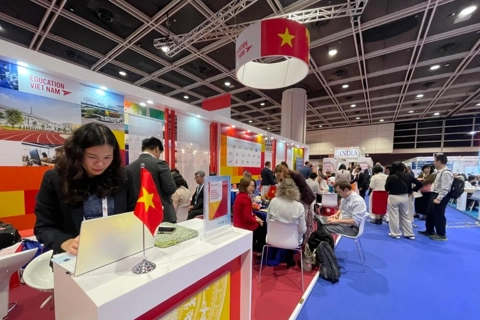
| Experts at the workshop in Hanoi on April 28. Photo: JICA Vietnam Office |

Since July 2020, JICA has been implementing a “Survey on promoting the climate change framework under the Paris Agreement Rulebook in Vietnam” that contributes to the country’s process to phase down F-gas from 2024.
The latest effort was a workshop held on April 28 to exchange experiences on F-gas management among Vietnam and other countries like Japan, Australia, Singapore, and Malaysia.
Jointly organized by JICA and the Department of Climate Change (DCC) under Vietnam’s Ministry of Natural Resources and Environment (MoNRE), the event address both challenges and solutions in F-gas management in Vietnam by regional speakers.
They agreed that Asian countries need to join hands to take actions on phasing down Hydrofluorocarbons (HFCs) -common F-gases- to meet the targets set out in the Kigali Amendment and contribute to the Paris Agreement.
“Together with the Initiative on Fluorocarbons Life Cycle Management of the Government of Japan, which Vietnam agreed to join in October last year, technical analysis on current management of F-gas in Vietnam by JICA’s Japanese experts will help MoNRE in formulation of specific regulations to control the use and disposal of F-gases," said Murooka Naomichi, Senior Representative of JICA Vietnam Office.
We also hope that our experiences on using appropriate technologies for recovery and destruction of F-gases are also useful for Vietnamese companies when the Government implement strict measures for F-gas management”, he added.
Dr. Tang The Cuong, general director of DCC, said “Learning from experiences of Japan and other countries will help us to come up with effective HFC control measures and particularly to stimulate the private sector to convert into more environment friendly technologies.”
Cuong said Vietnam’s revised Law on Environmental Protection (LEP) that regulates obligations for related ministries and relevant stakeholders in phasing out Ozone Depleting Substances and phasing down HFCs.
In addition, Vietnam reconfirmed its commitment in joining the global efforts in combating climate change with the Chapter on Responding to Climate Change in the revised LEP, which was adopted in November 2020 by the National Assembly.
The law sets important rules and principles for Vietnam to strictly control the consumption of F-gases in order to ensure the implementation of the Kigali Amendment to the Montreal Protocol, an international treaty on F-gases, which Vietnam has been a signatory since September 2019.
HFCs are widely used as a refrigerant in household and industrial air conditioners, refrigerators, cleaning precision electronic equipment, spray propellants, urethane used in building materials, etc. HFCs have much higher global warming potential than CO2 and if released, they stay in the atmosphere for decades.
According to a report by MoNRE, in 2019, Vietnam consumed 3,772 metric tons of HFCs while exporting 33.69 metric tons.