Growing number of FDI firms moving to Vietnam
Over the past 20 years, Vietnam has emerged as a significant manufacturing hub, deeply integrated into global supply chains.
Many experts agree that foreign manufacturers, especially from China, are intensifying their recruitment and relocation efforts to Vietnam.
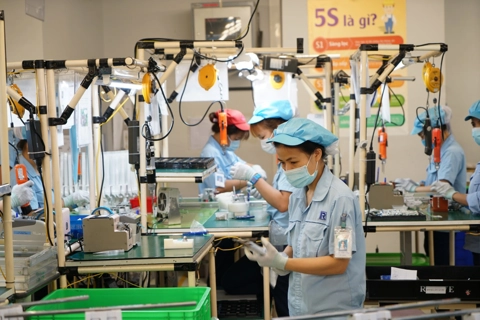
| Electronics production at Rythm Precision Vietnam at Noi Bai Industrial Park, Hanoi. Photo: Pham Hung/The Hanoi Times |
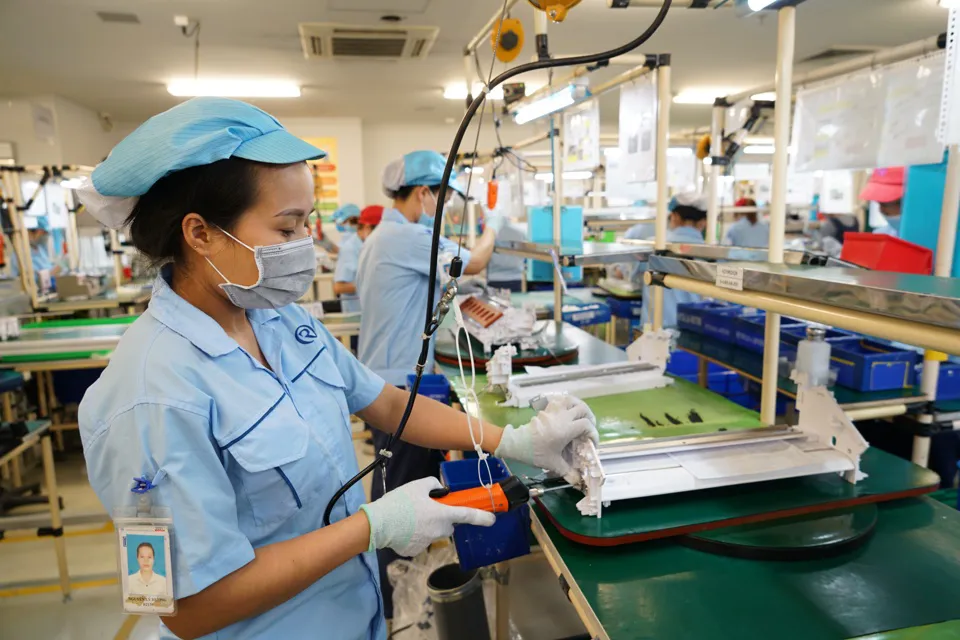
Adecco reports a 10% increase in demand for manufacturing and engineering roles in the first half of 2024 compared to 2023, with a notable requirement for Chinese language skills for positions in quality control and supply chain management.
“The growing need for employees fluent in Chinese and other languages highlights Vietnam's rising appeal as an investment destination, driven by the necessity to strengthen international connections,” according to Adecco.
In the same way, Navigos Search, a headhunter for middle and senior-level management, notes that Chinese-invested manufacturing companies are expanding in Vietnam, seeking candidates with experience (68.3%) and management skills (22%).
Industrially, these companies are moving towards high-tech sectors, including components and accessories for industrial production, electronics, and automotive manufacturing. The demand for Chinese-speaking personnel is a particular driver of activity in this labor market.
Of the 62 countries and territories with newly licensed investment projects in Vietnam during the first seven months of the year, funding from the world's second-largest economy tops the list. Specifically, foreign capital from Hong Kong reached $1.31 billion, while capital from mainland China totaled $1.22 billion. These two investors account for 23.4% of the total newly registered foreign direct investment (FDI).
In addition to China, global corporations increasingly choose Vietnam as an additional manufacturing hub. The General Statistics Office reports that total FDI (including new and additional investments) in the past seven months exceeded $18 billion, marking an almost 11% increase compared to the same period in 2023. Realized capital reached $12.55 billion, the highest amount for the first seven months since 2020.
New and expanded projects are primarily located in industrial zones in the northern region. In the second quarter, Bac Ninh continued to stand out with several new projects, such as Foxconn's US$383 million, 14.26-hectare circuit board manufacturing plant in the Nam Son – Hap Linh Industrial Park, and Amkor's semiconductor materials and equipment factory in Yen Phong II-C Industrial Park, with additional capital exceeding $1 billion.
In Haiphong, earlier this month, the Vietnam Industrial Park Group initiated phase two of a ready-built factory project at DEEP C Industrial Park, which will add over 80,000 square meters of mixed-use warehouses and high-quality storage facilities.
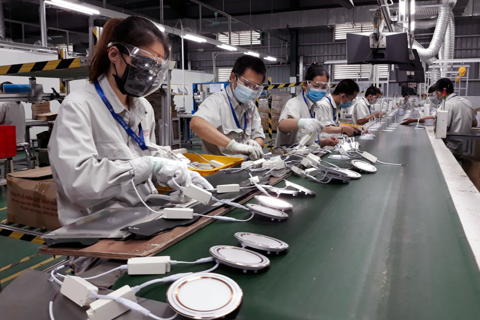
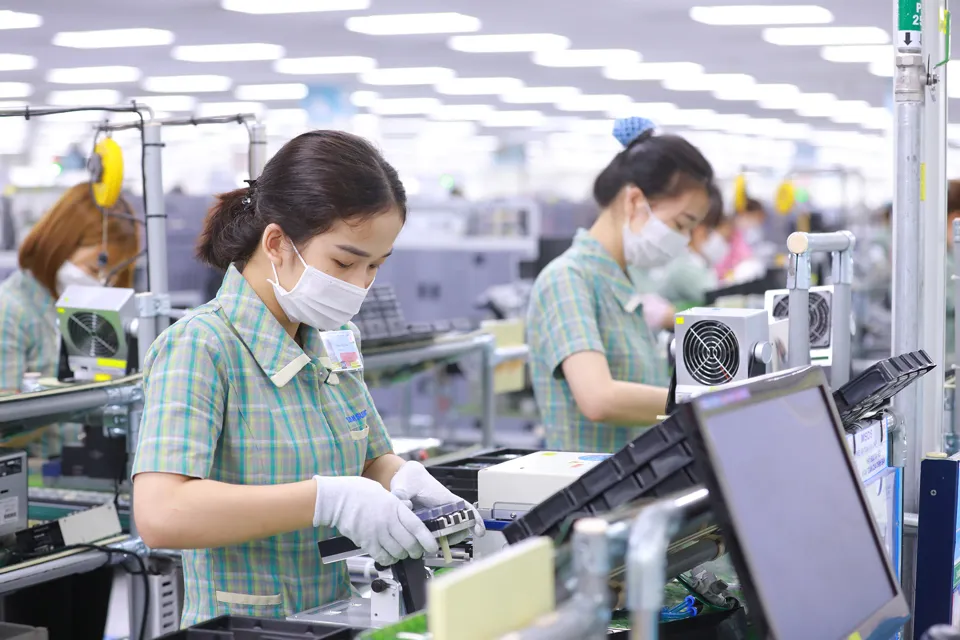
| Inside Samsung's factory in Vietnam. Photo: Hoang Anh/The Hanoi Times |
Competitive cost an advantage
According to HSBC’s report "Vietnam at a Glance" for July, Vietnam has the advantage of being "a top FDI destination, outperforming other Southeast Asian countries" in the trend of production relocation. This is attributed to favorable competitive cost structures and skilled labor.
Over the past 20 years, Vietnam has emerged as a significant manufacturing hub, deeply integrated into global supply chains. Exports have increased by an average of over 13% per year since 2007, driven largely by foreign-invested enterprises.
Historically, most FDI has come from South Korea, particularly Samsung. The efforts of these early market entrants have encouraged other major technology corporations to invest in Vietnam. Last year, Chinese manufacturers accounted for nearly 20% of all newly registered FDI.
In the "China +1" trend, competitive costs and supportive policies are key factors attracting investment to Vietnam. When comparing labor costs across Asia, production wages in Vietnam are lower than in China and other countries. Additionally, according to the PISA survey results, Vietnamese educational standards are highly regarded.
Other costs, such as energy prices, are also competitive. Vietnam has the second-lowest electricity manufacturing costs in Southeast Asia. Diesel fuel, which is widely used in the industrial sectors, is relatively inexpensive. Furthermore, as of May, Vietnam has signed, implemented, or is negotiating 19 free trade agreements (FTAs).
Another reason why Vietnam has become a preferred destination for manufacturing relocation, according to HSBC, is the proactive support from the government through its tax system. Vietnam enjoys a competitive advantage with a corporate income tax rate of 20%. Additionally, the government has introduced various tax exemptions, deferrals, or reductions to support businesses.
"In reality, Vietnam's involvement in global value chains has significantly increased over the years and can now be compared to that of Singapore," the HSBC report states.
However, Vietnam mainly remains a hub for importing components for final assembly. Therefore, to maintain strong investment flows, HSBC recommends that Vietnam move up the production chain and increase the domestic value-added share.
Another challenge in attracting foreign investment is the shortage of skilled labor. This shortage hampers the development of production capabilities in high-tech sectors such as semiconductors, logistics, and maritime transport.
Issues such as infrastructure quality, digital capabilities to ensure smooth trade processes and stable energy supplies also influence multinational corporations' investment decisions in the coming years, according to HSBC.