H&M, Syre Group to expand retail, green textile industries in Vietnam
Swedish companies plan to expand green investment in Vietnam's textile and garment industry.
THE HANOI TIMES — The Swedish fashion company H&M plans to expand its retail network in Vietnam to more than 20 stores, said Adam Karlsson, the H&M Group’s Chief Financial Officer.
The CFO revealed this information at his meeting with Vietnam's Prime Minister Pham Minh Chinh on June 13, which took place as part of the prime minister’s official visit to Sweden from June 12 to June 14.
H&M has been operating 13 stores in Vietnam since 2017 across the country. The company has also sourced from Vietnam for nearly two decades.
The Swedish company now collaborates with 103 local partner factories that collectively employ nearly 87,000 workers.
At the same meeting, Susanna Campbell, Chairwoman of Syre Group, an H&M subsidiary and part of the technology investment firm Vargas, said that the group plans to establish major textile recycling hubs in strategic locations around the world, including Vietnam.
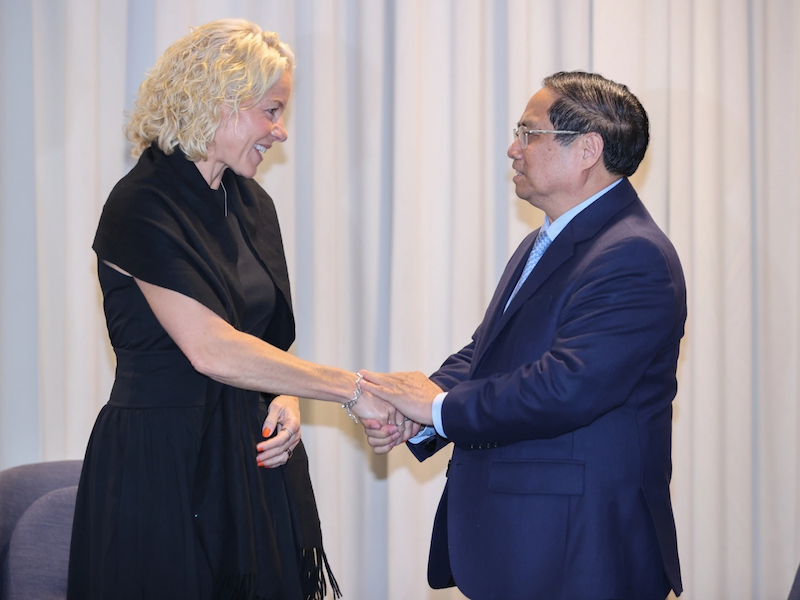
Susanna Campbell, Chairwoman of Syre Group, and Prime Minister Pham Minh Chinh (right) at the meeting. Photo: VGP
Syre Group has already been certified to build a high-tech polyester fabric recycling plant with a total investment of nearly US$1 billion in Gia Lai Province (formerly Binh Dinh Province).
The leaders of H&M and Syre expected that Prime Minister Chinh will support their development strategy and facilitate implementation, as they plan to expand green investment in Vietnam.
They expressed strong interest in participating in Vietnam’s transition to a circular textile industry.
Welcoming the proposals, Prime Minister Chinh said that developing a global circular textile ecosystem aligns with Vietnam’s strategic goals.
He encouraged Syre to share its expertise in managing and operating a sustainable, successful circular textile system.
The Vietnamese government leader also invited H&M and Syre to contribute to developing regulations that promote sustainable practices in Vietnam’s textile and footwear industries.
He urged the two companies to source materials domestically, uphold their commitments to high-tech applications, and ensure that their materials meet environmental standards in order to support sustainable development.
Representatives from both groups pledged to align their projects with Vietnam’s priorities, particularly those related to the circular economy and environmental protection, as outlined by the prime minister.p