Hanoi approves urban development program until 2035
The total estimated minimum development investment capital through 2035 is projected at $122.3 billion, with $52.2 billion for framework infrastructure and $70.1 billion for urban upgrades.
The Hanoi People's Committee has issued Decision No. 6809/QD-UBND, approving the Urban Development Program of Hanoi City for the period up to 2035.
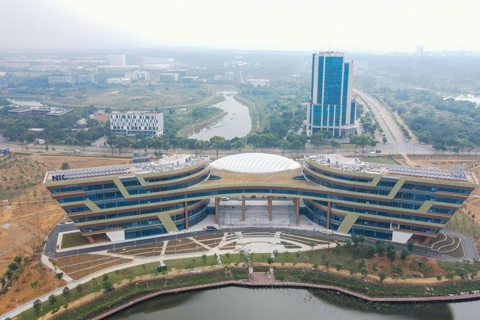
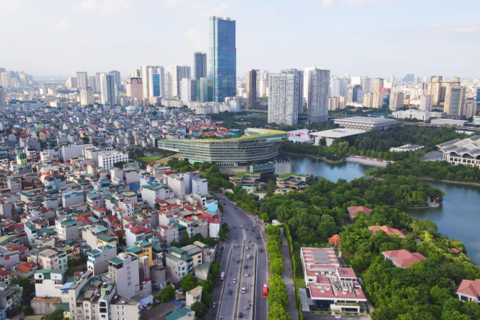
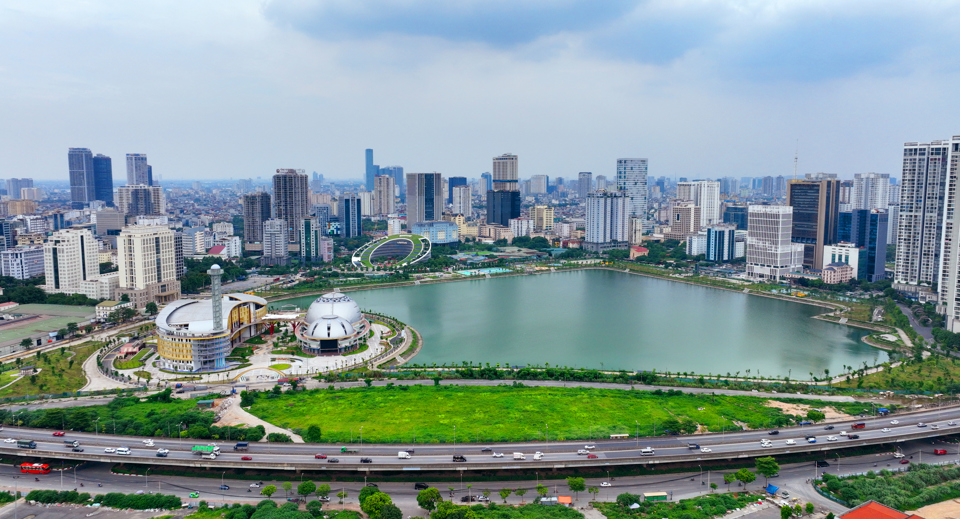
| Hanoi from above. Photo: Pham Hung/The Hanoi Times |
This program comprises a comprehensive set of tasks, solutions, initiatives, proposals, and projects aimed at achieving urban development goals for each phase, in line with the Capital Master Plan for 2021-2030, with a vision to 2050, and the adjusted Master Plan for Hanoi to 2045, with a vision to 2065. The program envisions Hanoi as the nation's political and administrative center, and as a city of "Heritage - Civilization - Modernity," preserving and promoting both tangible and intangible cultural values. It aspires to position Hanoi as a globally significant capital city that integrates unique cultural, historical, and traditional characteristics.
Hanoi is envisioned as a major hub for business, culture, education, science and technology, and international integration. The city aims to be a smart, modern, green, clean, beautiful, secure, and happy urban center that fosters rapid and sustainable development while acting as a catalyst for regional growth. It will play a critical role in the national urban development strategy, emerging as a key economic, trade, tourism, and commercial hub in Southeast Asia and the Asia-Pacific region.
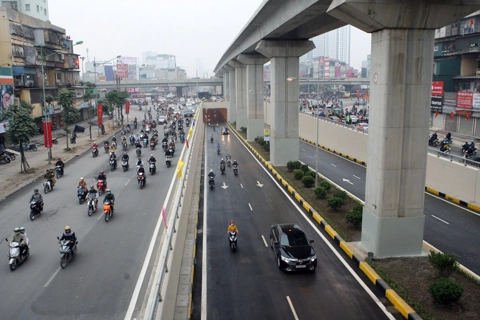
By 2030, the program sets a goal to transform Hanoi into a modern urban center that serves as a regional integration and service hub for the nation, and an attractive economic and cultural destination for the world. The urbanization rate is targeted to reach 65%-70%, with public transport accounting for 30% of travel.
Looking ahead to 2045, Hanoi aims to establish itself as a cultural capital, a smart, ecological city, and a center for finance, services, science and technology, and human resource development. It seeks to become a leading venue for political, economic, cultural, and scientific events in Asia and the world. The city will be characterized by green and ecological development, with the Red River serving as a symbol of growth. The urbanization rate is set to hit 75%, and the public transport utilization rate is expected to reach 50%.
The program outlines key metrics, including urban land use, urban housing per capita, urban green space per capita, public green space in the inner city, the proportion of urban transportation land as a percentage of urban construction land in the inner city, and urban wastewater treated to technical standards in the inner city.
The estimated total minimum development investment capital through 2035 is projected at $122.3 billion, with $52.2 billion allocated for framework infrastructure and $70.1 billion designated for urban upgrades.
Funding will come from the state budget and private sector mobilization. State budget allocations will prioritize critical projects and infrastructure development. Private sector contributions will be encouraged through mechanisms that facilitate corporate participation in public investment projects and promote the growth of small and medium-sized enterprises.
Hanoi plans to tap into international development assistance (ODA) and investment funds, mobilize resources from commercial banks and financial institutions, and promote public-private partnerships to attract additional investment for major urban and infrastructure projects.
Furthermore, the city will optimize land resources, implementing urban development projects to increase budget revenues from land. Efforts will also focus on encouraging investment in startups and new technological solutions to drive sustainable development. Hanoi will create opportunities for non-governmental organizations and charitable foundations to contribute to social and environmental projects, further enhancing its development trajectory.