Hanoi welcomes foreign investment in urban railway projects
Hanoi's ongoing urban railway projects offer significant opportunities for foreign investors, including those from China.
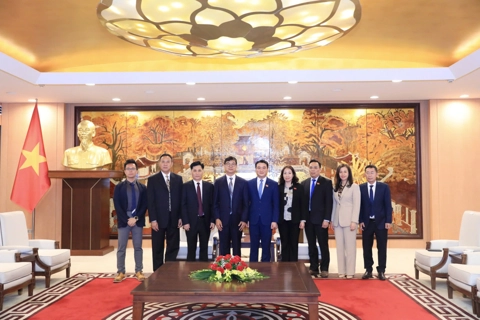
Vice Chairman of the Hanoi People's Committee Duong Duc Tuan, in a meeting today [December 17] with Chairman of China Railway Signal & Communication Corporation (CRSC) Lou Qiliang, stressed the importance of urban railways for a modern capital and welcomed CRSC's investment in developing Hanoi's railway system.
| Vice Chairman of the Hanoi People's Committee Duong Duc Tuan (r) and CRSC Chairman Lou Qiliang. Photos: Viet Anh/The Hanoi Times |
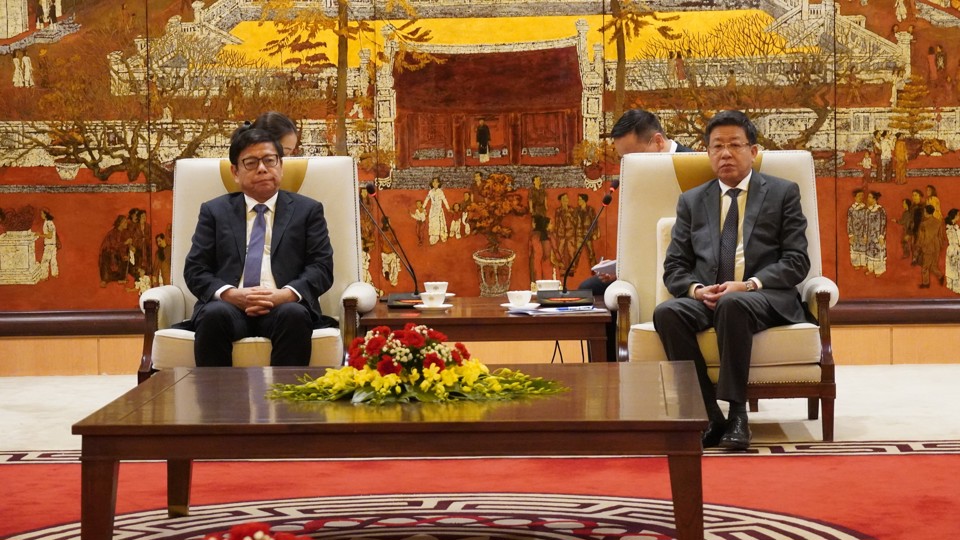
At the meeting, Tuan said that Hanoi is operating and implementing several urban railway projects with the support from international partners. Notably, the elevated Cat Linh-Ha Dong railway, funded by China, and the Nhon-Hanoi Station metro line, with France as the main financier, have already begun commercial operations.
He emphasized that the urban railway is the "backbone" of the public transport system, playing a crucial role in relieving traffic congestion and building a modern, civilized capital. The city is currently advancing key projects, including Line 2 (Nam Thang Long-Noi Bai), Line 3 (Troi-Nhon-Hoang Mai), and preparing for the development of Line 5 (Van Cao-Hoa Lac). In addition, Hanoi plans to extend existing metro lines, such as the Nhon-Hanoi Station line with a 4km underground section to Hoang Mai District, and the Cat Linh-Ha Dong line, whose extension to Xuan Mai (Chuong My District) is under study.
To overcome delays in project implementation, Tuan noted that Hanoi has devised a comprehensive urban railway investment plan up to 2035. Over the next 10 years, the city aims to develop 10 urban railway lines spanning nearly 410km. Between 2035 and 2045, 5 additional lines will be built, bringing the total length to over 600km. The total investment for this plan is estimated at $55 billion, or approximately VND1,300 trillion (US$51 billion).
Furthermore, Hanoi is working with ministries, sectors, and other localities to implement national railway projects to improve regional and international connectivity.
For his part, CRSC Chairman Lou Qiliang said that as a leading state-owned enterprise in China with a significant market share in railway signaling and information systems, the Chinese firm is well-positioned to mobilize funds and implement large-scale projects.
Lou reiterated that investment in Hanoi's railway system is feasible and effective. With extensive experience, CRSC and other Chinese construction enterprises are willing to work closely together to develop the best railway system for Hanoi.
He also suggested that Hanoi introduce reputable Vietnamese enterprises to cooperate on projects to ensure quality and progress.
Welcoming CRSC's interest in exploring investment opportunities, Tuan stressed that Hanoi's ongoing urban railway projects offer significant opportunities for foreign investors, including those from China.
Tuan expressed hope that through close cooperation, all parties would overcome challenges and build an advanced, modern public transport system. This development, he noted, would yield positive outcomes not only for Hanoi but also for international partners in the future.
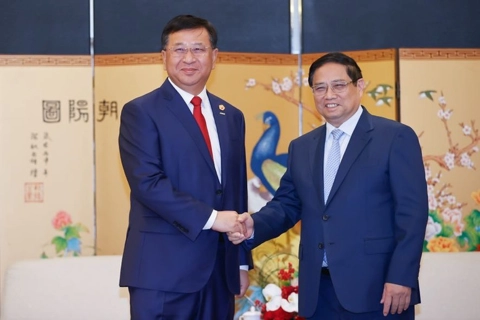
| Deputy Prime Minister Tran Hong Ha and the CRSC Chairman. Source: VGP |

In another meeting with Deputy Prime Minister Tran Hong Ha on the same day, the Vietnamese senior official expressed his hope that CRSC and other leading Chinese railway enterprises would work closely with Vietnamese businesses and partners to develop the railway sector in line with future growth requirements.
“The task for Vietnam’s railway sector is to adopt and master modern technologies in research, design, construction, operation, and management,” the Deputy Prime Minister stated. He called on CRSC to provide support and technology transfer to Vietnam Railways Corporation and other Vietnamese enterprises to achieve this goal, particularly in implementing strategic rail projects between the two countries, urban rail systems, and high-speed rail projects.
Additionally, CRSC was encouraged to share its experience and provide technical consultation to the Vietnamese railway authorities in developing standards, regulations, and legal frameworks for the sector, particularly in railway signaling and control systems.
In the short term, Ha suggested that the CRSC coordinate with the Ministry of Transport, relevant agencies, and enterprises to advance the implementation of three strategic railway lines connecting Vietnam and China, as agreed upon by senior leaders of both countries, as well as urban railway projects in Hanoi and Ho Chi Minh City.
For his part, Lou reaffirmed CRSC’s willingness to collaborate by offering safe, high-quality railway products and services with advanced technologies, strong digital transformation applications, and competitive prices for Vietnam.
He added that CRSC is willing to invest through suitable mechanisms, share expertise, support human resource training, and cooperate in research and development. The corporation also looks forward to partnering with Vietnamese counterparts on specific railway projects and cooperation programs, contributing to the realization of the shared vision agreed upon by the leadership of both countries.