Hanoi launches state-backed innovation hub to drive digital economy
The new innovation center is designed to connect policy, technology and talent, aiming to accelerate digital transformation, support startups and position the capital as a global testing hub for emerging technologies and creative industries.
THE HANOI TIMES — Vietnam's capital city today (February 26) debuted its Hanoi Innovation Center JSC as a new institutional model to reorganize the capital’s innovation ecosystem in a more coherent, market-oriented and sustainable manner.
Positioned as a strategic innovation institution headquartered in Hanoi, the center is designed to act as a “central brain” linking data, resources, policies, technology and culture.
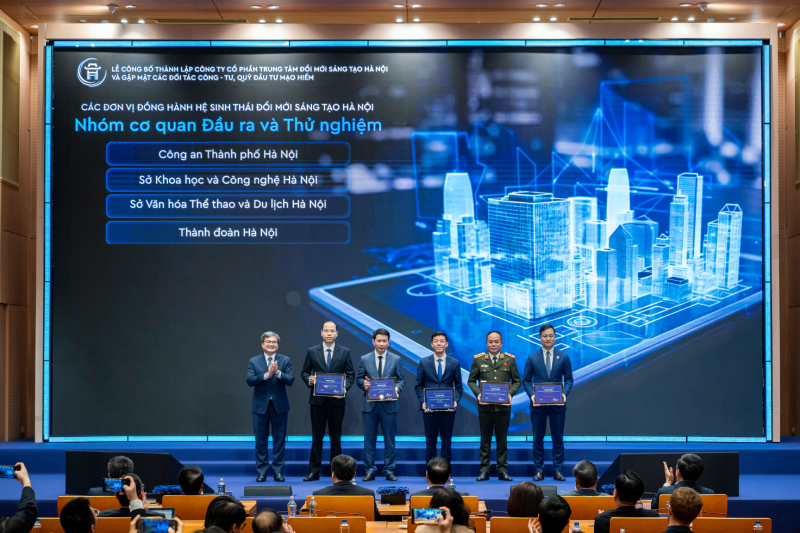
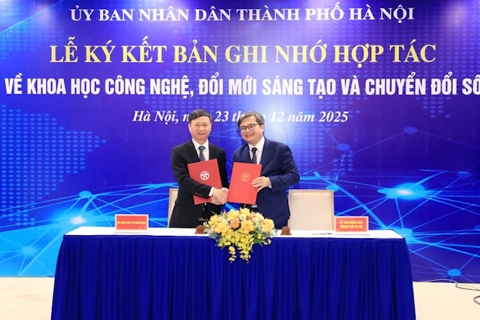
Vice Chairman of the Hanoi People’s Committee Truong Viet Dung (first from left) presents certificates to partner organizations supporting the Hanoi Innovation Center JSC. Photos: VGP
Its mission is to address urban challenges, support the national innovation ecosystem, promote the digital economy and society, improve living standards and develop creative industries tied to Hanoi’s identity.
Speaking at the launch ceremony, Truong Viet Dung, Vice Chairman of the Hanoi People’s Committee, said that science, technology, innovation and digital transformation underpin national productivity and competitiveness.
Hanoi hosts many ideas and startup programs, he said, but without a market-oriented mechanism the State’s strategic direction cannot translate into sustainable economic value.
“The establishment of the Hanoi Innovation Center JSC creates a new governance model: State-guided but enterprise-operated. It marks a shift from policy support to market execution,” Dung said.
For the first time, Hanoi has set up an innovation organization as a joint stock company with State capital.
Operating under modern corporate governance standards, the center pledges financial transparency, risk control and accountability to shareholders and the law. The State holds a 70% stake to safeguard development objectives while leaving day-to-day operations to the enterprise.
Dung described this as a transition from administrative allocation to co-investment and risk sharing, from fragmented support to ecosystem coordination, and from a loosely organized startup movement to a structured, outcome-driven value chain.
Positioning Hanoi as a global testing hub
Tran Quang Hung, the center’s Board Chairman, placed the initiative in a global context.
In an increasingly multipolar world, he said, the United States drives breakthrough technologies, China rapidly amasses vast data, and India operates as the world’s back office.
Within that landscape, Hanoi can become a controlled testing hub for new technologies and business models, Hung said.
“With a large domestic market, a young population and openness to innovation, Hanoi can attract global creative communities seeking real-world pilot environments,” he added.
That role could draw international capital, technology and expertise to Vietnam while opening opportunities for young Vietnamese founders.
“When successful entrepreneurs return home, they bring more than revenue or taxes. They bring global management experience, venture capital networks and technological connections,” Hung said.
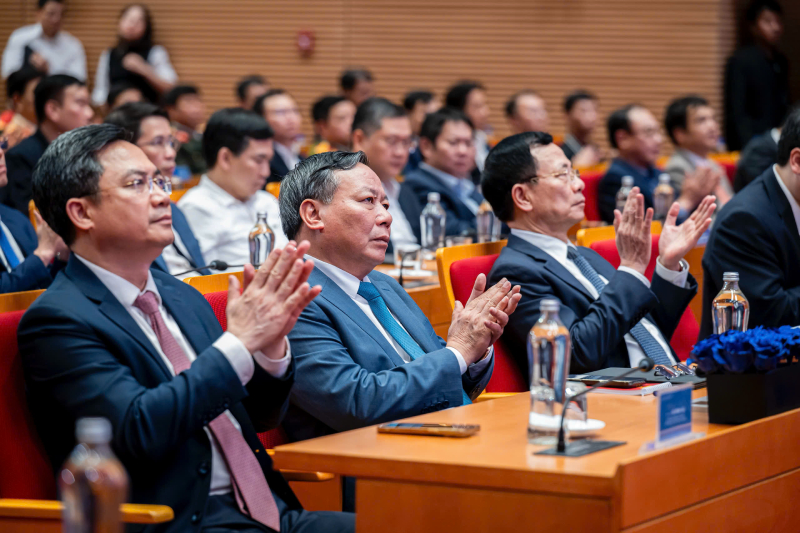
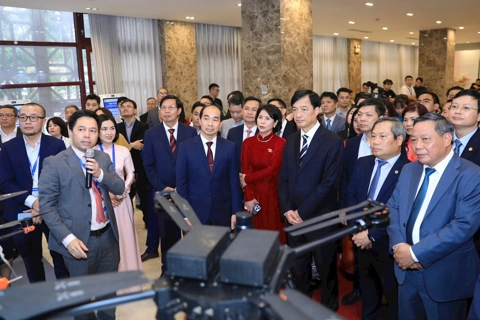
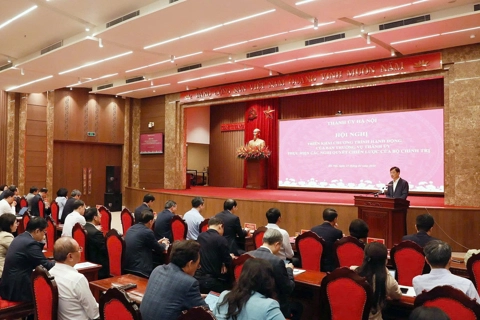
Delegates attend the launch ceremony of the Hanoi Innovation Center JSC.
The center also aims to attract foreign founders to build teams and launch startups in Hanoi, leveraging competitive labor costs and a dynamic business climate with three strategic priorities.
The first is to attract global creative communities to help tackle Hanoi’s urban challenges, including congestion, pollution and data governance.
The center plans to pilot advanced technologies in controlled settings, including AI, autonomous vehicles, fintech, digital assets, life sciences and cultural industries rooted in Hanoi’s identity.
The second priority seeks to encourage overseas Vietnamese technology enterprises and talents with international experience to register, operate and pay taxes in Hanoi.
The third focuses on coordinating and protecting domestic creative industries as some digital sectors face dominance from multinational platforms, aiming to foster healthy competition based on innovation.
To implement these goals, the center introduced a four-stage incubation and deployment model to build a market-oriented innovation value chain.
The first stage, connection, gathers and standardizes problem statements from public and private sectors, attracting talent from schools, universities, research institutes and young innovators at home and abroad.
The second stage, incubation, turns ideas into testable products, with artificial intelligence serving as a “co-founder” to shorten development cycles and speed market entry.
The third stage, platform building, assists enterprises with registration, corporate structuring, intellectual property protection, digital infrastructure, public-private partnership contracts and venture capital access through a shared digital system.
The fourth stage, scaling up, accelerates commercialization with backing from venture capital funds, including a leading role by the Hanoi Investment and Insurance Fund.
For 2026-2030, the city aims to incubate more than 200 innovative startups and mobilize over VND500 billion (US$19.2 million) in capital.
Dung said the center will link Hanoi’s development challenges in smart transport, digital healthcare, digital education, environmental protection and urban security with research capabilities from universities, institutes and enterprises through fair and transparent competition.
“When challenges are publicly announced, solutions selected through open competition and results measured by socio-economic impact, innovation will become a real driver of GRDP growth,” he said.
Technology for urban security and citizen services
At the ceremony, Lieutenant General Nguyen Thanh Tung, Director of the Hanoi Department of Public Security, highlighted the technology’s role in maintaining order in a rapidly urbanizing capital.

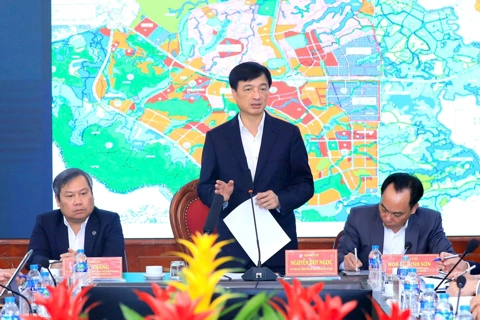
Tran Quang Hung, the center’s Board Chairman, believes the Hanoi Innovation Center JSC will lift the capital into a hub for international investors.
Hanoi police handle thousands of incidents daily, requiring rapid and accurate responses. Building on a licensed digital map system assigned to the innovation center, police are working to develop a digital security governance ecosystem.
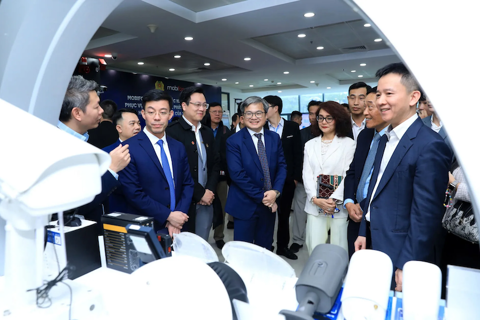
This system includes real-time patrol coordination, AI-enabled cameras capable of recognizing individuals and vehicles and detecting abnormal behavior, and aerial surveillance using unmanned aerial vehicles.
Tung said synchronized deployment will shorten response times, improve incident handling and reduce budget pressure.
Beyond security, the center proposed a super app for residents integrating navigation, ride-sharing, asset management, connectivity with the national digital identity platform VNeID and integration with the existing iHaNoi application.
The app will initially target six million iHaNoi users, with a pilot rollout in Hanoi before broader expansion.
Hung said residents must see tangible benefits from the center’s work and regard it as an extension of the city government. Innovation, he added, should be reflected in daily life, from transport and security to environmental management and public services.
At the launch, Dung called on technology firms, corporations, investment funds, research institutions and domestic and international partners to join the initiative.
He described the center as a collaborative platform where challenges are openly presented, solutions are responsibly tested and public and private resources are combined to create new value.
With its institutional structure, corporate governance model and strategic focus, the Hanoi Innovation Center JSC aims to convert technological momentum into measurable economic gains and support sustainable development in the capital.