Hanoi launches sweeping overhaul to unlock state economy growth
Hanoi has unveiled an ambitious five-year plan to reform governance, mobilize public assets and restructure state enterprises, aiming to turn the state economy into a powerful engine of sustainable growth.
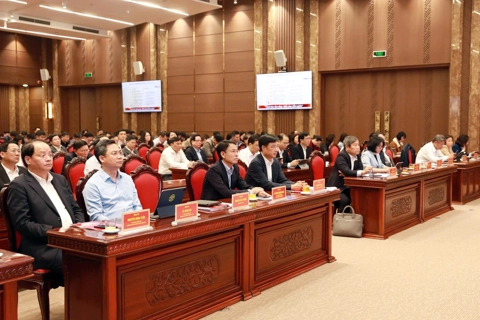
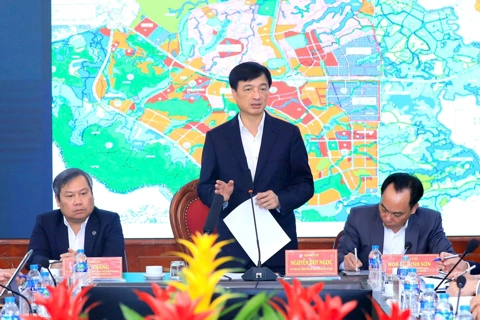
THE HANOI TIMES — Administrative reform and better governance top Hanoi’s agenda to develop the state economy, Chairman of the municipal People’s Committee Vu Dai Thang said today (February 25) at a Hanoi Party Committee conference.
The priorities form part of eight task groups and 79 specific actions in a five-year action program to implement Politburo Resolution 79 on state economic development.

A corner of Hanoi. In 2026-2030, the city will harness reforms in administration and policy making to boost state economic sectors. Photo: Hai Linh/The Hanoi Times
Thang said the city will establish a steering committee and issue a detailed rollout plan once the program gains approval.
In Q2 and Q3, Hanoi will complete proposals for six core resource pillars, including land and natural resources, public assets and infrastructure, the state budget, state-owned enterprises, state credit institutions and public service units.
The city will also seek special financial and urban development mechanisms from the central government, including greater autonomy for public service units and civil service reforms.
For 2026-2030, Hanoi targets about VND400 trillion (US$15.3 billion) in land-related budget revenue, more than double the previous period. Authorities will finalize land inventories, digitize and clean land databases, resolve delayed projects and define future land reserves within this year.
Hanoi also plans to digitize all public assets, integrate them with spatial data and disclose exploitation efficiency. It will complete major infrastructure projects with strong spillover effects within five years.
The city will expand public-private partnership models, including public investment with private management and private investment for public use. It will also pilot concessions for operating state-funded infrastructure.
Authorities will review and better use specialized housing, resettlement housing and old public properties to create new revenue streams.
Thang highlighted the role of communes and wards, which directly manage four of the six resource pillars: land, budget, public assets and public service units.
He urged local authorities to review all managed resources, finalize implementation plans in March 2026, tighten land oversight, resolve inefficient asset use, build medium-term public investment plans and reorganize public service units to improve service quality.
During 2026-2030, Hanoi aims to mobilize about VND3.7 trillion ($141.5 billion) in budget resources, equivalent to 32.3% of GRDP and raise development investment spending to 51.7% of total expenditure. Public investment will prioritize essential sectors and breakthrough projects with broad impact.
“The city requires all projects to measure socio-economic returns, calculate capital recovery time and annual contributions to growth,” Thang said.
This follows the direction of General Secretary To Lam that projects must undergo economic accounting rather than focus solely on disbursement.”
Hanoi also plans to complete restructuring of state-owned enterprises by 2027 and retain full state ownership in essential infrastructure sectors such as water supply, drainage, public transport and urban environmental services.
The city aims to build one to three enterprises among Southeast Asia’s top 500 companies, reinforcing leadership in strategic sectors.
Thang said the draft action program reflects strong political resolve to translate central strategies into concrete results.
“It sets a new mindset on how the state economy should operate in the capital’s next development phase,” he said.
Hanoi will implement Resolution 79 with a pioneering approach, linking it to a new growth model and the capital’s 100-year master plan.
“This long-term vision lays the foundation for sustainable development rather than short-term solutions,” Thang said.
The city government leader stressed that Hanoi controls substantial state economic resources that stabilize the macro-economy, build modern infrastructure and ensure social welfare and essential services.
The state economy will lead in shaping a new growth model driven by science, technology, innovation and digital transformation.
“We define state economy as equal to other sectors, with the private sector acting as a key growth driver and collective and foreign-invested sectors playing important roles,” Thang said.
He emphasized that the state economy will focus on core state functions and essential public services, investing in sectors with strong spillover effects where private capital lacks capacity or readiness.
Among the persistent problems with the state economic sectors, Thang pointed out that land use efficiency remains low in some areas and some projects delay land utilization.
Public assets, including resettlement and student housing, remain underused or vacant. Infrastructure accounting and post-investment management fall short of potential.
State-owned enterprises remain small and underperform relative to their resources. Public service units lack strong autonomy. Databases on land and public assets still fail to meet standards of accuracy and completeness.
“Hanoi sees significant room to unlock growth by removing these constraints and modernizing governance,” the chairman said.
Thang said the action program aims to reinforce the state economy’s leading role and ensure it drives a new growth model that supports rapid and sustainable development in the capital’s next phase.