Hanoi puts people first in implementing four strategic Party resolutions
Hanoi launches comprehensive action plans to implement Politburo Resolutions 71, 72, 79 and 80, prioritizing people-centered reforms in education, healthcare, culture and state economic development.
THE HANOI TIMES — Hanoi’s action programs to implement Politburo Resolutions 71, 72, 79 and 80 on education and training, culture, healthcare and the state economy all put people first under the principle of leaving no one behind, Hanoi Party Secretary Nguyen Duy Ngoc said.
The city regards education and training as a top national priority and the future of both the country and the capital, Ngoc said at a Hanoi Party Committee conference on February 25.

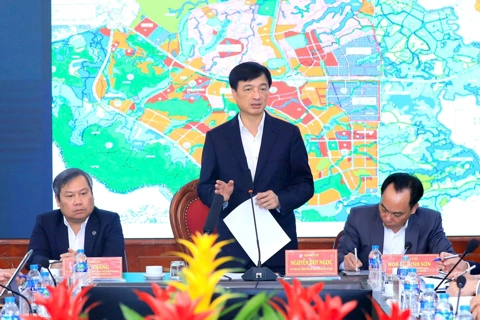
Hanoi Party Secretary Nguyen Duy Ngoc speaks in front of the delegates at the conference on February 25. Photos: Viet Thanh/Hanoimoi Newspaper
"Education must receive special attention to strengthen internal capacity and raise competitiveness," said Ngoc.
The capital should aim beyond leading the country and work toward matching the quality of advanced regional and global capitals, he said.
Hanoi faces complex challenges. The city must ease school overcrowding while leading digital transformation and deepening international integration. It must improve mass education and expand advanced programs to build a modern, efficient and sustainable system.
“We need to review and adjust school planning, develop the teaching workforce and allocate adequate land and resources for national-standard and high-quality schools,” Ngoc said.
Hanoi must build a healthy and civilized education environment, develop a high-quality labor market and become a leading training hub in the region and the world.”
On healthcare, Ngoc outlined a long-term goal to build a system worthy of the capital’s central role and turn Hanoi into a leading medical center in the region.
Residents must access services quickly, fairly and continuously, with universal health insurance implemented effectively, especially for vulnerable groups, he said.
Hanoi will follow a roadmap to waive basic hospital fees within insurance coverage. The city will shift from treatment-focused care to prevention and primary healthcare services, manage public health across the life cycle and strengthen grassroots facilities.
The city will link healthcare with education, science and social welfare, master advanced technologies and develop smart medical models.
“Hanoi must narrow gaps in healthcare access between inner-city and suburban areas and among rural communities. We must upgrade grassroots facilities, ease pressure on higher-level hospitals and manage public healthcare through synchronized electronic records,” Ngoc said.
He called for breakthrough mechanisms to mobilize private capital, expand public-private partnerships and develop high-tech medical and biotech centers that meet international standards while attracting corporations, experts and scientists to invest, research and work.
Regarding the state economy, Ngoc reaffirmed its leading role in guiding socialist-oriented development and steering key sectors such as green and smart urban infrastructure, multimodal transport, multi-purpose housing, environmental management, energy and strategic technologies.
“The state economy in the capital shapes a new growth model and provides resources to address urgent needs while promoting social equity,” he said.
He urged authorities to improve management and use of state resources, including land, public assets, infrastructure, the budget and financial funds.
He also called for restructuring state-owned enterprises, credit institutions and public service units to ensure transparency, accountability and performance measured by socio-economic outcomes.
“Hanoi must link state economic development with building a green and smart city while fighting corruption and preventing loss of public assets,” Ngoc said.
On culture, Ngoc said Hanoi holds unmatched advantages and responsibilities nationwide and expected the city to lead in balancing heritage preservation with cultural industry and creative economy growth.

Delegates attend the conference via an online channel at the Party Committee of Vinh Tuy Ward.
By 2030, the city plans to allocate more than 4% of annual budget spending to culture and gradually increase it. Cultural industries should contribute 9% of GRDP by 2030 and 12% by 2045.
The city plans to restore major structures such as Kinh Thien Palace and related sites within the Thang Long Imperial Citadel and promote them through digital technology.
“All socio-economic projects must factor in cultural space,” Ngoc said. “We must build the image of Hanoians as elegant and civilized to create soft power rooted in character and dignity.”
He stressed that culture must stand equal to economics and politics and that investing in culture secures long-term development.
The action programs focus on building a cultural and creative ecosystem, mobilizing resources, fostering well-rounded citizens and creating a humane and modern cultural environment.
They will balance tradition and modernity, national identity and global integration, physical life and digital space, while safeguarding cultural security. The programs integrate other strategic resolutions and ensure resources for Hanoi’s cultural development in the new era.
Ngoc said Hanoi’s action programs form part of implementing the 14th National Party Congress Resolution and align with other central strategies, affirming the capital’s pioneering role.
Hanoi must set higher benchmarks than the national average and measure progress against advanced regional and global cities, using international standards as reference points, he said.
The programs promote decentralization with clear responsibilities and digital transformation across all levels of government.
Ngoc said the initiatives translate socialist principles into concrete action, guided by a long-term vision centered on institutions, planning and development models. All efforts must serve national independence and the people’s prosperity, with citizens at the core.
The programs aim to ensure fair access to education, healthcare and culture, especially for vulnerable groups, and introduce bold measures to strengthen the state economy’s leading role.
Urgently turning action programs into reality
To ensure results, Ngoc called for strong political will, initiative and creativity at all Party levels to convert the action programs into practical plans tailored to local conditions.

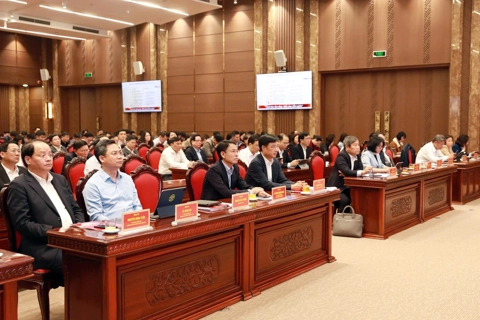
Delegates attend the conference at the head office of the Hanoi Party Committee.
“Agencies must measure success by citizen and business satisfaction to translate strategic decisions into rapid and effective action, driving sustainable development in education, health care, culture and the state economy,” he said.
He required Party secretaries and agency heads to take full responsibility for outcomes, demonstrate courage and tackle difficult tasks to shape Hanoi’s future.
“We face heavy responsibilities but also major opportunities. With decisive action, Hanoi will successfully implement these strategic resolutions,” Ngoc said.
He described the resolutions as milestones in strategic thinking that lay the foundation for a prosperous and sustainable nation.
"These resolutions provide a firm basis for Hanoi to lead in implementing the 14th National Party Congress Resolution and build a cultured, civilized and globally integrated capital," he said.
Ngoc urged officials to end bureaucratic habits and close the gap between words and action.
He said the prompt issuance of action programs shows Hanoi’s proactive leadership and determination to quickly translate central policies into practice.
As the capital, Hanoi carries a historic mission that extends beyond its borders.
“We must act as the leading driver for national development, test new models and create growth drivers with strong spillover effects, guided by breakthrough thinking and a 100-year vision,” he said.