Hanoi encourages businesses to develop processing industry
Under Hanoi’s strategy on agricultural and rural development to 2030, with a vision to 2045, the city identifies the development of the preservation and processing technologies as a fundamental and comprehensive solution to raise the value of of agricultural, forestry and fishery products.
As processing is considered an important step to add value to agricultural products, Hanoi has continued to encourage local businesses to develop their production models in line with its potential and advantages.
Higher economic values
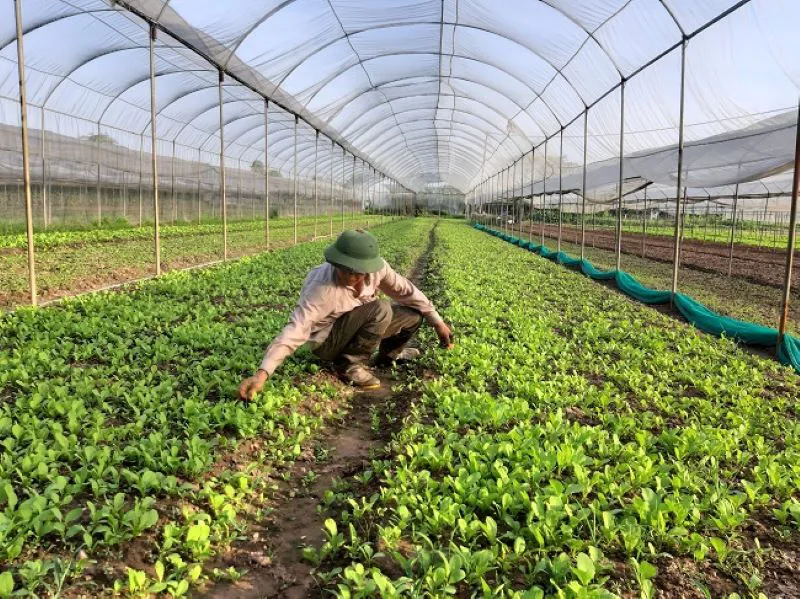
| Chuong My District's high-tech vegetable farm. Photo: Anh Ngoc |
Nguyen Thi Thu Hang, Director of the Hanoi Agro-Forestry and Fisheries Quality Management Sub-Department, said over the years, the city has applied many mechanisms and policies to support organizations, enterprises, cooperatives, and farmers to increase investment in processing technology.
Currently, the city has more than 250 enterprises processing farm produce, along with thousands of cooperatives and households operating in pre-processing and preservation to meet the demand of local consumption.
As one of the small-sized enterprises in the processing industry, 3Brothers Food JSC (Dong Anh District) is specialized in making ham, sausages, and cartilage.
Still, a newcomer in the processing field, the company’s products have already gained popularity among Hanoian consumers, Deputy Director of 3Brothers Food Nguyen Xuan Tuan said. Its revenue in the last three years reached up to VND5 billion (US$215,125) per year.
Meanwhile, Song Dat Food JSC (Thanh Tri District) also had a stable turnover from processed pork. Processed foods have a longer preservation time than raw meat and higher economic values, they said.
Hang from the municipal Agro-Forestry and Fisheries Quality Management Sub-Department said through processing, the value of raw agricultural products such as vegetables and fruits, livestock and poultry meat, and fresh seafood increased significantly. “This brings benefits to many stakeholders in the production and business chains. In particular, it also helps local authorities to better manage food safety issues,” she underlined.
Under Hanoi’s strategy for agricultural and rural development to 2030, with a vision to 2045, the city identifies the development of the preservation and processing technologies as a fundamental and comprehensive solution to raise the value of agricultural, forestry, and fishery products.
In addition, the Hanoi People's Committee also set a goal by 2030 to develop the processing industry with medium and advanced technology, as well as create highly competitive products that meet the requirements of domestic and export markets.
Unbalanced supply-demand
Although gaining notable developments in recent years, local experts said Hanoi's agricultural product processing industry is still not proportional to demand. The number of companies involved in this field remains small.
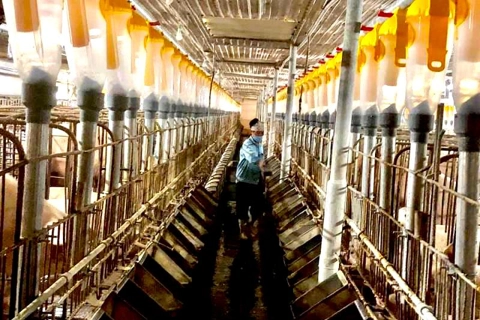
| Workers at Song Dat Food JSC's processing facility in Hanoi. Photo: Song Dat Food JSC |

Statistics from the Hanoi Department of Agriculture and Rural Development showed that more than 98% of the total number of farm produce processing establishments are currently small and medium-sized. Three main groups of processed products included meat (accounting for 42.6% of the total volume), vegetable (33.7%), and seafood (26.7%).
Equipment and machinery of farm processing establishments are mainly semi-automatic (accounting for 76.6% of the total number of establishments), followed by those using automatic line technology (14.7%) and manual processing technology (8.7%).
Meanwhile, the city’s farm produce preservation system is still modest. The city has 113 cold storage warehouses and among them, there are only seven warehouses with a scale of nearly 30,000m2), the remaining 106 warehouses are small with an area of over 5,300m2.
The production of agricultural products and processed foods in Hanoi is about 1,000 tons per month, while the capital's consumption demand amounts to almost 5,200 tons.
Therefore, the city has connected with neighboring provinces and cities in the production, consumption, and commercial promotion of processed foods to fully meet the demand of the capital’s consumers. This is considered an untapped potential of the processing industry, according to the municipal Department of Agriculture and Rural Development.
Dealing with current barriers
Currently, it is difficult to implement a number of mechanisms and policies to foster the development of cooperation and partnership in the production and consumption of agricultural products.
In Gia Lam District, Van Duc Agriculture Cooperative can’t access the preferential loan which was mentioned under Decree No. 98 to invest in processing vegetables and fruits because the administrative procedures are very complicated, the Director of the company Nguyen Van Minh said.
Therefore, many organizations, enterprises and cooperatives like Van Duc Agriculture Cooperative have to struggle with many barriers. Currently, most of the processing facilities take on loans from credit institutions to invest in the construction of processing zones, cold storage, and food preservation warehouses.
According to Ta Van Cuong, Deputy Director of the municipal Department of Agriculture and Rural Development, the simplification of lending procedures is one of the issues that need to be paid attention to promote the development of the preservation and processing industry.
Nguyen Van Khoi from the Vietnam Academy of Science and Technology suggested it is necessary to strongly apply science and technology to processing and preserving agricultural products, improve product quality and ensure food safety.
“Promoting market development, trade activities, as well as training to improve the quality of human resources should be rolled out so that the capital's agricultural product processing industry would develop as planned,” he said.