14TH NATIONAL CONGRESS OF THE COMMUNIST PARTY OF VIETNAM
Log in
Property

Hanoi office market: Highest vacancy rate in three years

The reality is largely attributed to Covid-19 impacts.

The vacancy rate of Hanoi’s office market in the first nine months this year hit a three-year low, according to JLL, a leading professional services firm that specializes in real estate and investment management.

 Vacancy of Hanoi's office between January and September hits record low

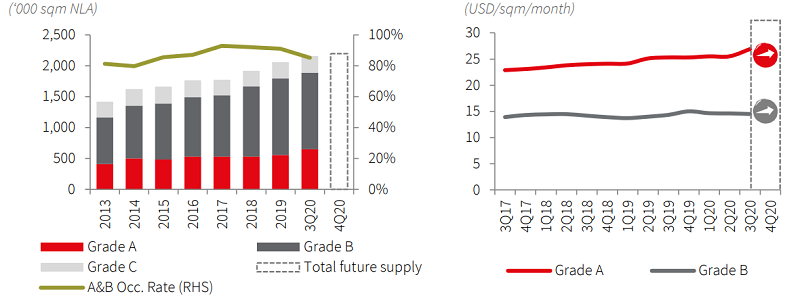
The new launch and the weak take-up during the quarter brought up the market average vacancy rate to 14.9% in the third quarter this year (3Q20), the highest vacancy rate since 2017, JLL has said in a recent report.

Three projects started operation in Hanoi in 3Q20, providing more than 122,000 square meters (sqm) of space, 75% of which came from Capital Place, a high-quality Grade A building.

Three new projects are scheduled for completion in the fourth quarter this year, bringing the total stock up to 2.2 million sqm by end-2020.

This is likely to drive up market vacancy, resulting in landlords more willing to negotiate with tenants. As tenants are likely to tighten their budgets until the pandemic is globally contained, market rents are expected to stabilize or even decrease in the near term, JLL predicted.

 Office total stock and office average rents in Hanoi. Source: JLL Research

Note:
[1] Rent refers to average net rent of Grade A and B office markets, excluding VAT and service charges.
[2] CBD area consists of Hoan Kiem (core CBD), Dong Da, Ba Dinh and Hai Ba Trung. Non-CBD area refers to the rest of the city.

Demand continues to weaken

Demand for office in Hanoi in Q3 remained weak across the market. Most of the existing buildings recorded negative net absorption as tenants continued to either relocate to the buildings with lower rents or scale down their sizes.

During the period, three new completions were less than 20% occupied with notably low pre-commitment rate. This phenomenon has not been seen for a while with most new buildings during 2018-2019 period managing to record pre-commitment of more than 46% on average at the opening date.

Net absorption returned to positive territory in Q3, at around 19,500 sqm, which was mainly contributed by the take-ups in the new completions.

Rental rates remain unchanged

The average net rent of Grade A increased by 5.8% on-quarter to US$26.9 per sqm per month in 3Q20, which was due to the completion of the high-quality Capital Place project with higher-than-average rent.

Meanwhile, most buildings in the segment kept their asking rents constant yet with more flexible leasing terms to support the tenants.

Rental growth in Grade B has also slowed to almost a standstill since the first outbreak of Covid-19, given the softening occupier demand as they turned cautious amid uncertain situation. Rents therefore were kept unchanged at around US$14.5/sqm/month in 3Q20.

Generally, although the demand softened, landlords were not ready to reduce rents to a large extent yet as the average occupancy rate, albeit lower than before, remained at a fair level of more than 85%.


Reactions:
Share:
Trending
Most Viewed
Related news
Tet renovation rush strains Hanoi crews, lifts finishing material costs prices

Tet renovation rush strains Hanoi crews, lifts finishing material costs prices

Hanoi’s home renovation market has entered its busiest stretch of the year, as year-end demand tightens contractor availability and raises the cost of finishing materials.

Vietnam construction materials rebound as prices rise and public investment accelerates

Vietnam construction materials rebound as prices rise and public investment accelerates

Rising steel and cement prices, stronger public investment spending and improving consumption across key material segments point to a broad recovery in Vietnam’s construction materials sector as 2026 begins.

Hanoi sets 40 sq.m housing space goal to lift urban living standards

Hanoi sets 40 sq.m housing space goal to lift urban living standards

Raising average housing space marks a people-centered shift in urban policy as the capital works to improve living standards, expand social housing and ensure that rapid economic growth goes hand in hand with safer and more livable neighborhoods.

Prime Minister urges measures to boost supplies and control house prices

Prime Minister urges measures to boost supplies and control house prices

Vietnam’s government is stepping up efforts to rebalance the real estate market as Prime Minister Pham Minh Chinh urges faster policy action to expand housing supply, address affordability pressures and ensure the sector supports both economic stability and social welfare.

Ho Chi Minh City forms first professional association for apartment management

Ho Chi Minh City forms first professional association for apartment management

Amid rapid urban growth, Ho Chi Minh City has established a professional body for apartment management, becoming the first locality in Vietnam to do so.

Real estate credit surge prompts tighter oversight to safeguard Vietnam’s financial stability

Real estate credit surge prompts tighter oversight to safeguard Vietnam’s financial stability

Vietnam’s real estate sector has absorbed a sharp rise in credit, supporting market recovery while raising concerns over capital concentration, speculative risks and the need for tighter policy coordination.

Revised housing roadmap doubles social housing targets for Hanoi

Revised housing roadmap doubles social housing targets for Hanoi

Vietnam’s push to accelerate affordable housing has significantly raised expectations for major cities, with Hanoi now tasked with delivering a far larger volume of social homes as part of the national goal to build more than one million units by 2030.

Social housing supply exceeds targets in 2025 as Vietnam tackles property imbalances

Social housing supply exceeds targets in 2025 as Vietnam tackles property imbalances

Vietnam surpassed its social housing construction target in 2025, marking progress in housing policy, but supply mismatches, high prices and legal bottlenecks continue to weigh on the real estate market.