Hanoi pilots digital document exchange platform to support businesses
Once fully operational, the system could establish a comprehensive digital ecosystem linking the government and businesses.
THE HANOI TIMES — The Hanoi Department of Science and Technology's newly piloted software system has enabled fully online document exchanges between enterprises and government agencies.
This signifies the capital’s efforts to digitize public services and support the private sector.
Developed as part of Hanoi’s 2025 digital transformation initiatives, the platform enables businesses and the department to send, receive, and manage documents online.
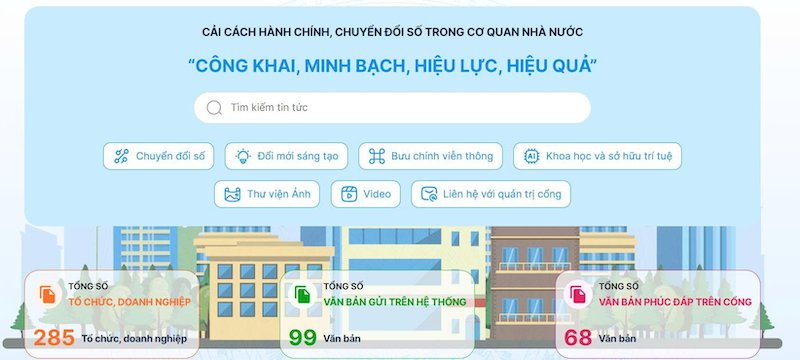
Interface of the digital document exchange portal between businesses and the Hanoi Department of Science and Technology
The system also contributes to the implementation of Resolution No. 68-NQ/TW, which promotes digital transformation and strengthens the role of the private sector in the national economy.
From May 5 to June 15, the system attracted 230 businesses and opened 350 user accounts during its pilot phase. The department sent 16 official dispatches, made 314 deliveries, and received 54 responses from enterprises.
According to Nguyen Anh Viet, Head of the department's Digital Economy and Technology Division, the system has two main modules: one for businesses at qlvbdn.hanoi.gov.vn and one for internal government use at quantri-qlvbdn.hanoi.gov.vn. The system is also linked with the city’s central document and operations management system.
"This allows businesses to submit and track documents 24/7, regardless of working hours or location," he said.
Even during the short pilot phase, measurable results were achieved. Express shipping costs were reduced by more than VND3.6 million (US$138). Average document processing times dropped from tens of minutes to just a few. Office resources such as paper, ink, and manpower were significantly saved.
"These savings support financial efficiency and environmental sustainability," Viet emphasized.
Duong Ngoc Huan, founder and CEO of the edtech firm Techco Vietnam and one of the pilot participants, said he appreciated the platform’s practicality.
"We joined from the start and immediately saw the difference. If printing, signing, and posting paper documents previously took at least a day or two and incurred delivery fees. Now, everything is handled digitally within minutes, and replies come back faster,” he said.
"The system is cost-effective, easy to use, and saves valuable time. We hope it will be expanded to benefit more businesses across Hanoi.”
However, the pilot revealed shortcomings, such as inconsistent digital signature formats among businesses and limited server capacity. To date, the platform has reached fewer than 6% of the 4,000 firms directly managed by the department.
"These challenges underscore the urgent need for broader deployment, infrastructure upgrades, and outreach to engage more enterprises," Viet noted.
Strategic shift for a digital capital

An official in Hanoi's Bach Mai Ward assists a resident with an online administrative procedure application. Photo: Linh Nguyen/Kinh te & Do thi Newspaper
In a metropolis like Hanoi, which is home to over 370,000 businesses and 390,000 nonprofit organizations, traditional paper-based communication has become increasingly outdated and inefficient.
Each year, city agencies send 5.3 million official documents to businesses and receive 20.6 million.
Nearly seven million of these documents are still handled on paper, equivalent to around 35 million printed pages. Printing and sending these documents costs more than VND104.7 billion ($4 million) annually, not including labor, storage, or logistics expenses.
Processing a single paper document takes up to 60 minutes, whereas processing the same document digitally takes just 10-15 minutes. A full transition to digital could save up to 5.2 million working hours annually.
This shift aligns with Hanoi’s broader digital transformation policy, as outlined in Directive No. 08/CT-UBND issued April 29, 2025.
The directive mandates that all transactions and procedures between government bodies and private organizations be conducted digitally. It also calls for the active participation of all sectors of society in the digital transformation process.
The digital document exchange platform is one of several initiatives that demonstrate Hanoi’s commitment to modernizing and streamlining its administrative system.