Hanoi promotes public-private partnership to boost livestock production
Hanoi is facing an increasingly tight space for breeding, as the city has the highest livestock density in the country.
Hanoi possesses all the necessary elements to promote public-private cooperation in developing the livestock industry.
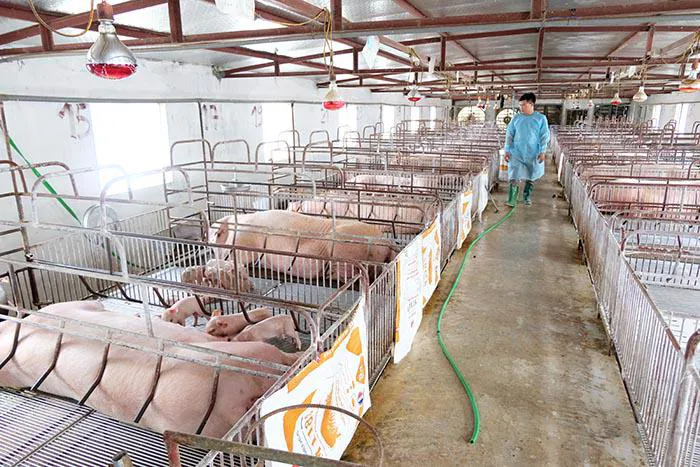
| Safe livestock production in Soc Son District. Photo: Tung Nguyen |
Nguyen Xuan Dung, Chairman of the Animal Husbandry Association of Vietnam (AHAV), made the remarks on March 16 at a conference on public-private partnership (PPP) in animal husbandry.
Dung added Hanoi boasts abundant resources in terms of human capital, materials, knowledge, ambition, businesses, institutions, and educational establishments, which are potential players in such a partnership.
Data from the Hanoi Department of Agriculture and Rural Development suggested the total number of buffaloes in Hanoi had increased by 4.1% to 28,700 heads by February 2023, while the cow herd decreased by 0.1% to 128,400 heads. The pig herd had increased by 3.7% to 1.4 million heads, and the poultry herd had increased by 0.5% to 38.7 million heads, with 26.2 million chickens, up 0.6%.
According to the agency, Hanoi's livestock industry is striving to adopt large-scale, high-tech, and bio-safe livestock models, and is gradually moving towards livestock planning that includes slaughtering, pre-processing, and processing to develop food chains and provide safe food for the capital's residents. At present, the city has designated specialized agricultural areas and large-scale farms, with 162 key livestock communes.
To achieve this, the industry has developed 53 chains that encompass the entire process of producing and consuming livestock products. Among these chains, many have attracted the participation of enterprises, cooperatives, and farming households, while several protected trademarks, including Ba Vi hill chicken, Soc Son hill chicken, Son Tay Mia chicken, and Van Dinh duck, have also been established.
Through a strict quality control system at every stage, the industry has successfully produced safe and high-quality livestock products, while raising awareness among producers to ensure safety and accountability to consumers. This has led to a new direction in livestock development for Hanoi during the period of extensive economic integration.
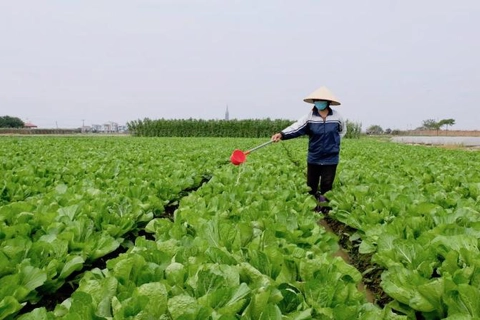
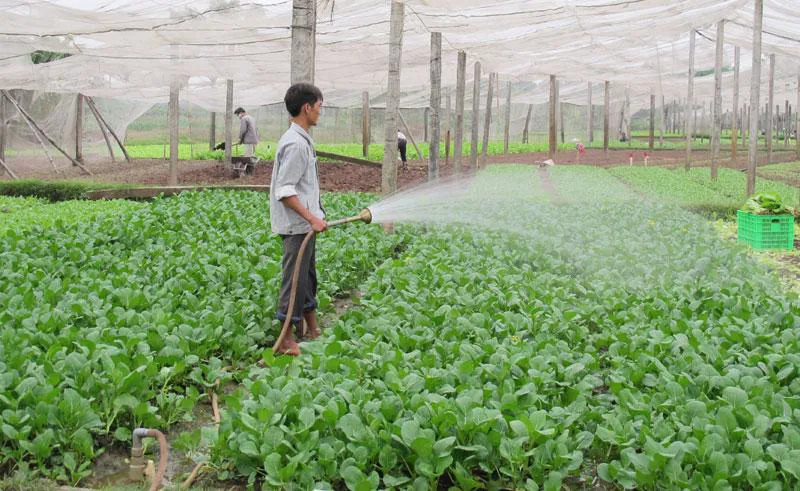
| Producing clean vegetables at Tien Yen Commune, Hoai Duc District. Photo: Ngoc Anh/The Hanoi Times |
However, the industry still faces many constraints, such as incomplete supply chains and predominantly small- to medium-scale linkages. In addition, commercial infrastructure, especially in suburban areas, has not been developed synchronously, while insufficient attention has been paid to planning concentrated breeding areas in some localities, and there are few high-tech breeding areas.
Nguyen Van Chu, Chairman of Organic Green Clean Food Chain, shared the difficulties and obstacles encountered in practical activities, citing the significant impact of consumer habits towards cold and frozen meat on product consumption. He also pointed out that government policies do not differentiate between chain and non-chain products, so priority policies are needed to promote the consumption of chain products in public systems such as schools and hospitals.
Nguyen Trong Long, director of the Hoang Long Livestock Cooperative, called for a policy to encourage the construction of multi-story houses to minimize the breeding area and to lower the criteria for handling the breeding environment, which is currently too high.
"Farmers currently face losses if the correct process is applied. Therefore, regulators should create conditions for farmers to produce by lowering the criteria," Long said.
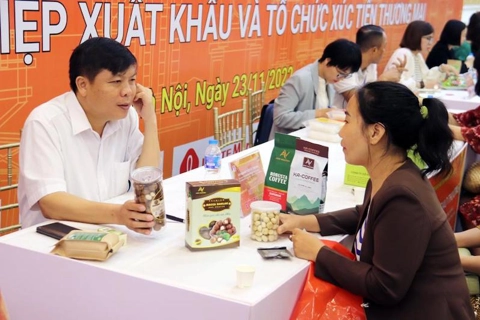
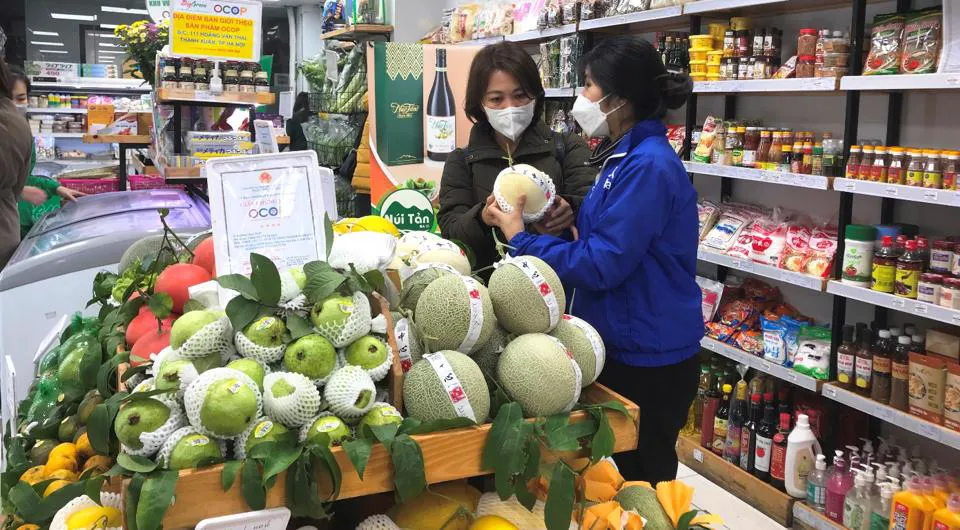
| Customers buy OCOP products at a grocery store in Thanh Xuan District. Photo: Le Nam/The Hanoi Times |
Joint efforts required
According to AHAV Chairman Nguyen Xuan Duong, the livestock industry is facing unprecedented challenges, including an increasingly tight breeding space as the city has the highest livestock density in the country.
This is compounded by rising production costs and a lack of control over raw materials for feed production. In addition, the industry is under pressure from imported products, and there are challenges related to food safety, farm environment, and humane treatment of animals, Duong said.
He emphasized that solving these difficulties requires the participation of multiple stakeholders. Public-private cooperation is necessary, with the State playing a critical role in connecting for consumption of standard products.
“To incentivize enterprises to engage in value chains, support policies should be channeled not directly to farmers, but through cooperatives and businesses,” he said.
During the conference, a representative from the Department of Industry and Trade shared that they have been actively promoting the consumption of chain and the One Commune, One Product (OCOP) program through various means, including introducing them into the distribution system and organizing trade connection events for enterprises and cooperatives.
The agency also helps support the opening of sales outlets for OCOP products in each commune, while working to instruct production households to work with businesses to bring their products into modern distribution channels.
Ta Van Tuong, Deputy Director of the Hanoi Department of Agriculture and Rural Development, emphasized the importance of public-private cooperation to promote the livestock industry and its value chain. He stressed the need for solutions to perfect chains, ensure transparency of chain products, and link chain products to consumption.
Among other things, he expects the authorities to improve regulations and policies, develop supply chains and ensure the safety and quality of livestock products.
Another key point is to strengthen coordination and information sharing among public and private sectors in the city, especially those involved in chain activities, to promote cooperation and consumption of products, Tuong said.
Tuong suggested the city will continue to promote the supply chain of safe livestock products throughout the city and collaborate with other provinces to promote livestock development, trade connection, and association in the production and consumption of safe and quality livestock products.
To improve product quality, Tuong pointed out the importance of strengthening animal quarantine, preventing diseases, developing livestock production through high technology and organic methods, and improving livestock management.
“Hanoi will support upgrading the supply chain of safe livestock products into a sustainable value chain that is in line with international standards, along with providing consulting and certification in animal husbandry, slaughter, pre-processing, and processing,” Tuong said.