Initiative supports Vietnamese SIBs in addressing Covid-19 aftermath
The new project will contribute to reducing the impact of Covid-19 on vulnerable groups, especially women and girls.
A CAD3.1-million (US$2.4 million) project is expected to support 300 social impact businesses (SIBs) with seed funding and market access, thus creating potentially 9,000 jobs for vulnerable people.
| An overview of the launch. Photo: UNDP |
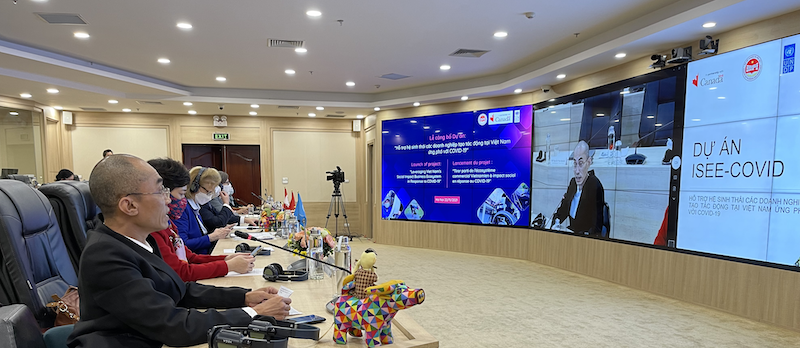
The project “Leveraging Vietnam’s SIBs ecosystem in response to Covid-19” or the ISEE-COVID is mainly funded by Global Affairs Canada, and some correspondent funds from the UN Development Program (UNDP) and the Government of Vietnam. It will be implemented in three years.
Speaking at the launching of the project on November 22, Canadian Ambassador to Vietnam Paul Deborah said SIBs provide incredible value to vulnerable communities in Vietnam in response to Covid-19, as well as contribute to sustainable and inclusive economic development.
“In partnership with UNDP Vietnam and the Ministry of Planning and Investment, our shared ambition is to improve the effectiveness of SIBs, especially those led by women, as a means to address the social and gendered impacts of Covid-19 as well as strengthen the SIB regulatory environment in order to enhance their social and environmental contributions in the communities they serve,” she underlined.
The project prioritizes support to SIBs in four key industries heavily impacted by Covid-19, namely sustainable agriculture, sustainable tourism, education, and health. These are also areas with a large female workforce and many SIBs offering innovative solutions dedicated to reducing poverty rates among women and girls.
The project will apply an ecosystem approach to tackle the inter-connected and systemic challenges that SIBs face. It will improve the capacity of SIBs themselves, build the capacity of and coordination between SIB intermediaries, as well as strengthen government policy-making capacities for enabling SIBs.
About 90 SIBs will benefit from revenue increases and develop plans to cope with Covid-19 and future shocks while 105 SIBs will have business plans that integrate gender and/or environment and climate change.
Meanwhile, at least four gender-responsive policies are expected to be developed or revised. An impact business network of at least 100 members would be established. The network would support an impact measurement and management system pilot for 5-10 SIBs.
| Canadian Ambassador to Vietnam Paul Deborah (L), Vietnamese Deputy Minister of Planning and Investment Tran Duy Dong (M), and UNDP Resident Representative Caitlin Wiesen (R). Photo: Phi Khanh |
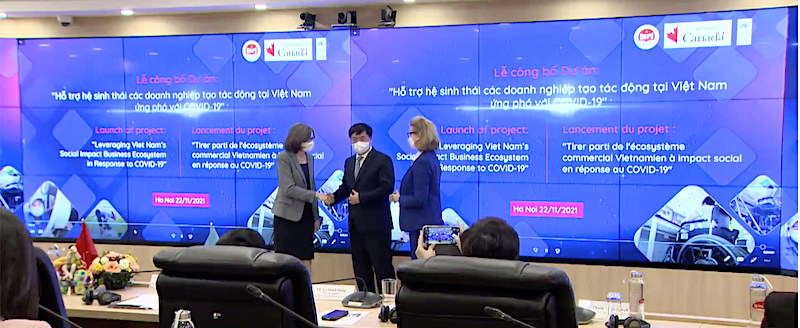
UNDP Resident Representative Caitlin Wiesen highlighted the timeliness of the project in supporting vulnerable groups and businesses in overcoming the prolonged and damaging impacts of the Covid-19 pandemic. She emphasized the crucial role of the private sector in general, and the social impact businesses in particular, in recovering and building forward better.
At the project’s launch, Tran Duy Dong, Vietnamese Deputy Minister of Planning and Investment said the project is expected to contribute to improving the capacity of SIBs, thus helping vulnerable groups, including women, people with disabilities, and ethnic minorities build capacity and strengthen coordination among intermediaries to support SIBs. It will also enhance the capacity of State agencies in policy formulation and implementation, thus creating favorable conditions for the development of SIBs.
He said the Ministry of Planning and Investment has implemented many practical programs and activities to support vulnerable groups, such as the programs ‘For the community development', the initiative ‘White Cane for the Blind in Vietnam’, and sponsored a number of vulnerable groups, including SIBs like KymViet, Vun Art, and Tam Ngoc Cooperative.
SIBs are organizations that have both business activities and a commitment to positively impacting society/environment as central tenets of their strategic operations. Balancing social/environmental aims with a commercial model allows them to sustainably solve social and environmental challenges.
UNDP’s study in collaboration with the National Economic University and the University of Northampton showed that 99% of SIBs employ female staff, while 74% have people from marginalized groups in their workforce. A typical SIB is micro-sized in personnel and revenue. Roughly 41% of SIBs’ leaders are female.