Travel
Kim Lien Pagoda: one of the 10 most ancient architectural works in Vietnam
Standing on a flat strip of land in Nghi Tam village, Quang An commune, Tay Ho district, Kim Lien pagoda is considered one of the 10 most ancient architectural monuments in Vietnam.
Under the Ly dynasty, King Ly Than Tong (1128 – 1138) commanded to build Tu Hoa palace in this place for his daughter, princess Tu Hoa, and her maidens to grow mulberries and raise silkworms in Tam Tang (silkworms and mulberries) farm nearby. When the princess passed away, a pagoda was erected in the old foundation of Tu Hoa Palace.
Under the Tran dynasty, Tam Tang farm changed its name to Tich Lien guild and the pagoda was re-named Dong Long and then Dai Bi under Le dynasty. The stele in the pagoda built under the reign of King Le Nhan Tong reads: “In the first year of Thai Hoa era (i.e. in 1443), the pagoda was found and called Dai Bi”.
In 1771, under the reign of King Le Canh Hung, the pagoda was renovated on a large scale and renamed Kim Lien pagoda.
From 1792 to 1793, during the reign of King Quang Trung, the pagoda was restored and took the the look as it’s seen today.
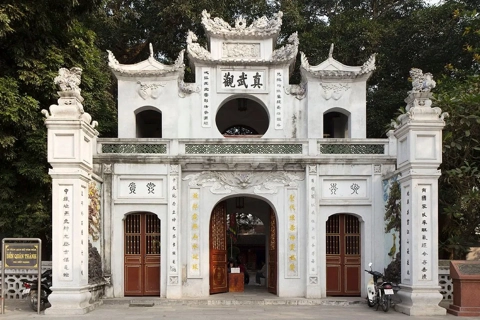
Looking from afar, the three-arch gate of Kim Lien pagoda radiates the hidden and proud beauty with a unique wooden structure: a row of four round wooden columns bearing the swoping-eave roof. A pair of huge main columns in the middle shoulder the gable roof forming the main arch which is higher and wider than the two arch on both sides. The three-arch gate of the pagoda also has sophisticated and engravings on wooden surface depicting dragon and flower.
The architecture of Kim Lien pagoda is perhaps influenced by the royal palace architecture and initially worships a royal member of the Ly. The layout of the temple includes a symmetrical axis from the three-arch gate to the main chamber. After the gate, there is a courtyard which leads to three houses arranged in three parallel lines in the shape of the Chinese character三 (meaning three). The back and the middle houses facing the west while the front house looks east. Three houses walls are built with thick ancient bricks without plastering. The round windows in the walls are decorated with Buddhist writings.
The temple has huge double - eave fish-scale roof. Its column foot rest on rock bases, which were carved with stylized lotus shape.
Still well preserved in the pagoda are the fine statues. Statues of Buddhas are arranged into two layers, of which the upper layer contains “Tam The” set (three statues of Buddha in the three ages – the past, the presence and the future), followed by statues of Amitabha, Avalokiteshvara (Guanyin) Bodhisattva and Bodhisattva Mahasthanaprata alongside statues of Ananda and Mahakassapa, two principal disciples of Gautama Buddha. The lower layer includes statues of Cundi, Jade Emperor and Nine Dragons Bathing the Baby Buddha. In addition, there is a statue of Uy Vuong Trinh Giang, who donated money to build the temple in the 32nd year of Canh Hung era (1771). All statues bear sculpture style of the 18th – 19th centuries. There’s also an ancient stele displayed on the right side of the pagoda on the square stone pedestal. Although time has faded many words carved on the slab, it’s possible to see the reign name: “the 3rd year of Thai Hoa era, the year At Suu, i.e. 1445 under the reign of King Le Nhan Tong”.
 Unique wooden structure of Kim Lien pagoda |
In 1771, under the reign of King Le Canh Hung, the pagoda was renovated on a large scale and renamed Kim Lien pagoda.
From 1792 to 1793, during the reign of King Quang Trung, the pagoda was restored and took the the look as it’s seen today.
 Inside the Kim Lien pagoda sees many fine statues |
The architecture of Kim Lien pagoda is perhaps influenced by the royal palace architecture and initially worships a royal member of the Ly. The layout of the temple includes a symmetrical axis from the three-arch gate to the main chamber. After the gate, there is a courtyard which leads to three houses arranged in three parallel lines in the shape of the Chinese character三 (meaning three). The back and the middle houses facing the west while the front house looks east. Three houses walls are built with thick ancient bricks without plastering. The round windows in the walls are decorated with Buddhist writings.
The temple has huge double - eave fish-scale roof. Its column foot rest on rock bases, which were carved with stylized lotus shape.
 The pagoda also has sophisticated and lissome engravings on wooden surface such as dragon, flower shapes |