Vietnam: Lessons drawn from first gov’t Covid-19 relief package
Amid the current uncertainties, the government should be visionary when adopting any support programs.
While the Vietnamese government has timely delivered the first Covid-19 relief package, its efficiency has not been up to expectations, according to Vice President of National Economics University (NEU) Bui Duc Tho.
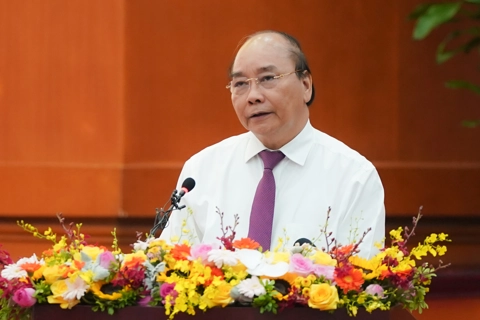
| Overview of the conference. Source: VGP. |
.jpg)
Around 80% of respondents said they could not access the government support program as they were not informed or failed to qualify for it, Mr. Tho said at a conference discussing measures to overcome Covid-19 economic impacts on October 15, referring to a recent survey conducted by the NEU.
Additionally, over 60% of enterprises have returned to normal operation, 30% were forced to scale down their businesses and 10% temporarily shut down.
Those of small scale are facing the most severe impacts from the pandemic, stated Mr. Tho.
On the contrary, economist Pham Chi Lan also pointed to the fact that many small enterprises are actually quite resilient against external shock, thanks to high flexibility in moving their operations online.
Mrs. Lan noted the majority of them have been well-prepared from previous market volatility, especially during the US – China trade tension.
Chief Representative of the Japan International Cooperation Agency (JICA) in Vietnam Shimizu Akira highlighted Vietnam’s positive performance in containing the pandemic and boosting economic recovery.
Mr. Akira said it would be much harder for Vietnam to realize its economic targets, if the country has to deal with hundreds of new Covid-19 cases every day just like what is happening in Japan.
For Vietnam to further its integration in global value chains and find the direction for economic development in the post-Covid-19 pandemic, Mr. Akira expected Vietnam to enhance its absorption capabilities of incoming investment capital, as well as focusing on developing high quality human resources.
At the conference, experts also agreed that amid the current uncertainties, the government should be visionary when adopting any support programs.
While the policy should continue to focus on easing conditions for credit access, waiving and freezing interest rates, taxes and expenses, the validity of these programs should be long enough for enterprises to recover sustainably.
More importantly, the government must take drastic actions in simplifying administrative procedures and creating a favorable business environment.
Meanwhile, economist Vo Tri Thanh suggested the second program could last until 2021 and must be in line with new global developments.
Moreover, Vietnam should take advantage of free trade agreements and foreign investment attraction strategy ahead of a shift of global investment flows, Mr. Thanh asserted.
Mrs. Lan said Vietnam must be aware of the sustainable issues in economic development, especially as the country’s economy has high level of openness. This came in the context fact that Vietnam has a large trade deficit with China but a trade surplus with the US.
In the long run, this could be a major risk, so Vietnam should grasp this opportunity to restructure its trading activities, open up new markets and avoid relying on a few ones, Mrs. Lan added.
Mrs. Lan urged the government to be selective in drafting new supporting programs, focusing on enterprises with high potential for development.