Market cap of Vietnamese firms much smaller compared to regional peers
The number of small enterprises upgrading to mid-sized and from mid-sized to large ones is very low, while the capital accumulation process among private companies has not been up to standard.
The average market capitalization of major Vietnamese firms on the stock market was estimated at US$186 million in 2018, much smaller compared to regional peers, including the Philippines (US$1.2 billion)m,Singapore (US$1.07 billion), Thailand (US$835 million), Indonesia (US$809 million) and Malaysia (US$553 million), according to the Ministry of Planning and Investment (MPI).
| Minister of Planning and Investment Nguyen Chi Dung at the meeting. Source: MPI. |
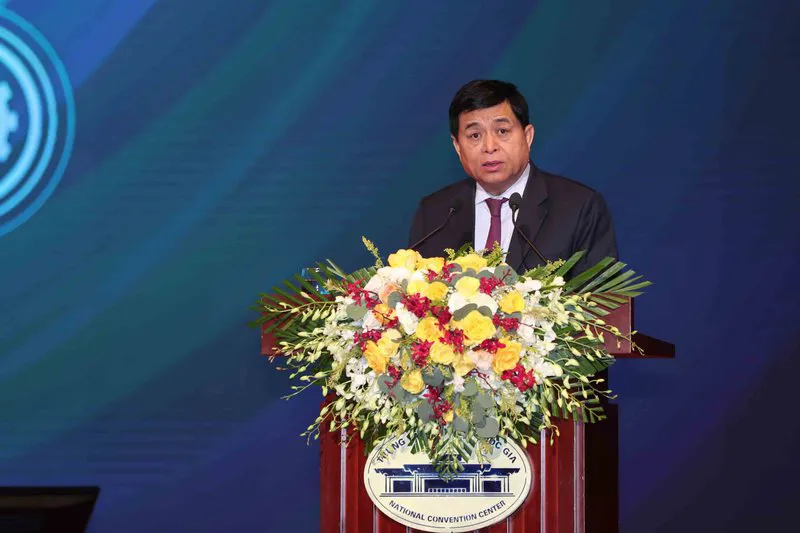
The number of small enterprises upgrading to mid-sized and from mid-sized to large ones is very low, while the capital accumulation process among private companies has not been up to standard, stated the MPI in a report read at a conference between Prime Minister Nguyen Xuan Phuc and the business community held today [December 23].
According to the MPI, Vietnam see a shortage of large and medium enterprises, leading to an imbalanced structure of the private sector. Statistics revealed 97% of over 700,000 enterprises in Vietnam are of small and medium sizes. However, of the 97%, 69% are micro and 29% are small businesses.
By the end of 2018, only 17,000 enterprises were categorized as large sized, and 21,000 enterprises, or 3.47% of the total, are of medium size. The rate proved to be modest compared to other economies with a more sustainable level of private sector development, in which medium enterprises account for 5 – 10%, stated the MPI.
The lack of medium and large enterprises is one of the main reasons restricting the linkage of Vietnamese enterprises to global value chain, not to mention the size of large Vietnamese enterprises is much smaller compared to regional average, said the MPI.
86% of Vietnamese firms do not conduct R&D
In addition to small sizes, the majority of Vietnamese enterprises have conducted limited research and development (R&D) activities, particularly in core and pioneer technologies.
According to the MoIT, only 10% of the total enterprises successfully registered one patent in the last three years, while most do not own a patent.
Additionally, investments by Vietnamese firms in R&D only account for 0.2 – 0.3% of revenue, much lower than 5% of those in India and 10% in South Korea, while the linkage between the business community and research institutes of universities remains weak.
A survey revealed 86% do not take part in any R&D activities, and only 14% are investing in new technologies.
The MPI also pointed to corporate governance as one of the weaknesses of Vietnamese firms as most of them do not have a long-term strategy or vision and lack high quality workforce.
A World Bank report suggested the quality of Vietnamese human resources is 3.79 points out of 10, ranking 11 out of 12 countries that participated in its survey in Asia.
Moreover, the Vietnamese firms also have weak linkage to global supply chains and low competitiveness.
A survey from the Japan External Trade Organization (JETRO) stated Japanese firms in Vietnam only purchased 32.4% of input services and materials from local suppliers in 2016, much lower than similar rates of firms with Japanese investment in other countries such as China with 67.8%, Thailand with 57.1% or Indonesia with 40.5%.
Among local suppliers for Japanese enterprises in Vietnam, 58.9% are foreign invested firms, and only 13% of services and input materials are provided by wholly-owned Vietnamese firms.