Number of green buildings in Vietnam doubles in 2024
Vietnam now has a cumulative total of 559 green-certified buildings. This figure far exceeds the original targets set for green buildings—80 by 2025 and 160 by 2030.
In 2024, the number of green-certified buildings reached 163, doubling from the previous year.
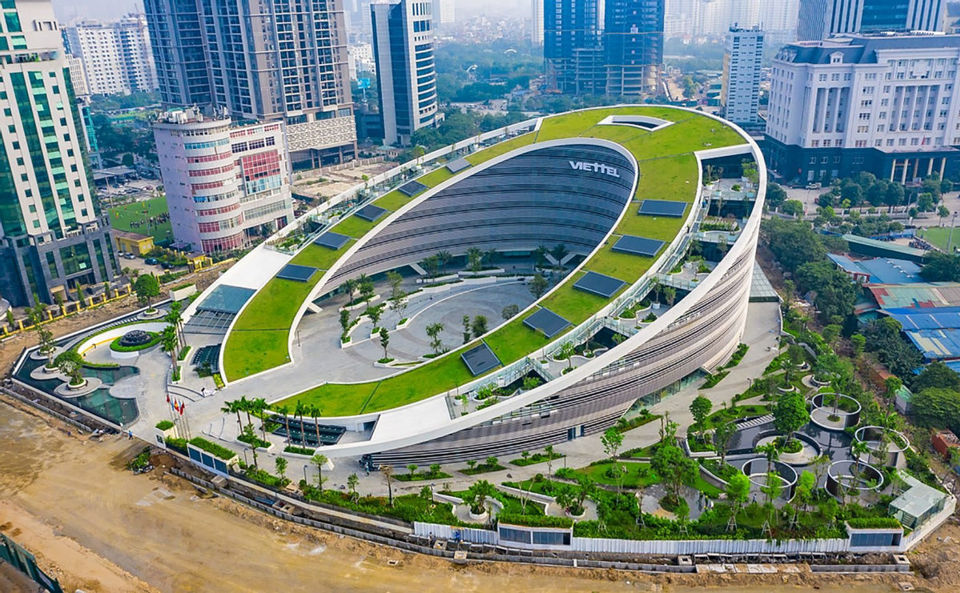
| The headquarters of Viettel Group is the first building in Hanoi to meet the standards of the U.S. Green Building Council. Source: Viettel |
This information was highlighted in the Vietnam Green Building Market Overview 2024 report, released last week by the EDGE certification system and the International Finance Corporation (IFC), a member of the World Bank.
Vietnam now has a cumulative total of 559 green-certified buildings, covering a total floor area of 13.6 million square meters. This figure far exceeds the original targets set for green buildings, 80 by 2025 and 160 by 2030.
Experts note that although Vietnam started the pursuit of green buildings later than other countries in the region, it has made significant progress, with the number of green projects increasing sharply in recent years. According to the Government’s Decree No.15 of 2021, green buildings must meet specific criteria and standards in their design, construction, and operation to ensure energy efficiency, resource conservation, environmental protection, and quality living conditions.
Green projects are expected to contribute to Vietnam’s commitment under its Nationally Determined Contribution (NDC) by helping reduce 74.3 million tons of CO2 emissions by 2030 in the construction sector, on the way to net-zero emissions by 2050.
To achieve green certification, buildings must meet sustainability criteria not only in terms of design and construction materials but also in environmental performance and energy-efficient operations. For example, replacing low-efficiency lighting with LED, reflective bulbs, and long-life halogen fixtures ensures that energy consumption remains below 20 watts per square meter of floor space.
Adjusting air conditioning by just one degree Celsius in common areas can save up to 10% of cooling or heating energy, said Tran Ngoc Duy, Deputy Director of Savills Hanoi’s Property Management Division.
Regarding water efficiency, Savills suggests solutions such as reducing water flow from taps to around 3.5 liters per minute, optimizing toilet flushing systems to 4.5 liters per flush, and implementing rainwater harvesting and recycling systems. According to Savills data, water efficiency measures have led to a 17% reduction in water consumption per square meter in office projects and a 3% reduction in residential projects.
The most common green certifications in Vietnam include EDGE (issued by the IFC), LEED (issued by the US Green Building Council), Green Mark (developed by Singapore’s Building and Construction Authority), and Lotus (developed by the Vietnam Green Building Council).
By building type, the report indicates that green-certified residential neighborhoods have declined over the past four years due to challenges in the real estate market but are now showing signs of recovery. The total certified floor area is approaching the peak levels seen in 2019 and 2020.
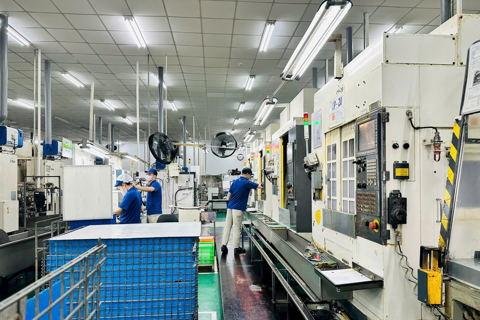
Industrial green buildings have grown significantly over the past two years, particularly with the emergence of green warehouses. The shift of manufacturing to Vietnam, along with accelerated industrialization, production expansion, and logistics growth, has driven this trend. In 2024, green-certified office projects reached their highest scale ever. Meanwhile, green retail and education projects have also seen significant growth.
Among the provinces and cities, Ho Chi Minh City led in terms of certified green floor area in 2024, with a total of 3.4 million square meters. It was followed by Hanoi, Binh Duong, Bac Ninh, and Haiphong.