Organic farming essential for Vietnam’s sustainable agriculture development: Expert
Speeding up the transformation towards an organic agricultural sector and clean farm produce would no doubt enhance Vietnam’s ability to penetrate global markets.
While the local agricultural sector continued its strong performance in the first six months of the year, sustainable development remains a long-term goal, which requires substantial changes towards modern and organic farming, according to agricultural expert Nguyen Thi Tuyet Mai.
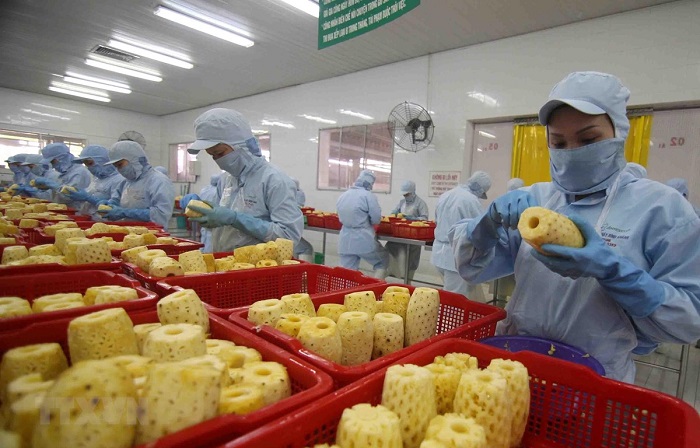
| Pineapple processing for exports at An Giang Agriculture and Foods Import - Export Joint Stock Company in An Giang Province. Photo: Vu Sinh |
Despite severe Covid-19 impacts, the local agro-forestry-fishery sector posted a positive growth of 3.84% in the first half of the year.
This year, the Ministry of Agricultural and Rural Development (MARD) estimates the total production volume of Vietnam’s top ten fruits to reach 8.3 million tons in 2021.
Mai, however, told The Hanoi Times the seasonal nature of Vietnam’s farm produce is putting pressure on the distribution system after harvesting seasons.
“This is particularly important as the Covid-19 pandemic has not been contained in Vietnam’s key export markets,” Mai said, referring to disruption in export activities in the past which had led to stagnation in the distribution of local farm produce, not to mention rising prices of fertilizers, transportation, and custom clearance fees.
According to Mai, since early 2021, Vietnam’s agricultural exports have been facing growing challenges from strict requirements on food safety and rules of origin.
“Difficulties in meeting technical standards remain even in export markets with high turnovers, such as the US, China, or Europe,” Mai continued.
For example, China has adopted measures to control frozen products due to fear of potential Covid-19 infections.
Amid growing demands on product quality, Mai pointed out the fact that agricultural production in Vietnam remains at a small scale, fragmented and spontaneous, along with the high level of dependence on pesticides, seen as a major restriction for Vietnam’s farm produce to penetrate the US and China markets.
Enhance reputation for Vietnam’s farm produce
Recent statistics showed Vietnam currently has 60 traders specialized in exporting organic farm produce with a turnover of $550 million per year.
Experts noted the figure remained modest as Vietnam is seen as one of the world’s largest agricultural exporters.
“Speeding up the transformation towards an organic agricultural sector and clean farm production would no doubt enhance Vietnam’s ability to penetrate global markets,” Mai continued.
The priority for Vietnam, as Mai said, would be to grasp opportunities at a time when the world is struggling with Covid-19 impacts.
Mai called for stronger efforts from the authorities in raising farmers’ awareness of the significance of modern agricultural production towards sustainability.
“Measures are required to change their production habits by focusing on high added-value products and ensure compliance with international standards,” she added.
The MARD could play a key role in this process, Mai noted, by offering technical solutions, including automation, nano-biological technologies, among others, in production. Nano-fertilizers should be used more widely instead of the traditional ones to ensure greater efficiency and be environmentally friendly.
“The amount of nano-fertilizer required in production is around 10-20% that of normal fertilizer, but offer 40% more in productivity,” said Director of Nano Farm Dang Quang Company Hoang Hai Anh.
Statistics from Hanoi’s Department of Agricultural and Rural Development noted Hanoi has been operating 141 supply chains of agro-forestry-fishery products that help distribute nearly 1,380 safe and high-quality organic products to supermarkets and stores across the city. In addition, Hanoi is collaborating with 21 provinces/cities to develop 786 safe supply chains, of which 253 have been verified to meet safety standards by the Ministry of Agricultural and Rural Development. The establishment and management of value chains are seen as key steps to control product quality in every phase and help raise awareness of farm producers on food safety, in turn raising added-value by 15-20% compared to those not produced under value chains. For the 2021-2025 period, Hanoi aims to set up the addition of 50 supply chains for the city’s key farm produce, with 100% applying IT for product traceability. |