Policymakers ratifies resolution on private sector development
The private sector, including business households, currently contributes around 51% of GDP and over 30% of the state budget.
THE HANOI TIMES — With nearly 90% of deputies voting in favor, the National Assembly passed a resolution today (May 17) for developing the private economy.
The resolution stipulates that high-tech enterprises, small and medium-sized enterprises (SMEs), and innovative startups are eligible for a minimum 30% reduction in land rent for the first five years from the date they sign a lease contract with infrastructure investors in industrial zones, clusters, or technology incubators. This reduction supports access to land resources and premises for production and business.

Party General Secretary To Lam, right, and State President Luong Cuong vote on the resolution. Photo: quochoi.vn
The state will reimburse the infrastructure investor for this land rent support in accordance with regulations. The provincial People’s Committee will determine the amount by which land rent is reduced.
Currently, Vietnam has nearly 450 industrial zones spanning approximately 93,000 hectares. However, small and medium-sized enterprises have limited access to these zones, and land rental costs remain high relative to their payment capacity.
Provincial People’s Committees must allocate a minimum of 20 hectares (or 5% of the total land area) per industrial zone or cluster established after the effective date of the Resolution, with ready-built infrastructure, for high-tech enterprises, SMEs, and startups to sublease. In addition, these businesses may be permitted to lease public assets, including unused or underutilized land and buildings, within the locality.
Enterprises, households, and individual business owners are eligible for a 2% annual interest rate subsidy when borrowing capital to implement green or circular economy projects that apply environmental, social, and governance (ESG) standards.
The SME Development Fund will provide loans to small and medium-sized enterprises and startups. It will also offer seed funding for innovative startup projects and technology incubators.
The fund will invest in local and private investment funds to increase capital availability for these businesses. It will receive and manage loans, grants, aid, and capital entrusted by organizations and individuals to support SMEs.
In terms of tax and fee support, startups and startup investment fund management companies are exempt from corporate income tax for the first two years and enjoy a 50% reduction in payable tax on income from innovative startup activities for the following four years.
Small and medium-sized enterprises are exempt from corporate income tax for three years from the issuance date of their first business registration certificate.
Experts and scientists employed by research and development centers, startups, and intermediary organizations that support innovation are exempt from personal income tax for the first two years. They only pay 50% of the tax on income derived from wages and salaries for the following four years.
Enterprises can deduct up to 20% of their taxable corporate income to set up a fund for the development of science, technology, innovation, and digital transformation. These funds may be used for in-house research or to commission scientific and technological research and development (R&D) and innovation activities.
The state will provide small and micro enterprises, business households, and individual entrepreneurs with free digital platforms and standardized accounting software.
This resolution introduces a groundbreaking principle for handling violations and incidents in business activities. It unequivocally differentiates between corporate and individual responsibility and between criminal, civil, and administrative liabilities.
Civil and economic measures are prioritized when addressing civil and economic violations. Enterprises, households, and individuals are encouraged to proactively remediate violations and damages.
The number of inspections (including inter-agency inspections) for businesses, households, and individuals is limited to once per year, unless there are apparent signs of violations. Inspections may be conducted in person or via digital platforms, with electronic data checks preferred. Entities that comply with legal regulations may be exempt from physical inspections.
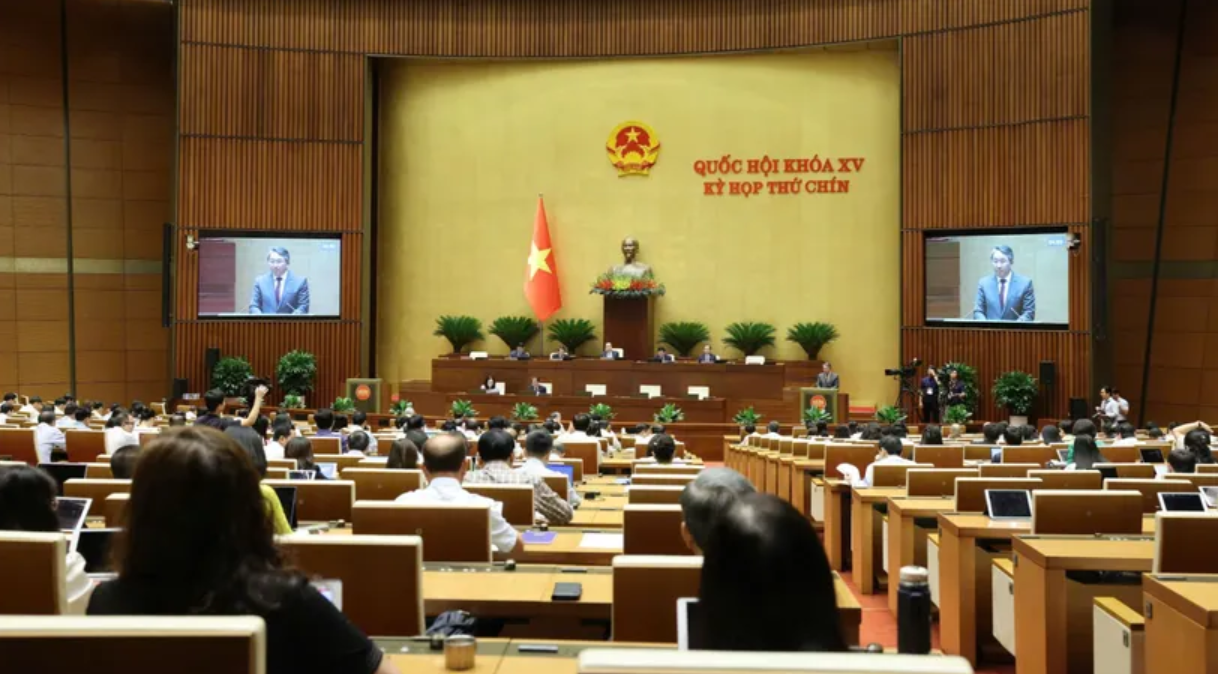
The National Assembly debates the resolution on the development of the private economy.
The resolution provides additional guidelines for handling physical evidence and assets during the investigation, prosecution, and trial of certain criminal cases, as stipulated in Resolution 164/2024 of the National Assembly. It requires the timely and effective handling of evidence and assets in a way that does not affect the proof or resolution of the case. This will allow for the prompt remediation of damage, the exploitation and use of assets, the unlocking of development resources, and the avoidance of losses and waste.
Vietnam currently has over 5.2 million business households, generating 8 to 9 million jobs, equivalent to the private corporate sector, according to data from the General Statistics Office between 2018 and 2020. The private sector, including business households, currently contributes around 51% of GDP and over 30% of the state budget.
Starting January 1, 2026, the lump-sum tax regime for businesses will be abolished. Instead, they will be required to register and declare taxes in accordance with tax administration regulations. This change is part of an effort to reach the goal of having two million businesses by 2030 and three million by 2045, as outlined in Politburo Resolution 68 on developing the private sector.
In order to implement these special policies, the National Assembly has tasked the government with reviewing and amending land, planning, and investment regulations. The review and amendment must be completed by December 31, 2026.
No later than December 31, 2025, the review and elimination of business conditions and overlapping regulations that hinder private sector development must be completed. The government must reduce administrative processing time, compliance costs, and business conditions by at least 30%, with continued substantial reductions in subsequent years.