Q1 sees foreign investors posting $1 billion in net sales
Similar outflows are seen across the region with Vietnam's foreign investor outflows remain moderate.
THE HANOI TIMES — Foreign investors posted net sales of over VND25.9 trillion (US$1.02 billion) on the Ho Chi Minh City Stock Exchange (HOSE) between January and March, 2025, the highest first quarter net outflow in the 25-year history of Vietnam's stock market.
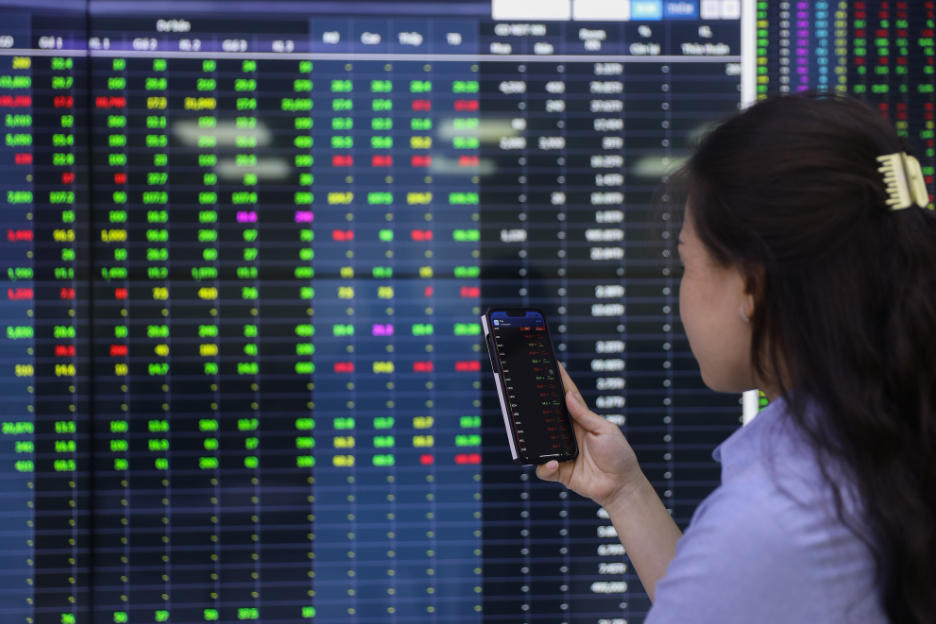
An investor at a local securities firm in Hanoi. Photo: Khanh Linh/The Hanoi Times
The move was largely attributed to profit-taking on stocks that saw strong gains in 2024, according to the bourse.
HOSE data shows that foreign investors bought over VND95.5 trillion ($3.75 billion) worth of stocks, bonds, ETFs, and covered warrants during the quarter, while selling over VND121.4 trillion ($4.77 billion). This resulted in a net outflow of nearly $1.02 billion, exceeding the total annual outflows in 2023, 2020, and 2016.
As of the end of last week, the cumulative net selling by foreign investors had risen to more than VND33.3 trillion ($1.28 billion). The selling trend was steady since February 2024. According to Yuanta Vietnam Securities, the outflows were partly driven by concerns over former US President Donald Trump's possible retaliatory trade policies.
Yuanta noted that similar outflows are seen across the region. Compared to its peers, Vietnam's foreign investor outflows remain moderate. Net foreign investor selling in Vietnam over the past year (as of March) totaled $3.2 billion, significantly lower than other markets such as Taiwan (China) at $43 billion, South Korea at $16.2 billion, Japan at $46 billion, and India at $14.9 billion.
During a press briefing on April 3, Ha Duy Tung, Deputy Chairman of the State Securities Commission (SSC), said net sales in the first quarter accounted for only 1.9% of total foreign holdings, which is considered a relatively small share. He linked the activity to Trump-era tariff concerns and said future trends will depend on US policy moves and international responses, including from Vietnam.
Deputy Finance Minister Nguyen Duc Chi emphasized the cyclical nature of foreign capital flows, saying it is normal for capital to flow out and return. He attributed the higher-than-usual volatility in the first quarter to several factors, including changes in investment strategies, fund policies, and market sentiment.
Transaction data shows that foreign investors aggressively offloaded shares of FPT, VNM, TPB, SSI, STB, and FRT during the quarter. Yuanta analysts explained that these are fundamentally strong stocks that posted substantial gains in 2024, prompting investors to take profits and rotate into other opportunities.
On the buying side, foreign investors accumulated shares in VCI, VIX, GVR, EIB, VGC, and GEX. The broader trend points to net buying in the securities and real estate sectors. For brokerage firms, key drivers are expectations of a market upgrade, the implementation of a new IT trading system, and improving liquidity. In the real estate space, hopes for a market recovery in the second half of the year with multiple catalysts are drawing attention.
Yuanta expects foreign inflows to strengthen once Vietnam’s new trading platform is operational and its market classification is upgraded by FTSE Russell. However, inflow patterns will continue to hinge on global macroeconomic conditions and USD volatility, it noted.
Recently, the US dollar index (DXY) has eased from 110 to around 103–104, raising hopes that Vietnam will find it easier to manage exchange rate stability.
Despite the VND/USD exchange rate remaining high, largely due to the State Bank of Vietnam’s ongoing accommodative monetary policy, the central bank’s liquidity injections have boosted market sentiment, especially in terms of trading volume. As a result, the VN-Index has room to grow and potentially attract more foreign capital.
According to SSI Securities, as of end-February, the intense selling had dragged the foreign investor ownership ratio on the Vietnamese stock market down to 13.1%, its lowest level since 2015. Combined with the weakening DXY, SSI analysts believe net selling pressure from foreign investors may ease in the coming months.
Nonetheless, SSI cautioned that global capital remains more concentrated in developed markets. To attract foreign investors again, Vietnam needs to take more targeted measures to develop and deepen its capital markets.