Refusing to sort garbage will result in fines from August
The maximum fine for an administrative violation in the field of environmental protection is VND1 billion (nearly $43 thousand) for individuals and VND2 billion (over $85 thousand) for organizations.
Households and individuals that fail to sort domestic solid waste as prescribed will be fined from VND500,000 to 1 million (US$21.4 - 42.8), according to a decree issued by the Vietnamese Government.
The decree will take effect from August 25.
The decree stipulates that agencies, organizations, and owners of production, business, and service establishments that generate industrial solid waste will be sanctioned as follows:
A fine of between VND3-5 million ($128.5 - 214.1) will be imposed on those failing to properly handle industrial solid waste.
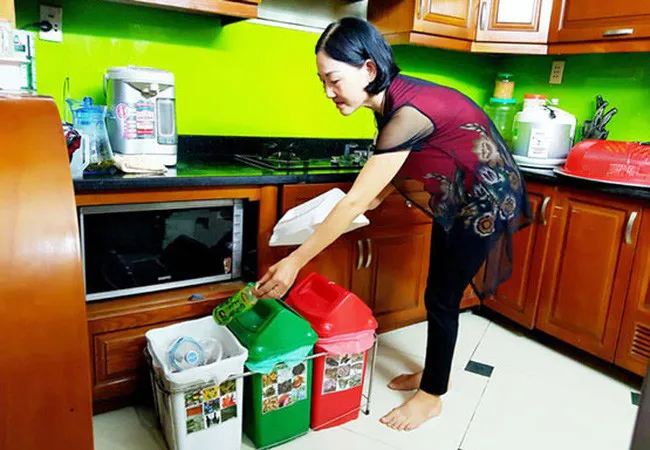
Sorting domestic waste at the source will contribute to environmental protection. Photo: Hanoimoi |
A fine ranging from VND 20-25 million ($856 - 1,071) will be imposed on those failing to sort industrial solid waste at the source as prescribed or whose equipment and tools used for storing industrial solid waste do not meet technical requirements for environmental protection.
The maximum fine for an administrative violation in the field of environmental protection is VND1 billion (nearly $43 thousand) for individuals and VND2 billion (over $85 thousand) for organizations. The statute of limitations for handling the administrative violation is two years.
Vietnam's Law on Environmental Protection 2020 stipulates that before December 31, 2024, all households must sort domestic waste prior to discharge.
Waste sorting at the source has been piloted in Ho Chi Minh City over the past ten years, and officially rolled out in the southern economic hub in 2018.
The 2020 Law on Environmental Protection prescribes volume-based fees for collecting, transporting, and treating domestic solid waste.
It also requires households and individuals to sort their domestic waste into three groups, namely recyclable, food, and others.
The amended law also stipulates that domestic solid waste which is sorted out is not subject to waste collection, transportation and treatment fees.
Food waste and waste classified as other types must be put in packages and sent to treatment establishments.
Provincial People's Committees have the right to determine the amount of the fee, while the sanitation unit has the right to refuse to collect waste from households and individuals that are not sorted, according to the law.