US plans to conclude the review of Vietnam’s non-market economy status in summer
This is a matter of great concern for both countries' leadership.
The US Department of Commerce is expediting the recognition process for Vietnam's market economy status, with completion expected by June.
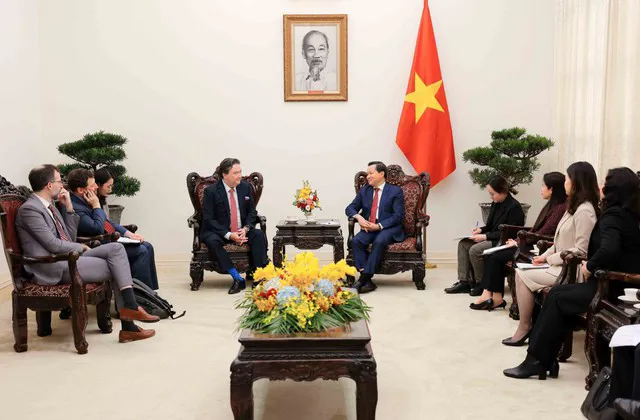
| Deputy Prime Minister Le Minh Khai and US Ambassador to Vietnam Marc E. Knapper. Source: VGP |
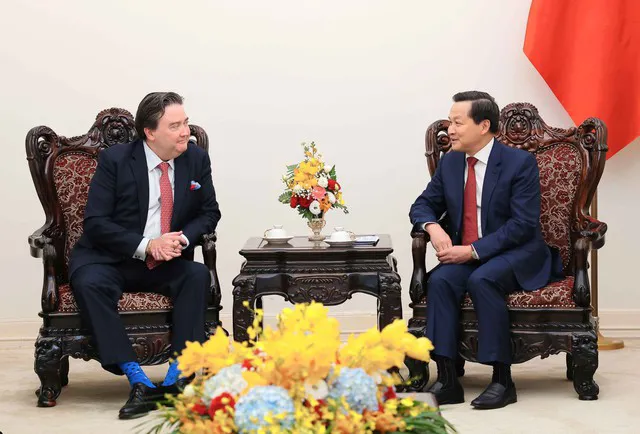
US Ambassador to Vietnam Marc E. Knapper revealed the information during a meeting with Deputy Prime Minister Le Minh Khai on January 31.
At the meeting, Deputy Prime Minister Khai noted that this year marks the first implementation of the high-level leaders' agreement between the two countries, propelling their bilateral relationship towards deeper, more comprehensive, stable, and sustainable development.
For Vietnam, the US holds strategic importance as a partner, said Khai.
He added that the Vietnamese Government highly values the consistent message from the US in support of a "strong, independent, self-reliant, and prosperous" Vietnam, and stressed Vietnam's readiness to work with the US in implementing detailed plans outlined in the high-level agreement and joint statements related to the Comprehensive Strategic Partnership.
Welcoming the US' enhanced responsible cooperation in the Asia-Pacific region through the Indo-Pacific Strategy and regional initiatives, Khai expressed hope that the US would continue supporting the central role of ASEAN, the ASEAN-US Comprehensive Strategic Partnership, the Mekong-US partnership, contributing positively to peace, stability, cooperation, and development in the region and the world, serving the interests of both nations.
Regarding the recognition of Vietnam's market economy status, Khai emphasized that this is a matter of great concern to both countries' leadership. He urged the US Ambassador to continue his strong advocacy and help speed up the US recognition of this status, hoping for completion as early as 2024.
“Vietnam is prepared to provide the necessary documentation for the US to review promptly,” said Khai.
The Vietnamese Government leader and US Ambassador Marc E. Knapper also discussed matters related to strategic trade control and high technology to facilitate enhanced cooperation, especially in the context of the two nations having a Comprehensive Strategic Partnership.
Acknowledging the remaining challenges, Khai expressed confidence that with the experience, understanding of Ambassador Knapper, and the role of the US Embassy in Vietnam, the difficulties would soon be resolved. Ambassador Marc E. Knapper pointed out that 2023 was a pivotal year in bilateral relations, marked by high-level visits, especially the visit of the US President to Vietnam.
In 2024, both sides will be responsible for implementing the agreements reached. The US plans to update signed documents, including joint statements and action plans, and not allow them to be frozen or forgotten.
Knapper suggested that the US aims to work closely with Vietnam to fulfill promises made to the people of both countries and to strengthen bilateral relations, the Comprehensive Strategic Partnership, and overall cooperation.
Providing insights into the US efforts in assisting Vietnam's semiconductor industry development, he stressed the need for an ecosystem, indicating that US companies desire to invest in Vietnam but require a legal framework, easier access to clean and reliable energy, technology infrastructure provided by trustworthy providers, and a high-tech workforce.
These issues need to be addressed within the next 12-18 months, he noted.
Knapper suggested that one way for Vietnam to attract investment in the semiconductor industry is through an expanded Information Technology Agreement under the WTO. Another area the two sides agreed to deepen in the Comprehensive Strategic Partnership is the clean energy sector, where the US is working with the State Bank of Vietnam and the Ministry of Finance to provide green financing and green bonds.
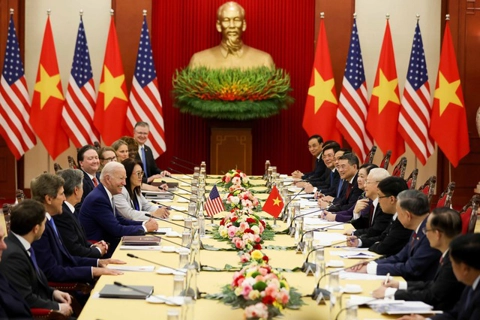
| Overview of the meeting. |
US recognition significant for Vietnam’s economy
To date, 72 countries, including major economies like Canada, Australia, and Japan, have recognized Vietnam as a market economy. Most recently, the UK officially recognized Vietnam's market economy status in a formal letter when it joined the Comprehensive and Progressive Agreement for Trans-Pacific Partnership (CPTPP). This recognition ensures that the UK will not apply unfavorable rules to Vietnamese imports in cases of trade defense investigations.
Since the first anti-dumping investigation involving Vietnam in 2002, the US has considered Vietnam a non-market economy. According to US regulations, the determination of a market economy status is based on six criteria set by the US Department of Commerce.
These criteria include the currency conversion rate, wage and labor negotiation issues, foreign investment levels, state and private ownership, government control over resources and prices, and other relevant factors. Currently, the US categorizes 12 countries, including Vietnam, as non-market economies in trade defense cases, which has a significant impact on Vietnamese businesses, especially in anti-dumping investigations.
In practice, when determining normal values for calculating the dumping margin, the US uses the value of a third country considered to be a market economy (surrogate country) to calculate the production costs of Vietnamese enterprises, instead of relying on data provided by them. This practice significantly inflates the dumping margin and does not accurately reflect the production reality of Vietnamese businesses.
Additionally, designating Vietnam as a non-market economy allows the US to impose country-wide tariffs – a rate applicable to uncooperative or non-demonstrative businesses showing a lack of government control. Country-wide tariffs are often calculated based on available data, leading to high rates that persist through all review periods, thus hampering consideration of tariff removal.
According to preliminary statistics from the General Department of Customs, in 2023, Vietnam's exports to the US reached US$97 billion, down 12.8% year-on-year. Nevertheless, the US remains Vietnam's largest export market.
In the context of the US being a major export market for Vietnam, the recognition of market economy status is therefore significant for Vietnam's manufacturing and export sectors.