US rejects China's claims in most of South China Sea
Washington said the world will not allow Beijing to treat the South China Sea as its maritime empire.
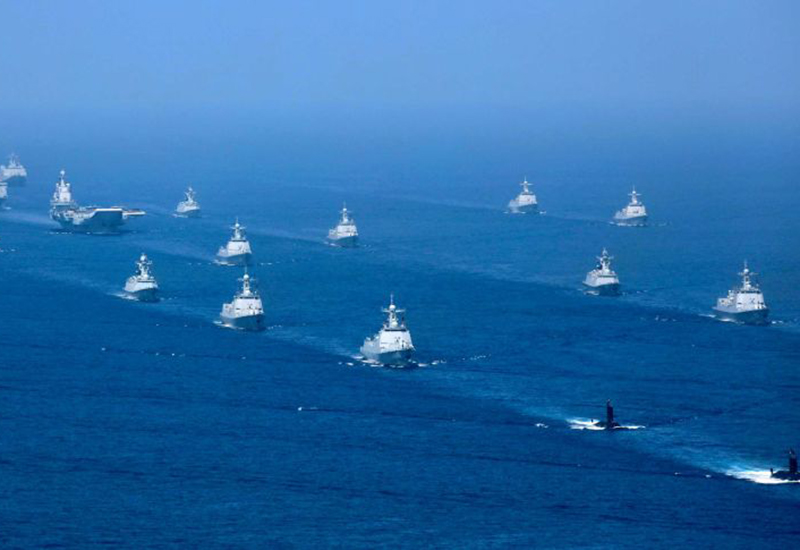
The US has said that Beijing’s claims to offshore resources across most of the South China Sea (SCS) are completely unlawful as the Asian giant has stepped up aggression in this disputed sea.
| China is becoming resurgent in the South China Sea. Photo: AP |
“Beijing uses intimidation to undermine the sovereign rights of Southeast Asian coastal states in the South China Sea, bully them out of offshore resources, assert unilateral dominion, and replace international law with “might makes right”, US Secretary of State Mike Pompeo said in a press statement on July 13.
“The world will not allow Beijing to treat the South China Sea as its maritime empire,” the US State Secretary noted.
“America stands with our Southeast Asian allies and partners in protecting their sovereign rights to offshore resources, consistent with their rights and obligations under international law. We stand with the international community in defense of freedom of the seas and respect for sovereignty and reject any push to impose “might makes right” in the South China Sea or the wider region,” he noted.
The US Department of State said they are aligning the US position on China’s maritime claims in the South China Sea with the ruling of an Arbitral Tribunal constituted under the 1982 Law of the Sea Convention in July 2016. Specifically:
(1) China cannot lawfully assert a maritime claim – including any Exclusive Economic Zone (EEZ) claims derived from Scarborough Reef and the Spratly Islands – vis-a-vis the Philippines in areas that the Tribunal found to be in the Philippines’ EEZ or on its continental shelf.
(2) As Beijing has failed to put forth a lawful, coherent maritime claim in the South China Sea, the US rejects any China claim to waters beyond a 12-nautical mile territorial sea derived from islands it claims in the Spratly Islands (without prejudice to other states’ sovereignty claims over such islands). As such, the US rejects any China maritime claim in the waters surrounding Vanguard Bank (off Vietnam), Luconia Shoals (off Malaysia), waters in Brunei’s EEZ, and Natuna Besar (off Indonesia).
"Any China action to harass other states’ fishing or hydrocarbon development in these waters – or to carry out such activities unilaterally – is unlawful," asserted the statement.
The statement, however, does not mention China's claims over the Paracel islands, also claimed by Vietnam.
(3) China has no lawful territorial or maritime claim to (or derived from) James Shoal, an entirely submerged feature only 50 nautical miles from Malaysia and some 1,000 nautical miles from China’s coast. James Shoal is often cited in China propaganda as the “southernmost territory of China.”
The statement noted that China has no legal grounds to unilaterally impose its will on the region. Beijing has offered no coherent legal basis for its “Nine-Dashed Line” claim in the South China Sea since formally announcing it in 2009.
Washington has several times raised voices against China's aggression in the resources-rich South China Sea, through which some US$5.3 trillion worth of goods transits annually. The Pentagon earlier this month protested China's military drills around the Paracel on July 1-5.