Vietnam-China Joint Statement: Towards deepening Comprehensive Strategic Cooperative Partnership
The 11-section statement outlines key agreements on deepening the Comprehensive Strategic Cooperative Partnership and advancing a Vietnam–China Community with a Shared Future.
THE HANOI TIMES — Vietnam and China issued a Joint Statement following the visit of General Secretary of the Communist Party of China (CPC) and Chinese President Xi Jinping on April 14-15, agreeing to deepen cooperation and build a more comprehensive and extensive partnership structure.
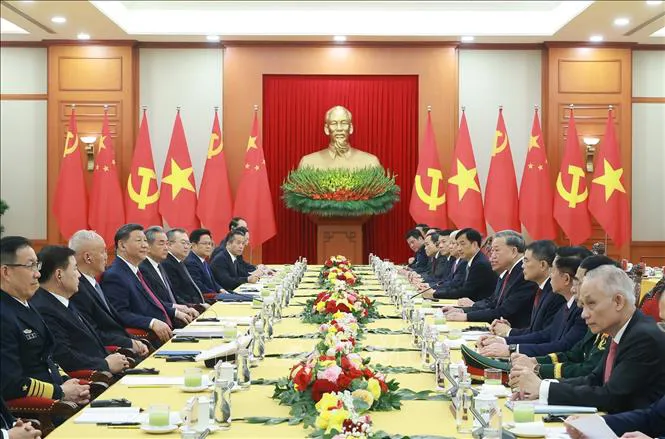
Meeting between General Secretary To Lam and General Secretary of the Communist Party of China (CPC) and Chinese President Xi Jinping. Photos: VNA
The statement, consisting of 11 sections, outlines key common understandings reached by both sides on strengthening the relationship, along with positions on regional and international issues of mutual interest.
Both sides agreed that China's drive to develop new quality productive forces and Vietnam's efforts to cultivate new growth drivers represent help build a more comprehensive cooperation structure.
Accordingly, Vietnam and China will accelerate the strategic development between the two countries and effectively implement the cooperation plan to link the "Two Corridors, One Belt" framework with the Belt and Road Initiative. Priority will be given to improving connectivity in infrastructure such as railways, expressways, and border gates.
Both sides support expanding cooperation in road, air and rail transport while facilitating customs inspection, quarantine, and import-export activities at rail border gates.
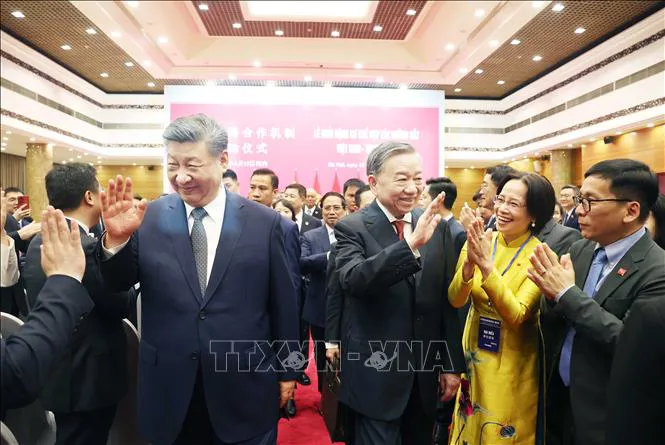
The two leaders at the Vietnam-China People's Friendship Exchange held in Hanoi on April 15.
In railway cooperation, the two sides will bring into play the role of the Vietnam-China Joint Committee on Railway Cooperation and implement the intergovernmental agreement on cooperation in standard gauge railway projects connecting the two countries. China expressed its willingness to work with Vietnam in technology cooperation and human resources training.
Both sides welcomed China's approval of technical assistance for a feasibility study on the Lao Cai-Hanoi-Haiphong standard gauge railway and agreed to expedite its groundbreaking. They also agreed to speed up research on the Lao Cai-Hekou railway and welcomed the signing of a grant letter for the design of two standard-gauge railway lines: Dong Dang-Hanoi and Mong Cai-Ha Long-Haiphong.
On road transport, both countries welcomed the launch of the Red River Road Bridge Project between Bat Xat (Vietnam) and Ba Sai (China) and agreed to move forward with the launch of the Thanh Thuy (Vietnam) - Tianbao (China) international border crossing project.
The two sides will promote the role of the Vietnam-China Joint Committee on Land Border Gate Management, accelerate the development of smart border gates, and establish dedicated freight corridors in certain areas, with consideration for expansion to other suitable border crossings, including Mong Cai-Dongxing. They will also enhance "soft connectivity" through smart customs cooperation.
In aviation, Vietnam and China will facilitate extensions and additional time slots for airlines operating in each other's markets, encourage airlines to resume and increase flights based on market demand, and welcome Vietnamese airlines to operate Chinese commercial aircraft through various arrangements. Both sides will support enhanced cooperation in the field of Chinese-made commercial aircraft.
The two countries agreed to strengthen strategic economic links by aligning regional development strategies such as the Guangdong-Hong Kong-Macau Greater Bay Area and the Yangtze River Delta with the expansion of the "Two Corridors, One Belt" economic corridor to Chongqing.
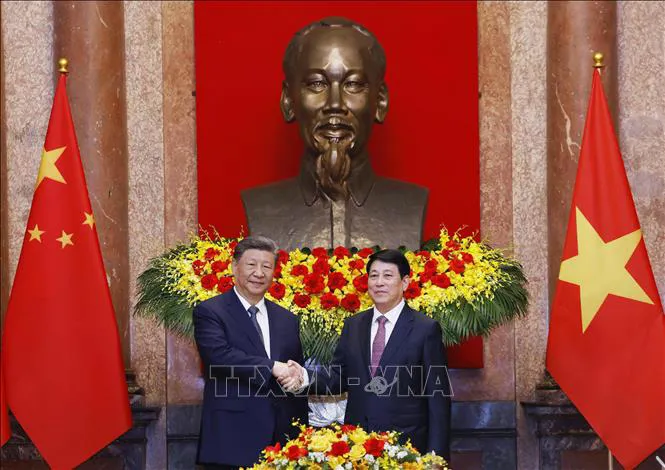
State President Luong Cuong and the Chinese leader in Hanoi on April 15.
They also encouraged reputable and technologically advanced enterprises to invest in each other's countries, and pledged to foster a fair and favorable business environment. The two sides welcomed cooperation between their enterprises in the research and application of 5G technology, and agreed to step up cooperation in emerging fields such as artificial intelligence, clean energy, green development, and digital economy.
Vietnam and China agreed to make full use of the Regional Comprehensive Economic Partnership (RCEP) and the ASEAN-China Free Trade Area (ACFTA) to promote balanced growth in bilateral trade.
They welcomed the signing of protocols on Vietnamese exports to China, such as chili, passion fruit, raw bird's nests, cleaned bird's nests, and rice bran. The two sides also pledged to strengthen customs cooperation, expand exports of competitive products, implement mutual recognition of Authorized Economic Operators (AEO), and promote single-window customs cooperation.
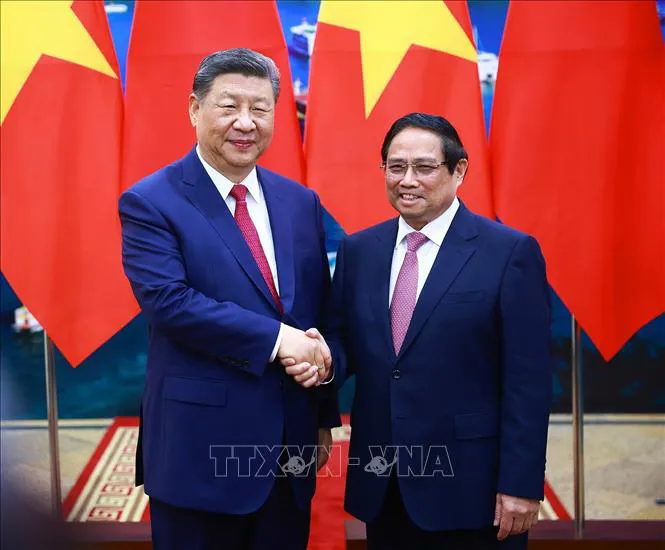
Prime Minister Pham Minh Chinh and CPC General Secretary and Chinese President Xi Jinping in Hanoi on April 15.
Vietnam and China agreed to strengthen cooperation in environmental pollution control, disaster prevention and mitigation, climate change response, water resources, and meteorology. They pledged to share hydrological information during flood seasons and improve integrated water resources management. Both sides aim to make science and technology cooperation a new highlight in their bilateral relationship, and agreed to promote cooperation in areas such as artificial intelligence, semiconductors, and nuclear energy.
They stressed the importance of nurturing the Vietnam-China friendship. The two countries, which share geographical proximity, cultural affinity, deep people-to-people ties, and similar political systems.
Vietnam and China reaffirmed their commitment to support each other on their respective paths to socialism, adapted to their national contexts, and to enhance strategic trust.
Defense and security cooperation was reaffirmed as one of the key pillars of Vietnam-China relations, contributing to strengthening strategic trust between the two Parties and the two countries.
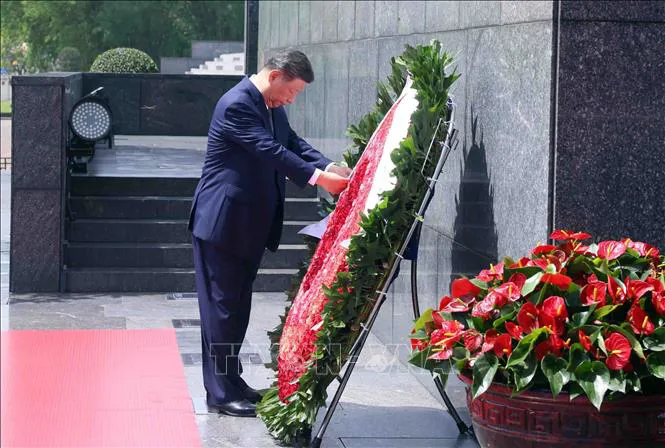
The Chinese leader lays a wreath in tribute to President Ho Chi Minh on April 15.
To reinforce the social foundation of the Vietnam–China Community with a Shared Future, both sides view the upcoming 75th anniversary of diplomatic ties and the 2025 Vietnam–China Year of People-to-People Exchanges as opportunities to promote rich, meaningful cultural and social exchange activities that build strong public support.
They also agreed to properly manage and resolve differences, safeguard overall friendly relations, and maintain regional peace and stability. The two sides exchanged candid and frank views on maritime issues, stressing the need to better manage and actively resolve maritime disputes and maintain peace and stability in the South China Sea. They agreed to effectively implement the cooperation agreements signed during the visit.
During the visit, Vietnam and China signed cooperation agreements in areas such as road and rail connectivity, customs inspection and quarantine, agricultural trade, defense, science and technology, culture, sports, education, public welfare, human resources, media, and local cooperation.
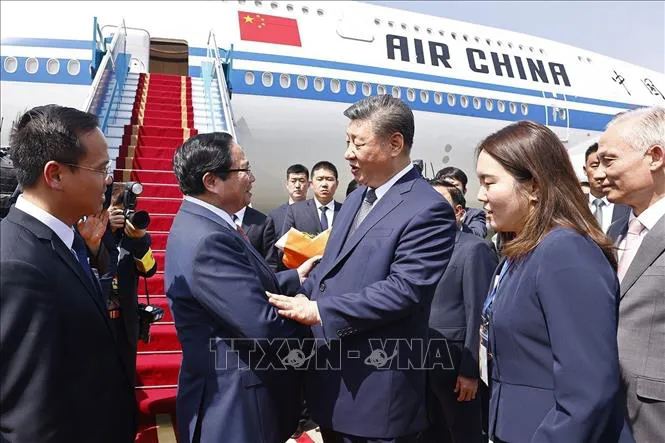
Prime Minister Pham Minh Chinh bids farewell to CPC General Secretary and Chinese President Xi Jinping at Noi Bai International Airport on April 15
Both sides agreed that the state visit of CPC General Secretary and Chinese President Xi Jinping to Vietnam was a great success, marking a historic milestone in bilateral relations and contributing greatly to strengthening the traditional friendship and pushing forward the building of a Vietnam–China Community with a Shared Future of strategic significance in the new era, thereby promoting peace, stability, prosperity and development in the region and the world.