US releases first-ever detailed study against China claims in South China Sea
China’s illegal claims have put Beijing on a collision course with the Philippines, Vietnam, and other Southeast Asian nations.
The US Department of State on January 12 disclosed its most detailed study against China’s claims in the South China Sea, calling assertion unlawful and rejecting it.
In the 47-page “Limits in the Seas” document issued by the Office of Ocean and Polar Affairs and the Bureau of Oceans and International Environmental and Scientific Affairs, the US said China’s expansive maritime claims in the South China Sea are inconsistent with international law as reflected in the 1982 United Nations Convention on the Law of the Sea (UNCLOS).
The paper is an update of a 2014 study that similarly disputed the so-called “nine-dash line” that forms the basis for much of Beijing’s stance.
| China's claimed nine-dash line in the South China Sea is rejected by the rest of the world. Source: DW |
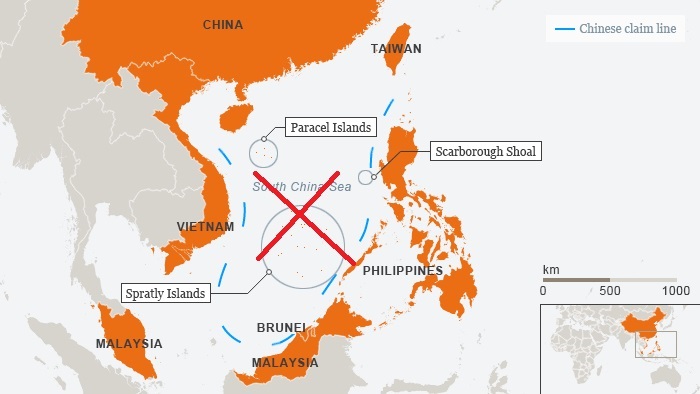
Since 2014, China has continued to assert claims to a wide swath of the South China Sea (SCS) as well as to what China has termed “internal waters” and “outlying archipelagos,” all of which are inconsistent with international law as reflected in UNCLOS, according to the Department.
Illegal claims have put Beijing on a collision course with the Philippines, Vietnam, and other Southeast Asian nations.
According to the US Department of State, China asserts four categories of maritime claims in the SCS.
(1) Sovereignty claims over maritime features: Beijing claims “sovereignty” over more
than one hundred features in the SCS that are submerged below the sea surface at high tide and are beyond the lawful limits of any State’s territorial sea. Such claims are inconsistent with international law, under which such features are not subject to a lawful sovereignty claim or capable of generating maritime zones such as a territorial sea.
(2) Straight baselines: China has either drawn, or asserts the right to draw, “straight baselines” that enclose the islands, waters, and submerged features within vast areas of ocean space in the SCS. None of the four “island groups” claimed by China in the South China Sea (“Dongsha Qundao,” “Xisha Qundao,” “Zhongsha Qundao,” and “Nansha Qundao”) meet the geographic criteria for using straight baselines under UNCLOS. Additionally, there is no separate body of customary international law that supports China's position that it may enclose entire island groups within straight baselines.
(3) Maritime zones: China asserts claims to internal waters, a territorial sea, an exclusive economic zone, and a continental shelf that are based on treating each claimed South China
Sea island group “as a whole.” This is not permitted by international law. The seaward extent of maritime zones must be measured from lawfully established baselines, which are normally the low-water line along the coast. Within its claimed maritime zones, China also makes numerous jurisdictional claims that are inconsistent with international law.
(4) Historic rights: China asserts that it has “historic rights” in the SCS. This claim has no legal basis and is asserted by the PRC without specificity as to the nature or geographic extent of the “historic rights” claimed.
The Department stated that the overall effect of these maritime claims is that China unlawfully claims sovereignty or some form of exclusive jurisdiction over most of the SCS. These claims gravely undermine the rule of law in the oceans and numerous universally-recognized provisions of international law reflected in UNCLOS. For this reason, the US and numerous other states have rejected these claims in favor of the rules-based international maritime order within the SCS and worldwide.
| Many countries reject China's maritime claims in the South China Sea. |
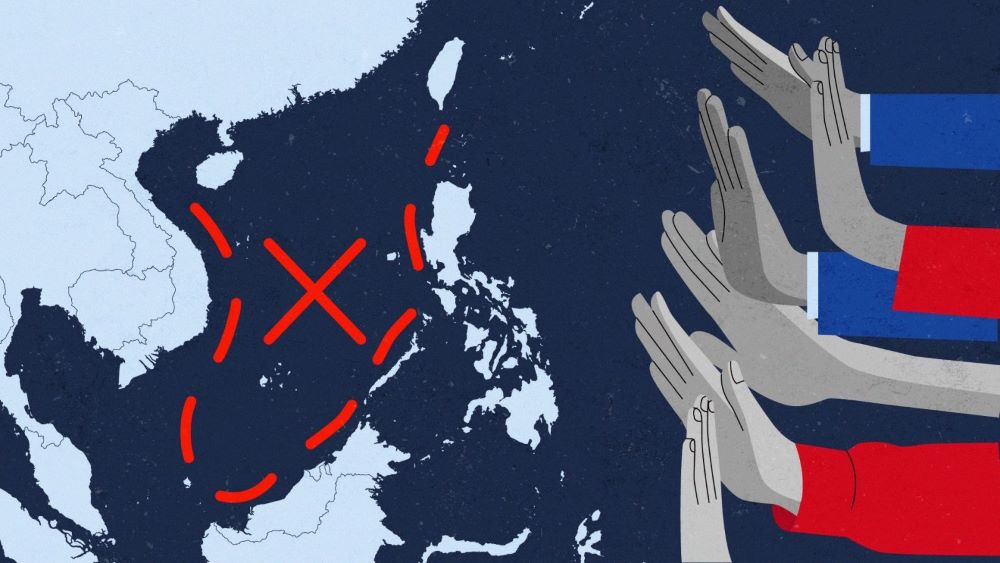
In July 2020, for the first time, the US made its policy on the South China Sea crystal clear. Thereby, Washington rejected China’s claim to most of these waters and asserted that America stands with its Southeast Asian allies and partners in protecting their sovereign rights to offshore resources.
So far, many countries rejected China’s claims in the South China Sea, namely Australia, Japan, Malaysia, the Philippines, the US, Vietnam, EU Three or E3 (the UK, France, and Germany), among others.
Vietnam submitted three notes verbales. The first note verbale issued on March 30, 2020 asserted that China’s claims “seriously violate Vietnam’s sovereignty, sovereign rights and jurisdiction in the East Sea (international known as the South China Sea). Vietnam argued that China’s claims in the East Sea exceeded “the limits provided in UNCLOS, including claiming historic rights; these claims are without lawful effect.”