US – Vietnam Bilateral Trade Agreement opens door for Vietnam global integration
Right after the signing of BTA, Vietnam’s parliament initiated a process of revising more than 170 laws to ensure the compatibility of its legislation to the deal and international laws.
With the US being the founding member of the World Trade Organization (WTO), the signing of the Vietnam-US Bilateral Trade Agreement (BTA) in 2000 was a significant step for Vietnam to initiate and deepen international economic integration, according to Nguyen Dinh Luong, Vietnam’s former chief negotiator for the BTA.
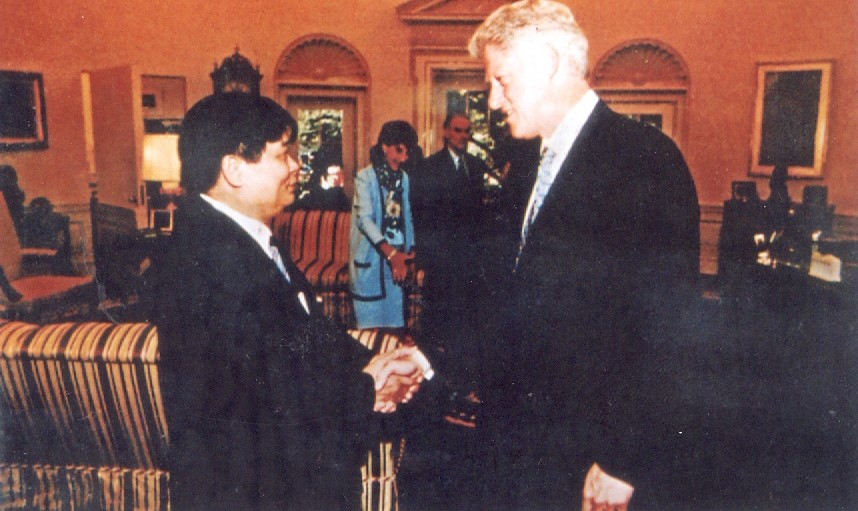
| US President Bill Clinton welcomed Vietnam's Chief Negotiator for BTA Nguyen Dinh Luong at the White House on July 13, 2000. |
“Right after the signing of the BTA, Vietnam’s National Assembly started a process of revising more than 170 laws to ensure the compatibility of its legislation to the BTA and international laws,” Luong said at a talk show on July 8 at Thuy Loi University, marking the 25th anniversary of the establishment of Vietnam – US diplomatic relations and 20th anniversary of the signing of the BTA.
“The process had no doubt sped up Vietnam’s shift from a centrally planned economy to a market-based one, which was initiated since the “doi moi” (reform) in 1986, and laid the ground for the country’s economic development as today,” Luong asserted.
Luong looked back the rough path that led to the BTA between Vietnam and the US, saying the relations between the two countries were a unique one that went from foes to friends, and later partners in various fields, including economy, trade, investment and even security.
Vietnam and the US are now supportive of each other in many international forums and share the same view in major issues, Luong said, but apparently, it was not so when the two countries normalized the diplomatic relations in 1995.
“A lack of trust between the two sides was a major stumbling block that caused the BTA negotiation process to last for nearly five years,” Luong said.
| Luong (l) at the talk show on July 8. Photo: Thuy Loi University. |

Luong said the first US Ambassador to Vietnam Pete Peterson at that time told him after the BTA signing that the deal would help Vietnam- US trade revenue hit US$6 – 8 billion, the figure Luong considered impossible, given the trade turnover between Vietnam and Soviet Union being around US$1 billion at its peak, or just dozen to hundreds of millions dollars with Eastern European countries.
Two years after the BTA, bilateral trade turnover exceeded US$8 billion. The trade relations have gained strong momentum from that moment on with annual growth of 10 -30%, and exceeded US$70 billion in 2019, a 75-fold increase from that of in 2000, Luong stated.
In 2000, Vietnam’s exports to the US was US$0.73 billion, but rose sharply to US$5.93 billion in 2005, US$14.24 billion in 2010, US$33.48 billion in 2015 and US$61.35 billion in 2019, making the US the largest export market of Vietnam, accounting for 28.5% of its total exports.
“There has not been another country with such rapid growth in trade with the US,” Luong noted.
According to Luong, growing economic cooperation was a key push for Vietnam – US cooperation in other fields, including cultural exchange and tourism.
Vietnam currently remains the sixth leading country in sending students to the US, Luong added.
Luong expected the US – Vietnam relations would continue to grow, thanks to Vietnam’s strategic geopolitical position.
“The US needs Vietnam for its Indo – Pacific strategy, especially given Vietnam’s growing importance in ASEAN,” Luong asserted. Similarly, Vietnam would also need the US for further development.
“In such context, economic cooperation would be at center and the driving force for US – Vietnam relations in the future,” Luong concluded.