Vietnam aims for five international-standard cities by 2045
The country should have a high level of urbanization comparable to ASEAN and Asia by 2045.
Vietnam aims to have at least five cities of international caliber to serve as locomotives for regional and international development networks by 2045, according to an action plan released by the Ministry of Construction (MoC) recently.
Under the action plan, the ministry will execute two resolutions, one by Politburo and the other by the Government, on the sustainable development, management, and construction of urban areas in Vietnam by 2030 with a vision for 2045.
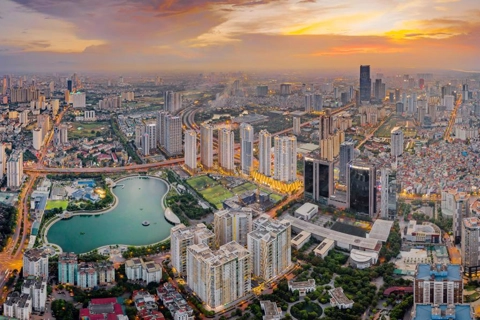
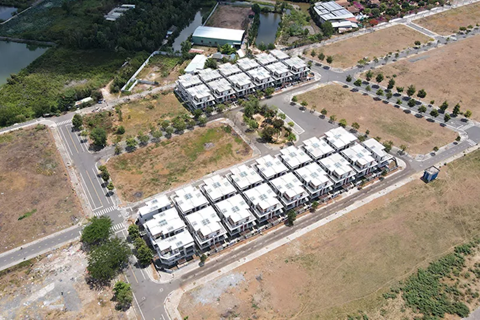
| Hanoi from above. Photo: Huu Thang |

The country plans to build a high level of urbanization comparable to ASEAN and Asia by 2045. The urban system would be integrated, balanced, and sensitive to climate change, natural disasters, and epidemics, while promoting environmental protection and distinctively modern architecture with green and smart elements, according to the action plan.
Other key targets include a national urbanization rate of at least 45% by 2025 and more than 50% by 2030. In addition, the ratio of urban construction land to the total natural land area is expected to reach about 1.5 to 1.9% by 2025 and 1.9 to 2.3% by 2030.
In addition, the MoC expects about 950 to 1,000 urban centers to be established across the country by 2025, and 1,000 to 1,200 by 2030. By 2025, all existing and new urban centers must have master plans, land use plans, programs for urban renovation, beautification, reconstruction, and development, and meet the criteria for urban classification, especially in terms of health care, education, training, and cultural infrastructure.
By 2030, Vietnam should have several national and regional urban centers that meet urban-level targets for health, education, training, and culture equivalent to the average of the four leading ASEAN countries.
The MoC also set a target for the ratio of transportation land to urban construction land to be about 11 to 16% by 2025 and 16 to 26 percent by 2030. The average green area per urban resident should be 6-8m2 in 2025 and 8-10m2 in 2030. In addition, the average urban dwelling is expected to have a minimum of 28 sqm in 2025 and 32 sqm in 2030.
Urbanization rate in Hanoi to reach 75% by 2030
Consistent with the overall urban development plan of the Ministry of Construction, Hanoi has set ambitious targets to raise its urbanization rate to around 60 to 62% by 2025 and to 65 to 75% by 2030. To achieve this, the city's Party Committee has issued an action program in line with Politburo Decision No. 06-NQ/TW, which aims to plan, build, manage, and sustainably develop urban areas in Vietnam to 2030 and beyond, with a vision for 2045.
The city aims to increase the urban construction area to 30% of the total natural land area by 2025 and to 33-36% by 2030. By 2025, Hanoi will have completed all district planning, satellite city zoning plans, functional area construction zoning plans, and detailed plans for the renovation and reconstruction of old apartment buildings, as well as a program for renovation, beautification, reconstruction, and urban development in the city. In addition, the city aims to establish a complete system of regulations related to planning and architectural management.
The Party Committee of Hanoi emphasizes the importance of long-term, integrated, and modern urban planning that prioritizes the well-being and quality of life of citizens, as well as urban culture and civilization, to lay the foundation for development. The city intends to improve the legal system by contributing to the revision of the Capital Law and the implementation of mechanisms and policies to promote sustainable urban development that leads to rapid and effective economic growth.
To mobilize the resources of the city and society, the Party Committee encourages economic sectors, especially the private sector, to invest in urban development, while strictly dealing with any violations of urban planning, construction, management, and development laws.
Higher quality in planning management is a key factor To achieve Vietnam's urban development goals, the MoC has outlined a comprehensive plan consisting of five task groups and 25 specific solutions. The first task group aims to establish a unified understanding and action for planning, building, managing, and sustainable urban development in Vietnam. To meet the requirements of sustainable urban development, the second task group focuses on improving the quality of planning and management. Specific solutions include innovative urban planning methods and approaches for upcoming major plans, including the construction plan for the Hanoi Capital Region and the urban and rural planning system for the period 2021-2030. The third group of tasks aims to promote investment in modern, interconnected urban infrastructure systems that are adaptable to climate change. The goal is to have at least 100 cities with perfect, smart, low-carbon, climate-resilient urban infrastructure. The MoC also aims to oversee the renovation and reconstruction of old apartment buildings, the construction of social housing for low-income people, and the implementation of the National Housing Development Strategy. The fourth task group is to develop human resources for urban development to meet the growing demand for urban management and development. The fifth task group will be the development of mechanisms, policies, and legal documents in support of urban development. The focus of this group will be on the drafting of laws on urban and rural planning, management and development, housing, real estate business, water supply and drainage, and underground space management regulations. |