Vietnam banks' ratings on positive trajectory: Fitch
The favorable economic backdrop has enabled banks to take advantage of ample asset origination opportunities to expand while rising household incomes and improved business cash flow keep credit risks in check.
The propensity of Vietnam's authorities to support the banking system is evident from recent regulatory actions, according to Fitch Ratings.
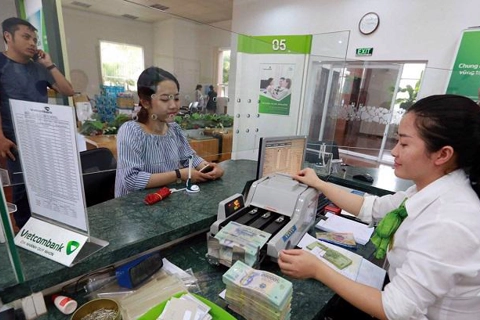
| A customer at a Vietcombank branch in Hanoi. Photo: Thanh Hai/The Hanoi Times |

This led to Fitch's upgrade of most domestic banks' Long-Term Issuer Default Ratings (IDRs) in November 2022.
Positive macroeconomic momentum, if sustained into 2023, also makes it likely that standalone credit ratings may be upgraded in the next 12 months, noted Fitch.
Fitch added the State Bank of Vietnam (SBV)'s record of prudential supervision over the past decade, and its policy response to a run on deposits at a mid-sized commercial bank in October 2022 have reinforced its view that the state has a strong propensity to support the banking system during times of stress to avert bank defaults.
The IDRs of state-owned banks with high systemic importance are now equalized with the sovereign rating as a result.
The operating environment for the banking system remains broadly supportive, with revenue prospects riding on Vietnam's strong economic performance, while asset quality, profitability, and capitalization continue to make steady progress.
“We believe that the risks of a liquidity crunch in the property sector spilling over to the banking sector are manageable, as refinancing challenges are mainly policy-driven and supply-and-demand fundamentals remain conducive over the medium term,” it said.
In this regard, Fitch said it revised the outlook on the operating environment to positive because of Vietnam’s strong economic momentum and healthy sector performance.
Vietnam's economy grew by 8.8% in the first nine months of 2022, a significant improvement from 2.6% in 2021. Fitch forecasts the country’s GDP growth to be sustained above 6% in 2023 and 2024.
The favorable economic backdrop has enabled banks to take advantage of ample asset origination opportunities to expand while rising household incomes and improved business cash flow keep credit risks in check.
Key performance indicators in the banking system have continued to improve. Loan growth in the first nine months of 2022 accelerated to 17%, higher than the 14% recorded in the same period last year, and the SBV announced in December that the 14% system credit growth limit for 2022 may be increased by 1.5pp-2.0pp.
The system's reported non-performing loan (NPL) ratio was steady at 1.5% as of the first half of 2022, unchanged from the same period last year, pushing credit costs lower year on year and raising the return on equity in the system to nearly 20% on an annualized basis.
Capitalization improved, although only modestly, as much of the generated capital was expended to sustain rapid balance-sheet growth. “We expect these trends to hold up in the near term, which would strengthen the case for a more favorable operating environment assessment,” it said.
Property sector is a key risk factor
Recent measures have led to a liquidity drain in the market and raised refinancing risks for over-extended property developers. These include the authorities' clampdown on bond issuance irregularities, which involved some local developers. The SBV has also directed banks to reduce their credit exposure to the real estate sector since early 2022.
The property sector's close linkages to banks, both in terms of direct credit exposure and via real-estate assets pledged as collateral, could have considerable repercussions for the banking system if the liquidity crunch leads to widespread defaults and a sharp correction in property prices.
"We believe such risks remain low, and the authorities have the flexibility to adjust their policy settings if necessary, to avoid market dislocation," Fitch stated.