Vietnam bond market expands to over US$83 billion: ADB
On an annual basis, the bond market expanded 23.5% year-on-year in the third quarter, slowing from 27.5% year-on-year growth in the second one.
Vietnam’s local currency bond market expanded 8.1% quarter-on-quarter to VND1,902.1 trillion (US$83.6 billion) at the end of the third quarter this year, a faster growth compared to the previous quarter’s increase of 6.1%, according to the latest edition of the Asian Development Bank (ADB)’s Asia Bond Monitor.
“The overall bond stock expansion was attributed to the recovery of government bonds from a contraction last quarter and corporate bonds sustaining strong growth,” stated the report.
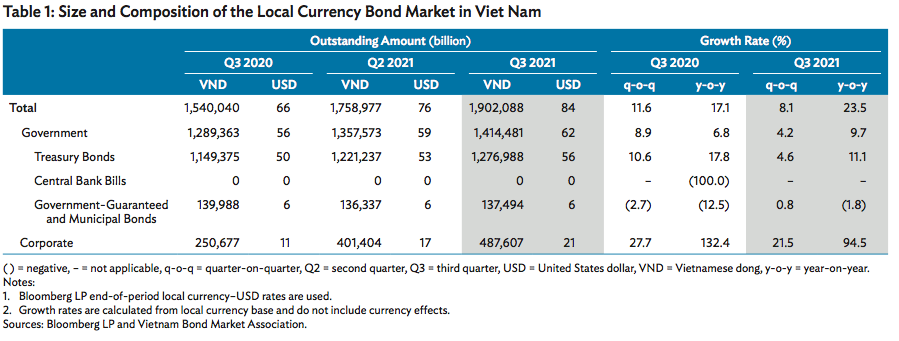
According to the ADB, at the end of September, government bonds accounted for 74.4% of Vietnam’s bond market, while corporate bonds comprised 25.6%. On an annual basis, the bond market expanded 23.5% year-on-year in the third quarter, slowing from 27.5% year-on-year growth in the second one.
In the July-September period, the government bond market increased 4.2% quarter on quarter, reversing the slight contraction of 0.5% in the previous quarter. The government’s outstanding debt amounted to VND1,414.5 trillion ($62.38 billion), with increases across all government bond segments except for central bank bills, which remained at zero.
Government securities outstanding were held almost entirely by insurance firms and banks at the end of September, which together accounted for 99.1% of the total holdings. Insurance firms held 56.8% of government securities, up from 53.9% at the end of September 2020, while banks held 42.3%, down from 44.8% during the same period.
The remaining outstanding bonds were held by securities companies, investment funds, o shore investors, and other investors. Foreign investors held 0.7% of government securities at the end of September, increasing from 0.6% a year earlier.
Meanwhile, the corporate bond market maintained its strong expansion at 21.5% quarter on quarter in this period, although the pace was slower compared to second-quarter growth of 36.6%. Outstanding corporate bonds reached VND487.6 trillion ($21.5 billion) at the end of September. The growth was underpinned by vibrant issuance activity in the corporate sector during the quarter, it added.
The top 30 local currency corporate issuers had aggregate bonds outstanding of VND309.1 trillion at the end of September, comprising 63.4% of the total corporate bond market. The outstanding bonds were largely from banks and property firms. Banks had the largest amount of outstanding bonds totaling VND217.2 trillion, or 70.3% of the top 30’s total debt, and property firms had VND49.0 billion with a share of 15.8%.
The Bank for Investment and Development of Vietnam remained the largest issuer at the end of the third quarter with outstanding debt of VND37.6 trillion, growing from VND25.9 trillion at the end of the second quarter.
Firms resorted to the bond market for funding as regulations from the SBV cautioned against lending to risky sectors. Despite the risk, corporate bonds, particularly from property firms, remained attractive to investors as they offered higher rates.
Looking at the region, the ADB’s report noted emerging East Asia’s bond market grew 3.4% in the third quarter to $21.7 trillion, although rising global inflation and a shift in the US monetary stance weakened regional financial conditions.
“The encouraging macroeconomic outlook and accommodative policy stances are supporting the region’s financial conditions,” said ADB Acting Chief Economist Joseph Zveglich, Jr. “However, central banks in the region may find they need to be less accommodative to keep inflation in check and to keep in step with US monetary policy changes. That said, the chance of another ‘taper tantrum’ is limited as the direction of the Federal Reserve’s stance is clearly communicated and the region’s economic fundamentals remain strong.”
ASEAN bond markets showed sound market capacity during the pandemic, evidenced by low bond yields amid rapid market expansion. Mid- and long-term bonds account for a majority of outstanding bonds in ASEAN bond markets, implying a relatively stable financing structure, stated the ADB.
Sustainable bond markets in the ASEAN region plus China; Hong Kong (China); Japan; and South Korea totaled $388.7 billion, remaining the largest regional sustainable bond market after Europe and accounting for 19.2% of global sustainable bond markets at the end of September.
Green, social, and sustainability bonds accounted for 71.6%, 13.0%, and 15.3% of the region’s sustainable bonds outstanding, respectively. As this regional market develops, the issuer base is also diversifying from just the financial sector to other business sectors.
Emerging East Asia comprises China, Hong Kong (China), Indonesia, South Korea, Malaysia, the Philippines, Singapore, Thailand, and Vietnam.