Vietnam drafts strategy to attract science, tech talent
Recently issued strategic resolutions all identify the development of high-quality talent as essential to successfully implementing national transformation goals.
THE HANOI TIMES — The Vietnamese Government has tasked the Ministry of Science and Technology with drafting a policy to develop and attract top-tier scientific and technological talent.
The policy is to be submitted to the Prime Minister by September 2025.
This assignment is crucial for implementing the Politburo’s Resolution No. 57, which identifies science, technology, innovation, and digital transformation as strategic breakthroughs for Vietnam's long-term development.
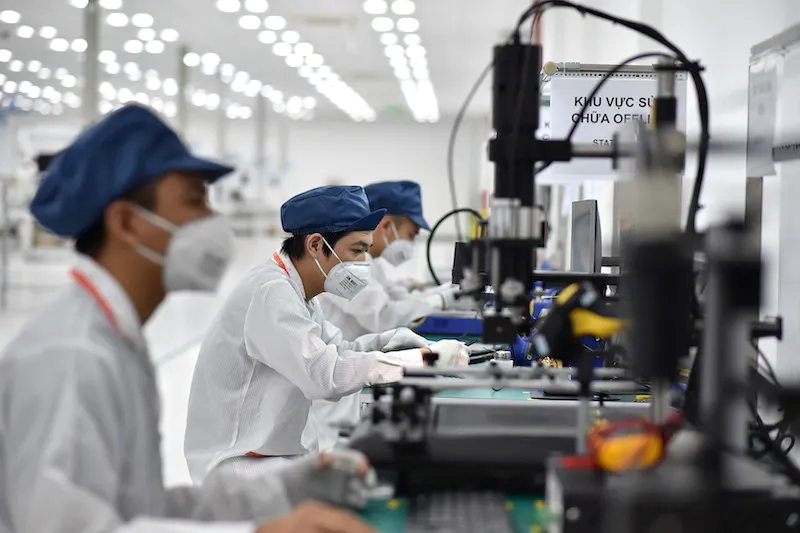
VinSmart factory in Hanoi's Hoa Lac Hi-tech Park. Photo: Vingroup
The forthcoming policy will focus on creating an environment that attracts and empowers leading experts, particularly in high-potential sectors such as artificial intelligence (AI), semiconductors, and new materials. It also aims to lay the foundation for a robust talent ecosystem that can meet the demands of national innovation.
According to Government Resolution No. 205/NQ-CP, issued following the governmental meeting in June, the Ministries of Home Affairs and Education were tasked with drafting joint policies to attract science and technology talent with a scholarship decree due this month.
Vietnam is facing a growing shortage of science and technology professionals. The Ministry of Education and Training reports that in 2024, only 9% of university entrants chose technology and engineering majors, and just 12% selected computer science and IT.
Tran Dinh Phong, an associate professor at the Hanoi University of Science and Technology, noted that Vietnam’s current research capacity is only half the average of upper-middle-income countries.
At the Central Steering Committee for Science, Technology Development, and Digital Innovation's mid-year review meeting on July 2, Party General Secretary To Lam reiterated the urgent need to finalize policies that attract and retain top experts.
He called for clear incentives, working mechanisms, and selection criteria for “chief architects” of national breakthrough initiatives to be included in the national talent strategy through 2030 with a vision toward 2050.
Minister of Science and Technology, Nguyen Manh Hung, pointed out that talent is the most decisive factor in Vietnam’s advancement into the era of science, technology, and innovation.
He noted that leaders must empower talent, requiring the state to create an open environment where new models can be tested, risk-taking is accepted, and exceptional individuals are free to demonstrate their capabilities.
Unified agency for talent management
According to a draft supervisory report by the National Assembly, Vietnam lacks elite experts in strategic fields such as AI, semiconductors, and defense technology, a gap partly caused by an overly expansive higher education system that fails to nurture excellence.
The report found that 30% of university graduates do not work in their fields of study. Outdated infrastructure, limited teaching capacity, and difficulty aligning curricula with international standards continue to hinder the development of a high-quality workforce.
The country also lags behind in developing large-scale high-tech enterprises that could guide labor market trends and align training with industry needs. International competition for talent is intensifying, yet Vietnam’s current incentive structures are insufficient to retain top talent.
The supervisory delegation has urged the government to assign a single agency to manage high-quality human resources across sectors, establish a national talent database, identify priority fields, forecast strategic labor demands, and design workforce policies aligned with national development needs.
|
Issued on December 22, 2024, Resolution No. 57 identifies science and technology as key drivers of modern production, governance reform, and socioeconomic development. The resolution positions human capital as the engine for breakthrough growth in Vietnam’s new development era. |