Vietnam government to consider reducing ownership at state-run commercial banks
Vietnam is committed to opening the financial market to foreign investors, particularly in financial services.
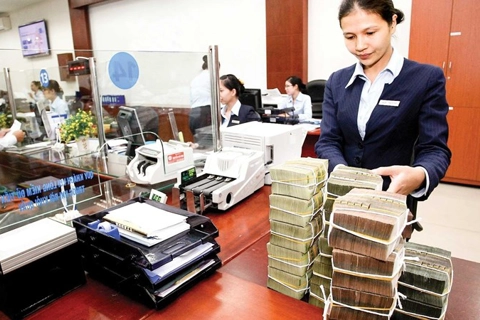
The Vietnamese government would consider reducing state ownership at four major state-run commercial banks (BIDV, Vietinbank, Vietcombank, Agribank), which account for 50% of the total credit supply in banking sector, to 65% by 2025, according to Deputy Prime Minister Vuong Dinh Hue.
| Deputy Prime Minister Vuong Dinh Hue (r) President of Warburg Pincus Timothy F.Geithner (l). Source: VGP. |

Hue shared the view in response to a suggestion from President of global private equity firm Warburg Pincus Timothy F.Geithner to raise foreign ownership limit in commercial banks to attract foreign investment and support the development of cashless payment initiative in Vietnam.
Vietnam is committed to opening the financial market to foreign investors, particularly in financial services, in compliance with the country’s commitments in multilateral and bilateral trade agreements, said Hue in a meeting with Geithner on December 17.
Hue expected Warburg Pincus to expand investment in Vietnam’s priority fields, including infrastructure, hi-tech, new materials, renewable energy, supporting industries, IT, among others.
To meet demand of foreign investors, the government plans to revise the Investment Law and the Law on Enterprises regarding the non-voting depository receipts (NVDRs), allowing foreign investors to increase their ownership and better control risks.
These two bills are scheduled to be submitted to the National Assembly for discussion and approval in May 2020, said Hue.
According to Hue, the government is planning to issue a regulation on “golden share”, which would be owned by the state and give its owner veto power over changes to charters at state-owned enterprises and commercial banks.
Hue expected the move would encourage the participation of private investors in developing Vietnam’s credit and payment systems.
Warburg Pincus’ first-ever investment in Vietnam was a US$200 million funding for Vincom Retail, the mall operator of Vietnamese conglomerate Vingroup, in 2013. The firm with US$40 billion assets under management has injected a US$100 million follow-on investment in Vincom Retail in 2015. Its highly successful US$740-million listing on the Ho Chi Minh City Stock Exchange in November 2017 was the largest-ever IPO in Vietnam at that time.
Warburg Pincus also linked up with Vietnam's VinaCapital to invest up to US$300 million in a hotel venture Lodgis Hospitality in November 2016.
In March 2018, Warburg announced a US$370 million investment in Techcombank. Three months later, it joined hands with Becamex IDC to establish a US$200 million logistics and industrial real estate investment joint venture.
In the first quarter of 2019, the New York-based private equity invested in MoMo electronic wallet to tap into the country’s fintech market. The fund also eyed the luxury resort Grand Ho Tram located in the southern province of Ba Ria-Vung Tau in Vietnam.