Vietnam, Hungary call for stronger economic ties
Leaders from both sides also reaffirmed their commitment to creating a "peace of mind" investment environment for investors.
Vietnamese Prime Minister Pham Minh Chinh and his Hungarian counterpart Viktor Orbán urged businesses and investors to increase their presence in each other's countries, emphasizing the importance of fostering robust bilateral relations.
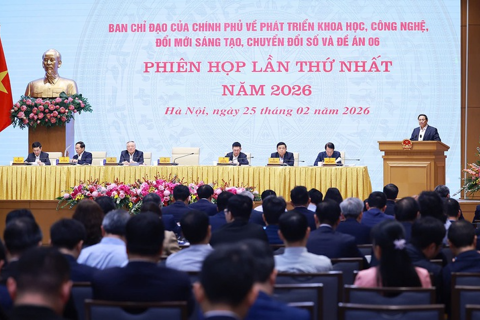
| Prime Minister Pham Minh Chinh at the forum. Photos: Nhat Bac/VGP |
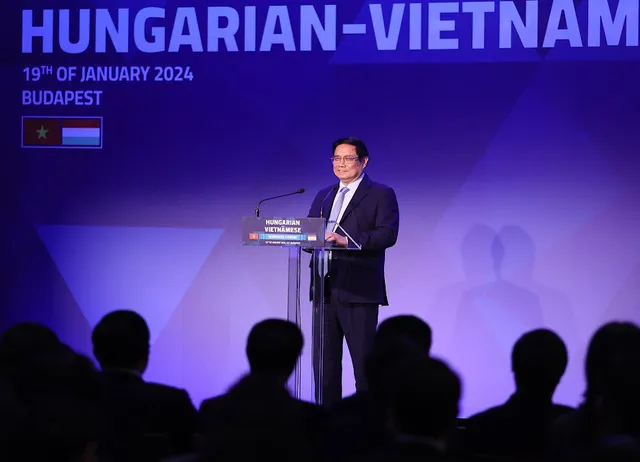
The view was shared by the two leaders at the Hungarian–Vietnamese Business Forum held in Budapest on January 19, taking place as part of the official visit of Prime Minister Chinh to the European country.
At the forum, Prime Minister Pham Minh Chinh called on investors and businesses from Hungary and Vietnam to invest in both countries, aiming to contribute to the mutual benefits and strengthen bilateral relations.
"There is no reason not to invest, do business, and develop your strengths in Vietnam and Hungary to benefit yourself and the two nations," Chinh stated.
Meanwhile, Prime Minister Viktor Orbán encouraged Vietnamese businesses to further increase their investments in Hungary.
He said that Vietnam's economy is growing robustly and expects its leading businesses to invest in Hungary.
“This will also support investment relations between the two countries," said Orbán.
According to the Hungarian leader, while the size of the economy may not be as large as Vietnam's, Hungary boasts economic diversity, which can benefit businesses looking to invest. Innovations such as the Rubik's Cube, the ballpoint pen, the coffee machine, and the computer all originated in Hungary.
Orbáncalled for Vietnamese businesses to consider Hungary as an investment option, and not to focus only on size but to evaluate other factors in Hungary's economy.
For his part, Chinh invited Hungarian businesses to invest in growth-driving sectors such as consumer goods, exports, and investment, while also focusing on emerging forces such as the green economy, circular economy, digital transformation, or artificial intelligence. Leaders from both sides also reaffirmed their commitment to creating a "peace of mind" investment environment for investors.
Responding to concerns about the potential impact of tensions in Ukraine on Hungary, Orbán stated: "This is not an issue," as Hungary has always stood for peace. "We will not have any policy that pushes Hungary into the risk of conflict," he added.
| Hungarian Prime Minister Viktor Orbán. |
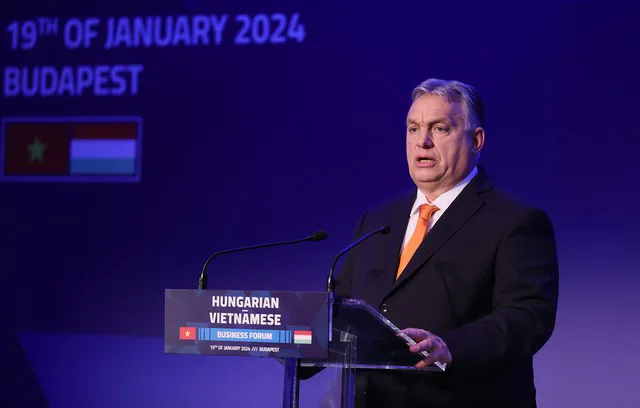
Similarly, the Vietnamese Government is committed to protecting the legal rights and interests of investors. "We always think about accompanying, encouraging, and protecting investors so that they feel safe when they come to Vietnam. No one invests in a country without stable policies," Prime Minister Chinh stated.
Addressing the business community, the Prime Minister also recalled the challenges in Vietnam's development, including wars, sieges, and embargoes. However, after nearly 40 years of innovation and integration, the scale of the economy has increased more than 53-fold, from US$8 billion in 1986 to around $430 billion in 2023, transforming a less developed country into a middle-income developing one.
Despite global and regional difficulties in recent years, Vietnam has maintained macroeconomic stability, controlled inflation, and promoted growth.
The Prime Minister reiterated that Vietnam will always honor its international commitments, and promote free trade agreements, and investment protection agreements.
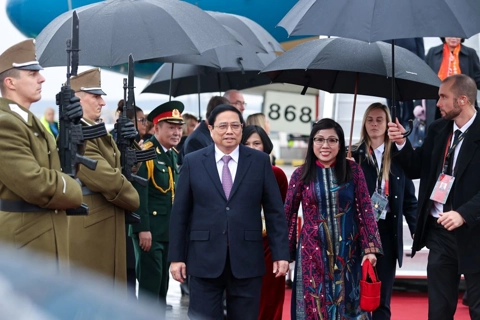
Prime Minister Pham Minh Chinh is paying an official visit to Hungary from January 18 to 20 at the invitation of Prime Minister Viktor Orbán. The Prime Minister is scheduled to meet with leaders and high-ranking officials of the country, visit businesses, universities, and commercial facilities, and participate in various other activities during the trip.
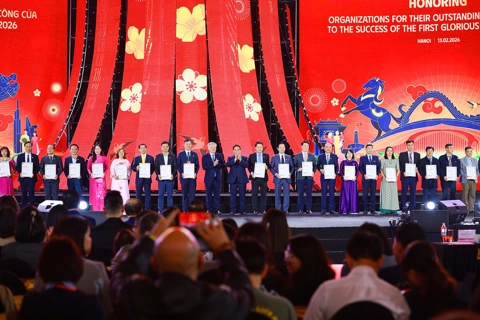
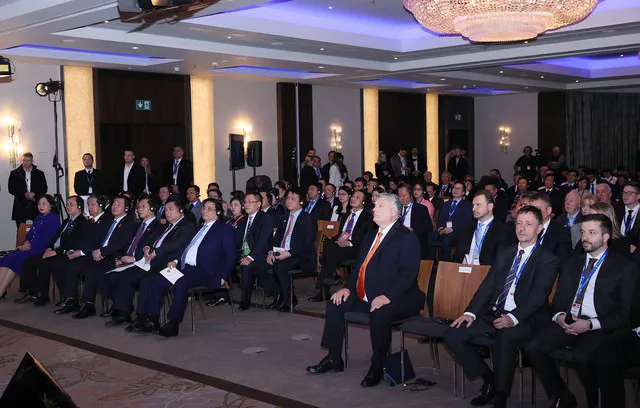
| Delegates at the forum. |
Vietnam and Hungary share a longstanding friendship and multifaceted cooperation with a history spanning over 70 years since February 3, 1950. In 2018, the two nations elevated their relationship to a Comprehensive Partnership, making Hungary Vietnam's first comprehensive partner in Central and Eastern Europe. Hungary is the largest official development assistance (ODA) provider to Vietnam in the region, having contributed EUR440 million (US$480 million) since 2017.
In the Southeast Asian region, Vietnam is the only country exporting a substantial volume to Hungary, reaching nearly $1 billion in 2020. In the three years from 2020 to 2022, the bilateral trade turnover between Vietnam and Hungary consistently exceeded $1 billion every year.
Currently, Hungary has 15 active foreign direct investment (FDI) projects in Vietnam, with a total registered capital of $50.66 million, ranking 55th among the 105 countries and territories investing directly in Vietnam.