Vietnam launches Semiconductor Alliance to build skilled workforce, strengthen global industry ties
The newly launched Semiconductor Alliance in Vietnam seeks to develop skilled professionals, foster collaboration between universities and businesses while preparing the country to play a more active role in the global semiconductor industry.
THE HANOI TIMES — Five universities across Vietnam jointly launched the Semiconductor Alliance on November 27 to promote training, research and the development of high-quality human resources for the country’s growing semiconductor industry.
Held at the Vietnam National University – Hanoi in Cau Giay Ward, the launch ceremony was a bold move in building a connected ecosystem linking education, research, production and commercialization.
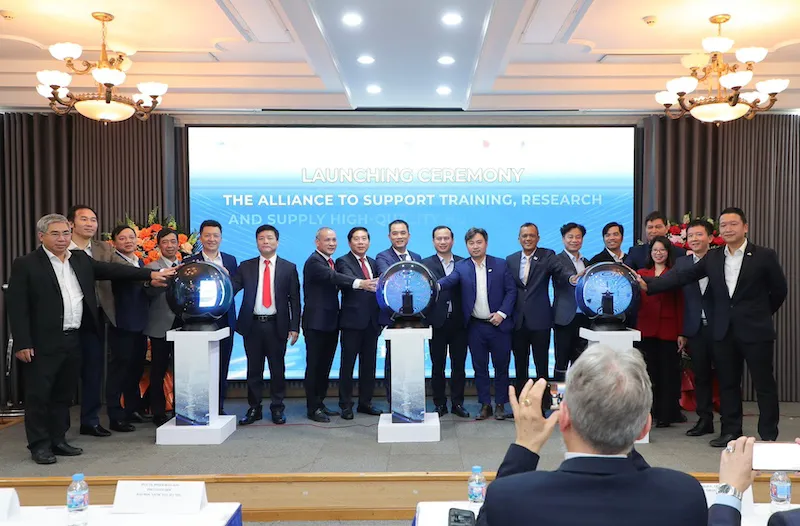
Delegates attend the launching ceremony of the Semiconductor Alliance on November 27. Photos: VNU
The five founding members are the Vietnam National University – Hanoi (VNU), the University of Danang, the Vietnam National University – Ho Chi Minh City, the Hanoi University of Science and Technology and the Posts and Telecommunications Institute of Technology.
The alliance originated in 2023 when the Ministry of Education and Training proposed a coalition of five universities tasked with training high-level talent for the chip sector.
Since then, more than 20 universities, organizations and businesses from Vietnam and abroad have joined the Semiconductor Alliance. All members may collaborate with partners outside the network, creating an open and flexible structure aligned with the global semiconductor industry’s rapid pace.
Pham Bao Son, Vice President of Vietnam National University – Hanoi, described the alliance as a strategic initiative demonstrating the university’s commitment to supporting government programs, particularly the national semiconductor talent development initiative through 2050.
He said developing the semiconductor sector is both a strategic objective and an opportunity for Vietnam to master core technologies, enhance national competitiveness and improve its position in the global value chain.
The university has invested in research infrastructure, designed specialized curricula and launched major projects aimed at creating practical products for businesses and society, Son said. These include multiple research programs and the establishment of a national microchip design, manufacturing and testing center, along with shared laboratory facilities at Hoa Lac.
“The university aims to train 10,000 semiconductor specialists by 2030, in line with national goals,” he said.
Liang Enwei, Vice President of Guangxi University in China, called the alliance an important initiative that will advance Vietnam’s semiconductor ambitions and strengthen cooperation between Vietnamese and Chinese universities and enterprises.
Le Duc Anh from the University of Tokyo highlighted the strong demand for semiconductor talent, saying the sector represents a major economic opportunity and a path for Vietnam to advance within the global high-tech value chain.
Bridging talent gaps to accelerate semiconductor growth
At the alliance launch, experts highlighted a global shortage of semiconductor engineers, presenting Vietnam with a major opportunity to expand its role in the supply chain.

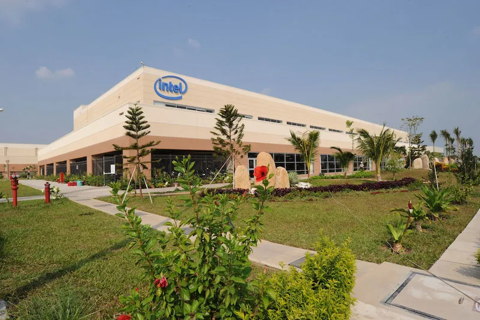
The electronic semiconductor assembly and testing plant of Intel Products Vietnam Co Ltd. Photo courtesy of the company
Vu Kim Chi, Market Development Director at the Mitsubishi Research Institute, said Japan alone is projected to lack around 200,000 semiconductor professionals by 2035 as it pursues a goal of capturing 15% of the global market.
She said the talent shortage spans roles from factory operators and production engineers to R&D specialists, emphasizing skills in data analytics, AI, robotics and Japanese language proficiency.
“This is the moment for Vietnam to consider training talent for domestic needs and for international demand,” she said.
She recommended a three-way collaboration model involving universities, businesses and training agencies to close the gap between education and industry requirements.
From the business perspective, Wan Azmi Bin Wan Hussin, Chief Operating Officer of CT Semiconductor, said the talent shortage is a shared challenge across Asia and Europe.
“Asia alone is short nearly 450,000 highly skilled semiconductor professionals. Vietnam is part of this trend,” he said, noting that new graduates often need at least six months of practical training before becoming fully productive on production lines.
Kenneth Tse, General Manage of Intel Products Vietnam, praised Vietnamese engineers and students for their eagerness to learn.
He said solving the workforce challenge requires strong cooperation between government, universities and industry.
“Hands-on experience on production lines is the best way to learn,” he said, adding that direct exposure equips engineers with the skills employers need.
Experts agreed that Vietnam has strong potential, but warned that the biggest challenge is speed: demand for skilled workers is growing faster than training capacity.
They said expanding international partnerships, giving students early factory exposure and standardizing training programs are urgent steps to help Vietnam seize the global semiconductor opportunity.
Expanding international cooperation, providing students early exposure to production environments and standardizing training programs were identified as urgent steps to ensure Vietnam can capitalize on the global semiconductor opportunity.