Vietnam moves to ban harmful AI systems over safety risks
Vietnam is advancing a landmark artificial intelligence (AI) law that would ban high-risk systems capable of impersonation, manipulation,or serious harm, as the Government seeks to close regulatory gaps, strengthen data security and ensure AI develops safely and responsibly.
THE HANOI TIMES — The Vietnamese government has proposed a ban on developing artificial intelligence (AI) systems that can impersonate humans, manipulate perceptions or behavior, or seriously harm users’ lawful rights and interests.
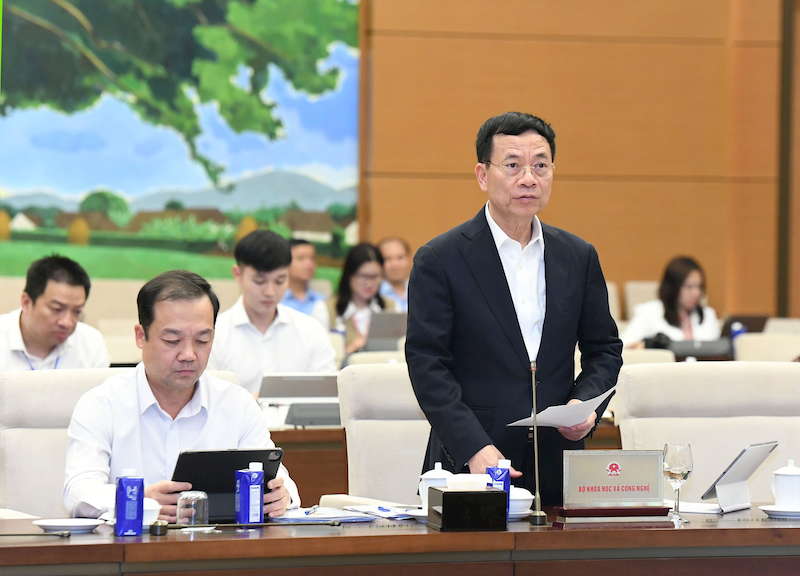
Minister of Science and Technology Nguyen Manh Hung presents the draft Law on Artificial Intelligence to the National Assembly Standing Committee on November 17 in Hanoi. Photo: Dai bieu Nhan dan Newspaper
The proposal is outlined in the draft Law on Artificial Intelligence, presented by Minister of Science and Technology Nguyen Manh Hung to the National Assembly Standing Committee on November 17.
The full draft will be submitted to the National Assembly on November 21, with legislators scheduled to debate it on November 27.
For the first time, the draft defines “unacceptable-risk AI systems”, technologies that may cause serious, irreparable harm to human rights, national security, public order and safety, or are created to perform acts prohibited by law.
These systems would be banned from development, deployment, provision, or use in any form in Vietnam.
Such systems include those designed to support illegal activities; those that use fabricated or simulated people or real events to intentionally deceive or manipulate users; technologies that exploit vulnerabilities of sensitive groups; and systems that create or disseminate high-risk fake content threatening national security or public safety.
According to the document, the rapid advancement of AI is creating new security risks. Deepfake technology can be abused to spread disinformation, defame individuals, commit fraud and destabilize society. Autonomous weapons raise difficult ethical and legal questions.
Meanwhile, legal frameworks are evolving more slowly than the technology itself, leaving widening regulatory gaps. A timely legal foundation is therefore needed to control risks while still promoting research and AI applications in Vietnam.
Minister Hung said the draft law aims to establish a unified legal framework ensuring AI develops safely, responsibly and for the benefit of people. AI is considered part of the country’s intellectual infrastructure, a driver of productivity, innovation and technological autonomy.
The draft law consists of eight chapters and 36 articles. It emphasizes human-centered AI policies and clarifies the State’s role in governance and facilitation.
It introduces a risk-based management model to ensure AI applications remain transparent, safe, accountable and aligned with national security, data sovereignty and technological reserves.
The draft also requires AI systems to be non-harmful, unbiased and respectful of human values, with clear oversight, inspection and violation-handling mechanisms to strengthen deterrence and public trust.
The government plans to build a stronger innovation ecosystem and high-quality workforce through support for research, investment and training across institutes, businesses and individual developers.

Vingroup showcases VinRobotics humanoid robots at the 80th Anniversary Exhibition in Hanoi. Photo the courtesy of the company
The National Assembly’s Committee on Science and Technology agreed with the draft’s policy direction but recommended clearer quantitative or qualitative criteria to classify AI risks.
It also suggested expanding prohibited behaviors to enhance deterrence and consistency, such as banning the use of AI-generated deepfakes for fraud, defamation, political disruption, election manipulation, or threats to national security.
National Assembly Vice Chairman Tran Quang Phuong noted that risk-based regulations must be designed in line with Vietnam’s practical capacity.
He also called for a unified mechanism clarifying the government’s coordinating role and the responsibilities of ministries and agencies.
National Assembly Chairman Tran Thanh Man highlighted the need for strong inter-agency coordination among ministries and other relevant bodies, as cybersecurity and online safety cannot be the responsibility of any single ministry.
He stressed that all regulations must put people at the center, ensure cybersecurity, uphold national autonomy, support international integration and promote inclusive, sustainable development with balanced governance.
He noted that many Vietnamese businesses are already active in AI, making a legal framework essential. The government would issue detailed guidelines to ensure the law is implemented effectively over time.
While the recently passed Law on the Digital Technology Industry contains a chapter on AI, these provisions only offer foundational principles and do not form a comprehensive legal corridor for AI research, development, deployment and ecosystem growth.
Man emphasized that when used correctly, AI is not just a technology but a core driver of economic, social and defense development.
However, opportunities come with challenges, making a timely legal framework necessary to manage risks and support innovation. The law must encourage creativity, ensure a flexible regulatory environment, protect human rights and apply risk-based oversight.
Man called for stronger regulations on personal data and privacy protection, harmonization with the Cybersecurity Law and alignment with international commitments such as the Budapest Convention and the newly adopted the UN Convention against Cybercrime (Hanoi Convention).
These concerns also apply to the draft Cybersecurity Law 2025 (which merges with the 2018 law) now under consultation.
Tran Quoc Chinh, Vice Chairman of CMC Group and CEO of CMC Cyber Security, said data must be treated as the central asset that requires protection.
He noted that once the cybersecurity law is approved, it will create a unified legal framework requiring solution providers, from infrastructure to data protection, to comply with national and international standards.
“This higher level of compliance would ‘indirectly ensure stronger protection for users’ data,” said Chinh.