Vietnam mulls sharp rise in casino entry fee for locals
Such higher rates are intended to discourage individuals without adequate financial capacity from entering casinos.
THE HANOI TIMES — Vietnam is considering a sharp rise in casino entry fees for locals, with the Ministry of Finance proposing charges of VND2.5 million (US$100) per day or VND50 million (US$2,000) per month, roughly double to two-and-a-half times current rates.

A casino in Vietnam. Photo: Royal
The proposal, outlined in a draft decree on casino operations now open for feedback, has drawn mixed reactions from relevant ministries and agencies.
The Ho Tram Project Company recommended keeping the daily entry fee at VND1 million (US$40) and suggested that the VND50 million (US$2,000) rate should apply annually instead of monthly. The company noted that its proposal is similar to Singapore, where casino entry fees are about VND3 million (US$120) for 24 hours and VND60 million (US$2,400) for one year.
Current rules only set daily and monthly fees and do not include an annual option. Under an annual fee of VND50 million (US$2,000), players would pay less than VND4.2 million (US$168) per month, equal to about 16.8% of the current monthly cost and 8.4% of the ministry’s proposed rate.
Ho Tram argued that a VND50 million yearly fee would be more viable and competitive compared with regional markets while encouraging domestic players to use licensed casinos.
This would help curb illegal gambling activities and increase budget revenues from fees and taxes.
Phu Quoc Investment and Development JSC also recommended lower rates than the ministry’s proposal, suggesting either VND1.5 million (US$60) for a 24-hour pass or VND35 million (US$1,400) per month, which is 30% to 40% below the Finance Ministry’s draft.
The MoF did not agree with these recommendations, saying that the higher rates are intended to maintain reasonable parity with current fees and to discourage individuals without adequate financial capacity from entering casinos.
The Ministry of Justice countered that raising entry fees as a way to assess financial capacity is inappropriate. It asked the drafting agency to study more feasible alternatives and provide clearer justification for the proposed increase.
The MoF responded that the matter had already been reported and approved by the government and the Politburo. It said the financial-capacity requirement aligns with international practice and domestic conditions and helps limit foreign currency outflows caused by complex administrative procedures.
Last month, the government issued Resolution 8, which allows eligible Vietnamese citizens to enter the Phu Quoc casino project in the southern province of An Giang.
The government also approved a five-year pilot program permitting Vietnamese players at the Ho Tram casino in Ho Chi Minh City and the Van Don casino in the northern province of Quang Ninh.
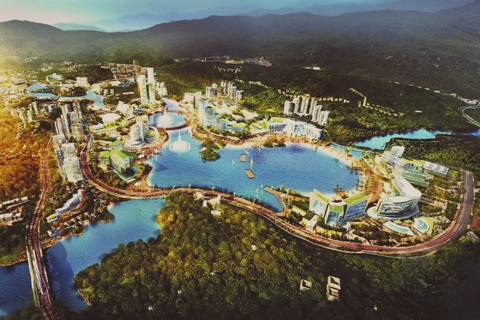
Vietnam now has nine operating casino projects, including six small-scale facilities and three large ones. The first casino to admit Vietnamese players is the Corona Phu Quoc casino, developed by Phu Quoc Tourism Investment and Development JSC. The complex has an investment capital of more than VND50 trillion (US$2 billion) with 1,470 gaming machines and 147 tables.
During the five-year pilot program, Vietnamese players accounted for 52% of total visits and generated 88% of casino revenue.
Before 2023, when Covid-19 restrictions were in place, Vietnamese customers made up an average of 71% of visits and 87.9% of revenue.
In 2024, the share of Vietnamese visitors fell to 12% and revenue dropped 71% from VND4.177 trillion (US$167 million) in 2023 to VND1.207 trillion (US$48 million) in 2024.