Vietnam posts five-year high FDI disbursement as investor confidence strengthens nationwide 2025
Despite global economic and geopolitical headwinds, foreign capital flows into Vietnam accelerated in 2025, with investment increasingly concentrated in high value-added sectors, highlighting the country’s growing appeal as a stable, long-term destination for investors.
THE HANOI TIMES — Vietnam recorded a five-year high in foreign direct investment (FDI) disbursement, reaching US$23.6 billion during January–November 2025, according to the Ministry of Finance’s General Statistics Office.
The figure proves strong foreign investor confidence in the country’s economic stability and long-term growth prospects, the office said in its 11-month socio-economic development report.

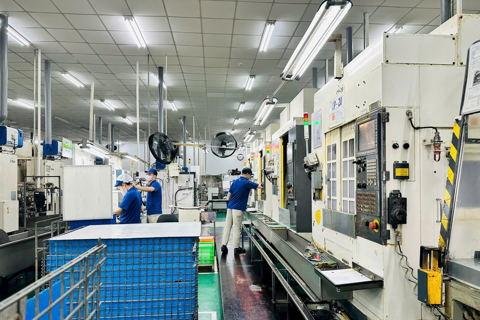
A local worker at Stanley Electronic Company in Vietnam. Photo: Hai Nguyen/The Hanoi Times
The report also revealed that the surge appears clearly in scale as well as in the structure and quality of investment flows.
Capital has shifted strongly toward high value-added sectors, led by processing and manufacturing, which accounted for 82.9% of total disbursed FDI.
Real estate ranked second with nearly US$1.7 billion, or 7.1%, while electricity, gas, steam and air-conditioning production and distribution attracted US$754.9 million, equivalent to 3.2%.
Another notable trend is the sharp rise in capital contributions and share acquisitions. Investors recorded 3,225 transactions with a combined value of US$6.1 billion, up 50.7% year-on-year.
This trend shows that foreign investors increasingly seek faster market entry by leveraging the existing infrastructure, market share and operational capacity of domestic firms.
Vietnam attracted US$33.7 billion in FDI over the 11-month period, marking a 7.4% increase from the same period last year. During this time, authorities licensed nearly 3,700 new projects with total registered capital of US$16 billion.
While the number of new projects rose sharply by 21.7%, newly registered capital fell 8.2%, indicating more cautious investment decisions amid global uncertainty.
Among 88 countries and territories investing in Vietnam during the period, Singapore remained the largest source of newly registered capital, contributing nearly US$4.3 billion, or 26.9% of the total.
Sweden entered the top five foreign investors with US$1 billion in new capital. This development signals the early emergence of a new wave of European investment, particularly in high technology, green energy and sustainable development, aligning with Vietnam’s strategy to attract next-generation FDI.
Despite strong momentum, challenges persist. The gap between rising project numbers and declining registered capital reflects a more cautious approach by multinational corporations, especially as the global minimum tax regime begins to take effect.
Looking ahead to 2026, FDI inflows are expected to continue growing with stronger focus on green and digital sectors.
Vietnam continues to maintain its appeal to international investors, with total registered capital likely to approach or exceed US$38–40 billion.
In this context, eco-industrial parks and renewable energy projects are likely to gain a competitive advantage as green standards become increasingly mandatory.
In its report on 11-month FDI inflows, the Foreign Investment Agency under the Ministry of Finance noted that global investment remains under pressure from economic and geopolitical uncertainty, pushing capital toward markets with strong fundamentals and high absorption capacity.
As global capital flows shrink and restructure, the Asia–Pacific region continues to stand out as a key destination, driven by sustained demand in electronics, semiconductors and technology, particularly in Vietnam, Thailand and Malaysia.
“Vietnam remains a trusted destination thanks to its stable macroeconomic environment, consistent investment policies and improving capabilities in electronics and component manufacturing,” the agency said.