Vietnam’s AI economy to reach US$130 billion by 2040
The report identified AI as a key driver of Vietnam’s future economic growth.
THE HANOI TIMES — Vietnam's economic growth is expected to be catalyzed by artificial intelligence (AI), with a contribution of between US$120 billion and US$130 billion by 2040, according to the Vietnam's AI Economy 2025 report.
Released on June 12 in Hanoi, the report identified AI as a key driver of Vietnam’s future economic growth.
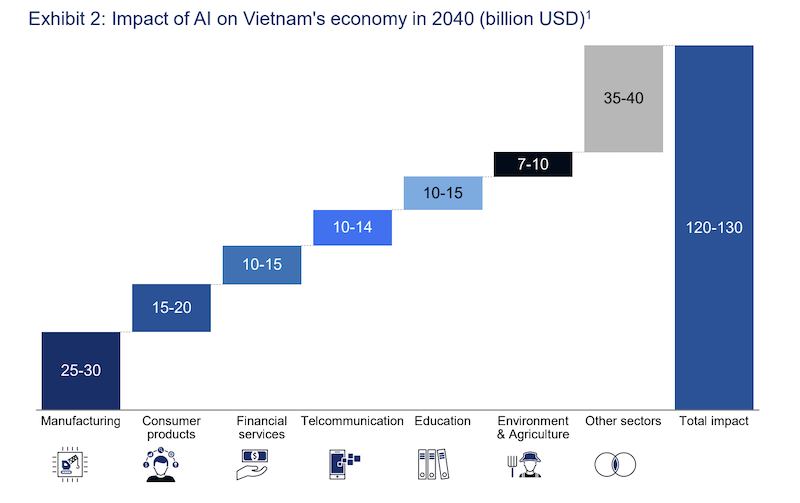
Screenshot from the Vietnam's Al Economy 2025 report. Source: NIC
This growth will be fueled by $45-$55 billion in consumer demand and $60-$75 billion in productivity gains through automation and analytics.
These figures reflect AI’s vast potential for Vietnam. Strategic investment, workforce training, and ecosystem development could help Vietnam become a regional AI leader in the global digital economy.
The report provides a thorough overview of Vietnam’s AI economy, draws from international experience, and identifies opportunities in key sectors. It also presents strategic pillars to support the implementation of Vietnam’s new AI policies.
At the report's announcement ceremony, Vu Quoc Huy, Director of the National Innovation Center (NIC), said that AI is a strategic priority for Vietnam.
“We are determined to participate in this global race and establish a strong national position in this critical field,” he said.
He stressed the need for deeper collaboration with economies and leading technology firms worldwide to accelerate AI development.
Kubo Yoshitomo, Deputy Chief Representative of the Japan International Cooperation Agency (JICA) in Vietnam, said that the report's findings and policy recommendations provide valuable insights for policymakers, businesses, academic institutions, and investors working to advance AI-driven transformation in Vietnam.
Delegates attending the event said that although Vietnam has made progress in adopting AI, government and public service applications are still in the early stages. Most solutions and use cases are still in the pilot phase and are limited to certain provinces or agencies.
The report pointed out that scaling up nationwide faces challenges such as the need for sustainable financing models, enhanced cross-sector and regional cooperation, and improved access to practical, high-impact AI solutions.
It also highlighted barriers on the business side, including concerns about cost-effectiveness, limited workforce capabilities, and difficulty accessing high-quality data for AI deployment.
Recommendations

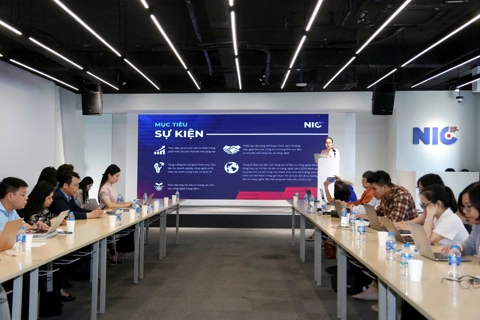
Delegates at the launch of the Vietnam’s AI Economy 2025 report. Photo: NIC
To drive AI-led growth, the report offered two strategic recommendations based on three development pillars. First, it suggested prioritizing high-impact AI use cases across the public and private sectors, supported by clear communication and robust public-private partnerships.
The report also calls for establishing a robust AI startup ecosystem through accelerator programs and a national AI innovation fund. Furthermore, it emphasizes the importance of sustainable, collaborative research, supported by updated AI curricula and targeted upskilling.
Strengthening the foundational pillars of Vietnam’s AI economy requires additional focus on three enabling pillars: scalable AI literacy programs tailored to different audiences; open access to sector-specific data through international partnerships and investment incentives; and a clear, flexible AI governance framework that includes regulatory sandboxes.
The NIC director announced that the NIC will collaborate with JICA DXLab to launch the AI Startup Acceleration Program in Vietnam. This initiative aims to support early-stage startups by strengthening their capabilities, expanding their market access, attracting investment, and gradually building a strong foundation for the country’s AI innovation ecosystem.
Huy emphasized that with its young, dynamic, tech-savvy population and a strong drive for innovation, Vietnam is well-positioned to become a regional hub for AI research, development, and application.