Vietnam’s online food delivery market jumps 19% in 2025 as duopoly tightens grip
Rapid urbanization and app-based lifestyles are reshaping how Vietnamese consumers order meals, with food delivery platforms expanding quickly in 2025 amid rising competition, service innovation and growing reliance on digital channels for everyday dining across major cities.
THE HANOI TIMES — Vietnam’s online food delivery market rose 19% year on year in value to US$2.1 billion in 2025, according to the sixth edition of Momentum Works’ annual report Food Delivery Platforms in Southeast Asia.
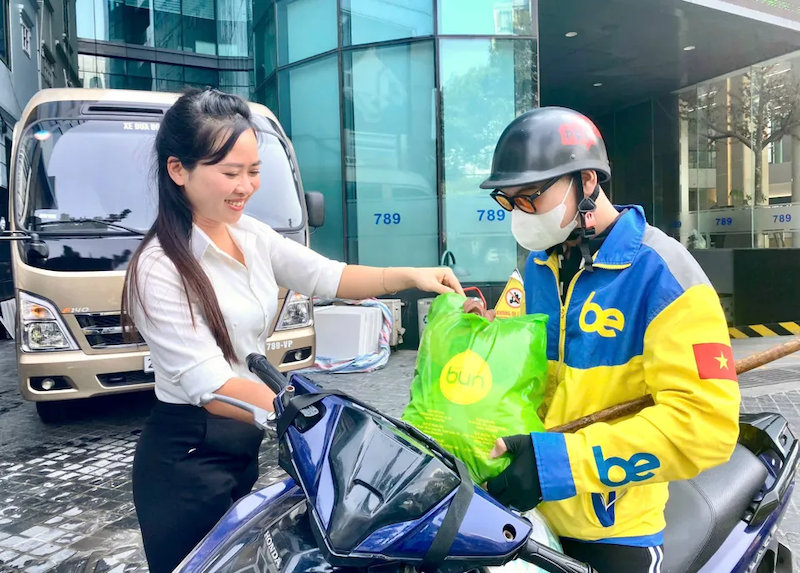
Food orders delivered by beFood in Hanoi. Photo: Khanh Ly/The Hanoi Times
ShopeeFood and GrabFood led the market, together accounting for 48% of total spending across four platforms.
Some 4% of market share belonged to beFood while newcomer Xanh SM Ngon, which entered the market recently, has yet to record measurable revenue.
Momentum Works said gross merchandise value (GMV) covers only completed orders placed through delivery applications, excluding direct restaurant orders and canceled transactions.
Earlier estimates from the e-Conomy SEA 2025 Report by Google, Temasek and Bain & Company put Vietnam’s ride-hailing and online food delivery market at $5 billion in 2024, up 20% from the previous year, with projections of $9 billion by 2030.
Consumer surveys continue to show firm demand. A 2025 study by Decision Lab found food ordering via mobile apps has become routine, especially in Hanoi, Ho Chi Minh City and Danang.
German data firm Statista linked the market’s rapid expansion to high smartphone penetration, busier urban lifestyles and growing demand for convenience.
Competition, however, has thinned. In 2023, six platforms operated in Vietnam, including ShopeeFood, GrabFood, beFood, GoFood, Baemin and Loship.
Baemin exited the market in December 2023. Gojek followed in September 2024, leading to GoFood’s withdrawal. By the end of 2024, domestic platform Loship had also shut down.
The ShopeeFood-GrabFood duopoly may face renewed pressure after Xanh SM Ngon entered the market in June 2025. The platform aims to leverage its electric two-wheeler ride-hailing network to gain traction in food delivery.
Established players continue to adjust. GrabFood has added group ordering, options for solo diners and in-store dining vouchers to diversify revenue. ShopeeFood has expanded the use of artificial intelligence in affiliate marketing and livestream commerce to stimulate demand.
Regionally, Vietnam remains the smallest online food delivery market among the six countries tracked by Momentum Works, behind Indonesia, Thailand, the Philippines, Malaysia and Singapore.
The combined market across the six countries reached $22.7 billion last year. Thailand posted the fastest growth at 22%, lifting its market value to $5.1 billion.
Jianggan Li, Founder and CEO of Momentum Works, said Southeast Asia’s food delivery sector continues to expand in scale and users.
Platforms are focusing on affordability to reach mass-market consumers while extending beyond delivery into dine-out services and advertising.
With richer data from online and offline consumption, Li said platforms are positioned to evolve from transaction channels into “demand orchestrators” across the food and beverage ecosystem.