Vietnam’s seafood exports to US expected to rise ahead of new tariffs
Vietnam’s seafood export growth is showing signs of divergence across products and markets, as the looming US retaliatory tariffs create new challenges for the industry.
THE HANOI TIMES — Vietnam's seafood exports to the US in May and June are predicted to increase by 10% to 15% compared to April, as local businesses race to fill orders before new US reciprocal tariffs take effect on July 9, according to the latest prediction of the Vietnam Association of Seafood Exporters and Producers (VASEP).
VASEP noted that Vietnamese enterprises are ramping up exports of key items such as shrimp and pangasius to the US in order to maximize revenues before the tariff hike increases overall costs.
Meanwhile, shipments to other major markets such as China and ASEAN are expected to slow, with growth projected at only 3% to 5%, due to intensified competition from Chinese seafood products. Meanwhile, exports to the EU and Japan are likely to maintain steady growth of 8% to 10%, aided by free trade agreements.
"Facing high US tariffs, exporters of these products need to redirect shipments to the domestic market and nearby regions such as ASEAN," the association said.
Shrimp leads sector recovery
VASEP reported that Vietnam's seafood sector made revenues of $3.3 billion in the first four months of 2025, up 21% year-on-year.
Shrimp remained the standout performer, generating nearly $1.3 billion, up 30% from a year ago, thanks to rising prices in the global market.
Meanwhile, mollusks, crabs and swimming crabs also performed strongly. Exports of mollusks reached $216.4 million, up 18%, while those of crabs and swimming crabs reached $83.1 million and $112.1 million, respectively, up 82% and 50%. These increases were largely driven by higher demand from China and ASEAN markets.
Vietnam seafood exports to China surge
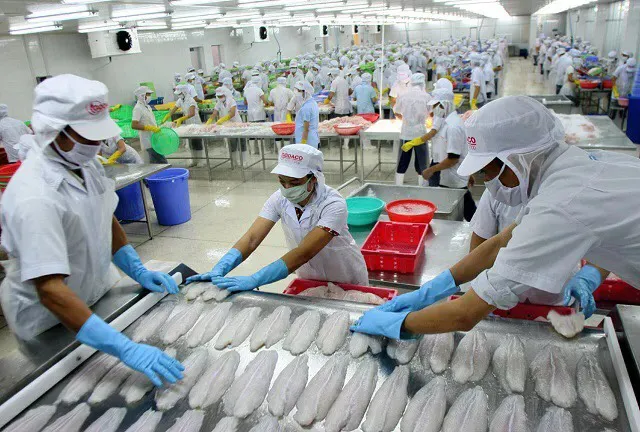
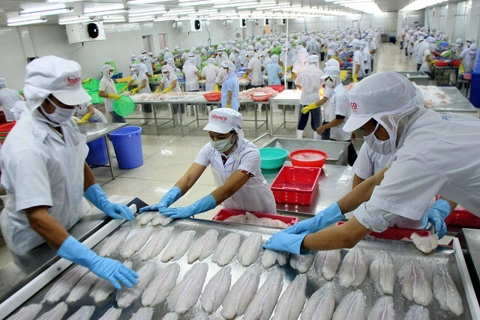
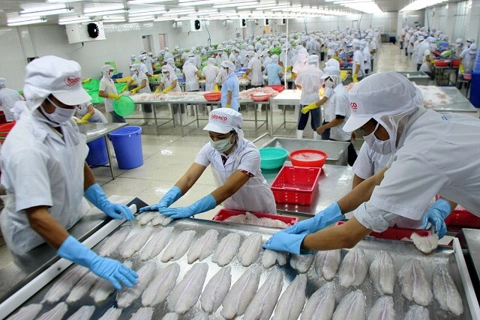
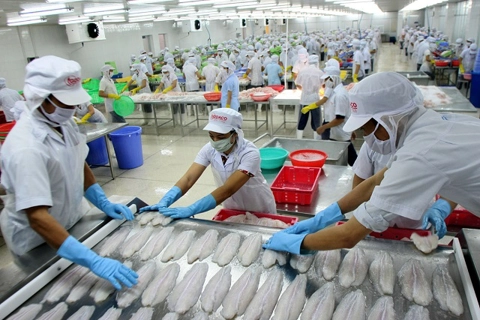
Seafood is processed for export at Godaco Company in the southern province of Tien Giang. Photo: Viet Hung/Kinh te & Do thi newspaper
In the first four months of 2025, China, including Hong Kong, was top destination for Vietnam's seafood, generating $709.8 million in export revenue, up 56% from the same period last year.
Japan ranked second with total imports of Vietnamese seafood reaching $536.6 million, up 22%. The EU was the third largest importer with $351.5 million, representing an increase of 17%, supported by preferential tariffs under the EU-Vietnam Free Trade Agreement. South Korea followed with $264.1 million, up 15%.
In contrast, exports to the US fell sharply in April, down 15% to $498.4 million, reflecting the early impact of the current US retaliatory tariffs.
The double whammy of reciprocal tariffs and anti-dumping duties on certain seafood products is hurting Vietnam's exports to the US. Core exports such as pangasius and shrimp have been directly affected.
VASEP said the tariffs increase the cost of products, prompting US importers to consider alternative sources such as India or Ecuador. In addition, technical barriers, including strict food safety inspections and traceability requirements, are reducing Vietnam's competitive advantage in the US market.
Therefore, free trade agreements (FTAs) such as the Comprehensive and Progressive Agreement for Trans-Pacific Partnership (CPTPP) and other FTAs are helping Vietnamese businesses offset losses by expanding exports to the EU, Japan, and ASEAN.
In addition, local enterprises are shifting to value-added products and diversifying export destinations to reduce reliance on the US. Leading firms such as Sao Ta Foods JSC and Vinh Hoan Corp. are among the pioneers.
At this year's annual general meeting, Sao Ta Foods, one of Vietnam's leading shrimp exporters, revealed that it may exit the US market altogether if the proposed tariffs of up to 46% are imposed.
The company is trying to penetrate other markets, including Canada, Australia, South Korea, and Japan. Its Chairman Ho Quoc Luc also identified China as a promising destination and noted that the company is closely monitoring the market in preparation for entry when conditions are favorable.
In the first quarter of 2025, Sao Ta and its subsidiary exported more than $46 million worth of seafood to the US. In the most recent 40-day period, the shipment volume reached up to $60 million. The accelerated pace of exports during the 90-day tariff grace period is part of the company's risk mitigation strategy.
In contrast, Vinh Hoan, the leading pangasius exporter, has committed to continuing its export push to the US before the new tariffs are enforced.
However, the company has cautiously adjusted its 2025 post-tax profit target to VND1 trillion (US$38.5 million), down 18.4% from the previous year.
In 2024, VHC recorded a gross profit of VND1.9 trillion (US$73.1 million), up 26% year-on-year. Its post-tax profit reached VND1.3 trillion (US$50.4 million), marking a 34% increase compared to 2023.