Vietnam stock market clears major legal hurdle to potential upgrade
Starting November 2, foreign investors will no longer be required to pre-fund 100% of their transactions, promising the removal of a major roadblock for Vietnam's market upgrade process.
The Ministry of Finance has issued a new circular amending and supplementing several provisions regarding transactions, clearing, settlement, and information disclosure in the stock market. Under this new regulation, foreign investors buying stocks are no longer required to have sufficient funds (non-pre-funding) at the time of placing orders, as was previously the case.
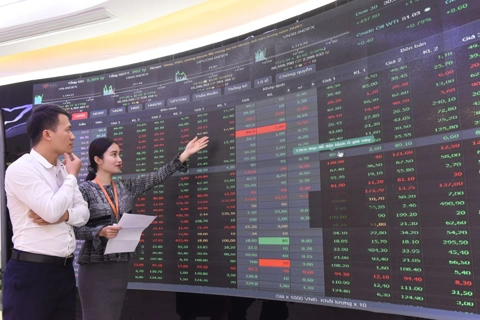
| An investor at a securities company in Hanoi. Photo: Khanh Linh/The Hanoi Times |

To implement this, securities firms must assess their clients' financial capacity to determine margin requirements based on a mutually agreed basis. If a foreign institutional investor lacks sufficient funds, the securities company will cover the shortfall from its own trading account and must sell the securities as soon as they arrive in the investor's account.
"Any gains, losses, or other related costs will be settled according to the agreement between the securities firm and the foreign investor," the new circular stipulates.
The Ministry of Finance also clarified that the bank where a foreign institutional investor holds a securities custody account would be responsible for covering any shortfall in funds if it incorrectly confirms the customer's account balance, leading to insufficient funds for settling securities transactions. The requirement for foreign investors to pre-fund 100% of their transactions has been seen as one of the major barriers to upgrading the stock market.
Experts and analysts have pointed out that this requirement complicates matters for foreign investors, particularly large institutions, as they will be exposed to foreign exchange risks regardless of whether the transaction is successful.
Globally, very few markets still use a pre-funding mechanism. Instead, most rely on collateral to mitigate risk. Vietnam aims to upgrade its stock market from frontier to emerging market status by 2025. Currently, both MSCI and FTSE Russell classify Vietnam as a frontier market. However, FTSE Russell has placed Vietnam on its watchlist for a potential upgrade to emerging market status.
According to international rating agencies and financial institutions, two key issues need to be addressed: the pre-funding requirement and foreign ownership limits. Restrictions on foreign ownership should only be applied to sectors where they are truly necessary. The World Bank estimates that upgrading the market could attract $25 billion of new foreign investment into Vietnam by 2030.
As per the stock market development strategy approved by the Prime Minister, the market capitalization of Vietnam’s stock market is expected to reach 100% of GDP by 2025 and 120% by 2030. The number of investor trading accounts is targeted to reach 9 million by 2025 and 11 million by 2030, with a focus on developing institutional and professional investors as well as attracting foreign investors.