Vietnam strives to reduce digital technology gap amid Covid-19 pandemic
It is necessary to give practical orientations and plans to ensure equitable access to technology in the current context.
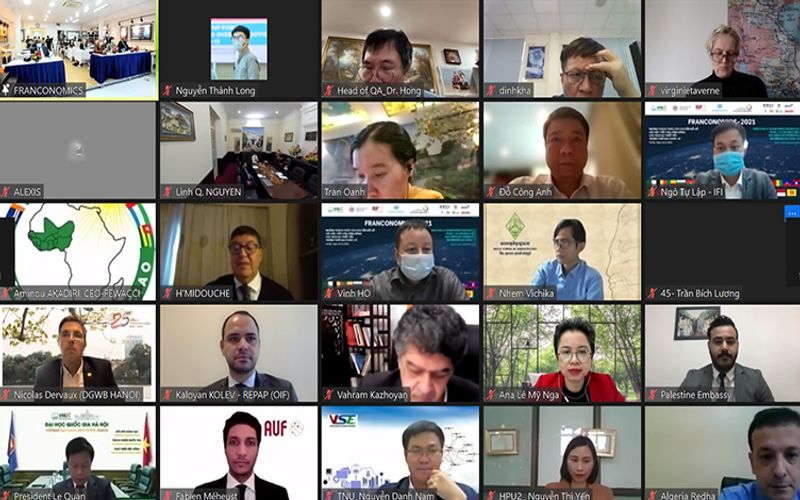
Vietnam strives to reduce the digital technology gap amid the Covid-19 pandemic as equitable access to digital technology is the current issue in the country, Dr. Ngo Tu Lap, director of the International Francophonie Institute (IFI) under the Vietnam National University (VNU) said at Franconomics III-2021 forum held virtually in Hanoi from November 24 to 25.
The forum has been jointly held by the IFI, the International Organization of Francophonie (OIF), and the United Nations Industrial Development Organization (UNIDO) with the theme: “Challenges of digital transformation in equitable access to essential services amid the Covid-19 pandemic”.
At the forum, Dr. Ngo Tu Lap stressed that the Covid-19 pandemic exposed the need to have a new model of cooperation in socio-economic life, in order to build a smart economy, a smart society for a bright future of all nations and peoples in the world.
Lap acknowledged that the Covid-19 pandemic has seriously affected countries in terms of economy, culture, and social life. More than ever, the world is called upon to adapt to the pandemic.
Therefore, digital transformation has proven its key role in the economic recovery of most countries around the world. However, despite the efforts exerted over the past two years, digital transformation has in fact created unequal access to essential services in all countries regardless of development level, the director noted.
“Thus, Franconomics was created with a view of providing an opportunity to rethink the challenges of digital transformation for equitable access to essential services during the pandemic, with a focus on access to information technology, educational and health services, as well as industry 4.0 and smart agriculture,” Lap said.
An overview of the virtual event. Screenshot: Nguyen Ngan |
“Digital transformation is seen as an optimal lever that opens up opportunities to stabilize and pursue the sovereign missions of nations as well as public and private economic activities. However, the digital transformation process is posing many challenges, especially in the current Covid-19 era, when borders are closed, supply chains and services are disrupted, and technical infrastructure has not yet met the needs of immediate digital transformation,” Lap told The Hanoi Times.
For his part, French Ambassador to Vietnam Nicolas Warnery assessed that the global crisis caused by the Covid-19 pandemic has left extremely strong consequences not only in terms of employment but also in mobility due to social distancing measures, affecting access to public services.
“However, thanks to digital technology, we have succeeded in maintaining classes for students, especially through online schooling,” the ambassador said.
With these classes, online platforms and digital content transmitted via tablets or smartphones have grown exponentially to be able to provide education anywhere and for everyone.
Nevertheless, the digital transformation also causes big disparities, especially for the part of the population who have been "on the sidelines" of the digital revolution due to different reasons.
In addition, the French Ambassador assessed that Vietnam is a country that adapts quickly to digital transformation. Particularly, Vietnam has nearly 69 million Internet users (out of a population of 98 million), with an increase of 550,000 new Internet users from 2020 to 2021, nearly 72 million accounts on social networks, and around 154 million active mobile devices.
Vietnam has recorded another eight million new digital consumers from the beginning of the pandemic to the first half of 2021. Since the crisis started, e-commerce has grown by 53% with a revenue of about US$21 billion. Vietnam's digital economy is estimated to reach US$57 billion by 2025 and US$220 billion by 2030, ranking second in the region, after Indonesia.
These numbers demonstrate the extraordinary adaptability of the Vietnamese to complicated situations. However, they do not reveal the disparities that may exist in the population, especially in the most remote areas, Warnery said.
Inequality in access to technology and technical infrastructure between countries and territories, between urban and rural areas has created barriers to the process of global digital transformation and the development of society. It is necessary to give practical orientations and plans to ensure equitable access to technology in the current context, the ambassador emphasized.