

Vietnam targets 90% profit goal for Japanese Companies
Japan’s businesses continue to rank Vietnam among their most attractive destinations in Southeast Asia, supported by rising profitability, expanding investment plans and closer government-to-business engagement.
THE HANOI TIMES — The Vietnamese government aims to lift the share of Japanese companies operating profitably in Vietnam to 90%, Prime Minister Pham Minh Chinh said on February 9 during talks with the Japan Chamber of Commerce and Industry and 37 Japanese firms.
Citing a survey by the Japan External Trade Organization (JETRO), Chinh said 67.5% of Japanese companies in Vietnam reported profits in 2025, the highest level since 2009 and above the ASEAN average of 65.3%.
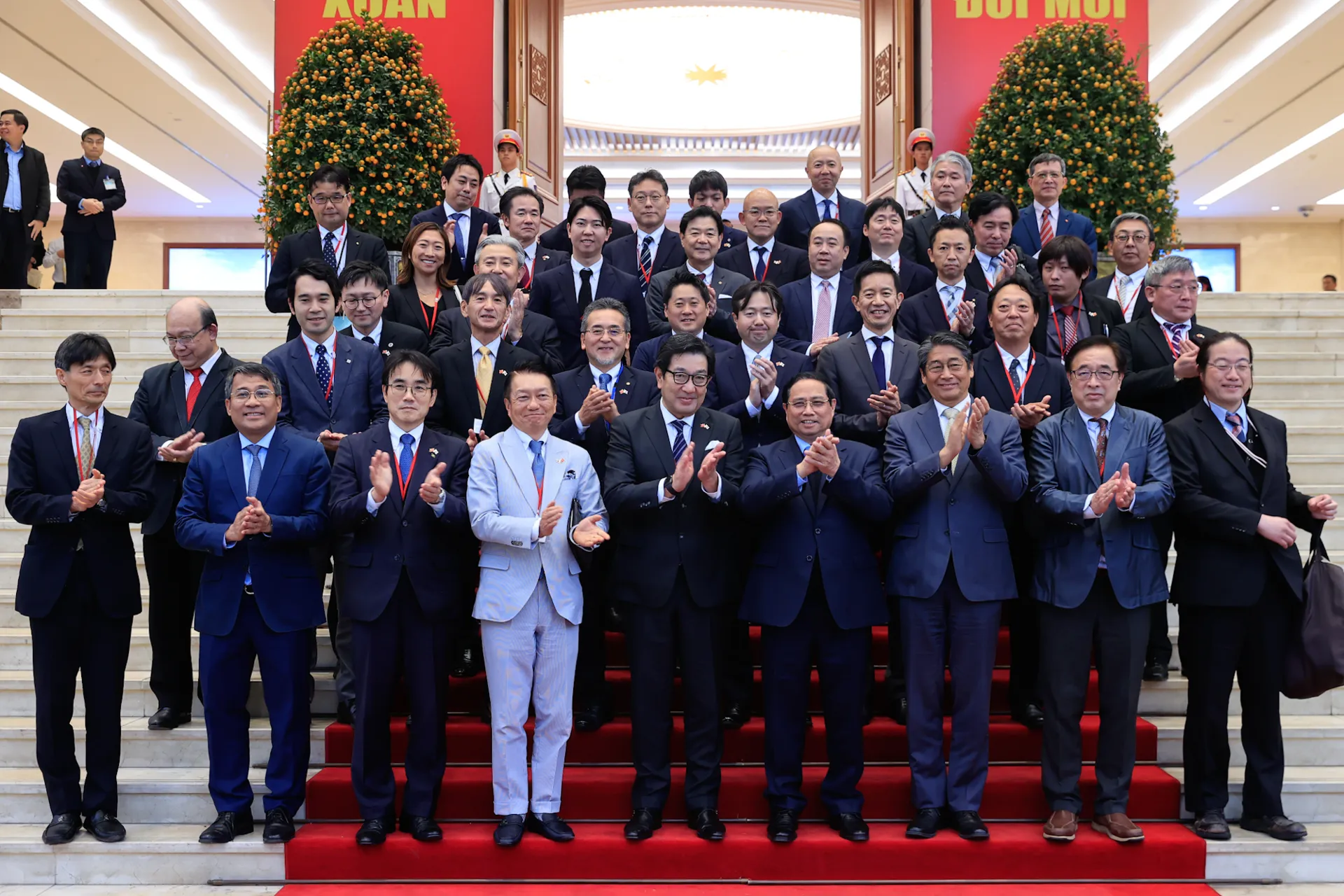
Prime Minister Pham Minh Chinh (front row, fourth from right) meets Japanese business executives and officials on February 9. Photo: VGP
About 56.9% of Japanese firms plan to expand operations in Vietnam over the next one to two years, ranking first in ASEAN for the second consecutive year, he said.
Japan remains one of Vietnam’s largest investors. As of January 31, 2026, Japanese investors held more than 5,700 valid projects in Vietnam with total registered capital of US$78.9 billion.
In 2025, Japan ranked fourth among 113 countries and territories investing in Vietnam, after Singapore, China and South Korea, with 296 new projects worth $3.7 billion, up 6.6% from 2024.
Japanese investors operate in 19 sectors, led by manufacturing and processing with 2,050 projects and $48.6 billion in capital, accounting for 61.6% of total registered investment.
Other major areas include power generation and distribution, gas, water and air conditioning with 32 projects worth $11.8 billion, or 14.9%, and real estate with 127 projects worth $9.3 billion, or 11.8%.
Bilateral trade also hit a milestone as two-way turnover exceeded $50 billion for the first time, reaching more than $51.4 billion in 2025, up 11.3% from a year earlier.
Vietnam posted a trade surplus of nearly $2.1 billion with Japan, a proof showing Japan’s role as a key, stable and complementary trade partner in regional supply chains.
“There is still huge room for growth. I expect that 90% of Japanese companies will operate profitably in Vietnam,” Chinh said.
He called on both countries to deepen cooperation in policy and practice, develop concrete programs and projects and strengthen dialogue to build trust and mutual understanding.
Keita Ishii, Chairman of the Japan-Mekong Economic Committee, Chairman and CEO of Itochu Corporation and head of the Japanese business delegation, said Japanese firms of all sizes are keen to expand business ties with Vietnam.
He praised Vietnam’s efforts in administrative reform, improving the investment climate, developing human resources and advancing digital transformation.
Japanese companies want to contribute to stronger Vietnam-Japan economic ties and help elevate bilateral relations, Ishii said.
Prime Minister Chinh said Vietnam has set long-term goals, including double-digit economic growth during 2026-2030 and becoming a high-income developing country by 2045.
He said improving competitiveness, restructuring the economy and fully using opportunities from international integration remain central to sustainable development.
According to the Vietnamese government leader, Vietnam will maintain political stability, ensure security for people and businesses, safeguard sovereignty and territorial integrity and pursue an independent and diversified foreign policy, he said.
The country will pursue rapid and sustainable growth while advancing three strategic breakthroughs in institutions, infrastructure and human resources, aiming for transparent rules, efficient infrastructure and effective governance.
Vietnam will prioritize investment in five strategic, green and high-tech areas, including science and technology, innovation, digital transformation, semiconductors and electronics, the digital economy, green and clean energy, research and development and high-tech agriculture.
Chinh urged the Japan Chamber of Commerce and Industry, the Japan-Mekong Economic Committee and relevant agencies to promote investment, improve quality, accelerate technology transfer and support Vietnamese firms in joining Japanese value chains.
The government will continue building a stable, transparent and predictable investment environment and treat investor confidence as a strategic asset, he said.
He called on Japanese businesses to expand cooperation with Vietnam and help deepen the Comprehensive Strategic Partnership for peace and prosperity in Asia and beyond.
Improving labor quality
Ishii said Japan faces a major challenge as its working-age population declines rapidly, with a projected labor shortfall of about 11 million people by 2040.
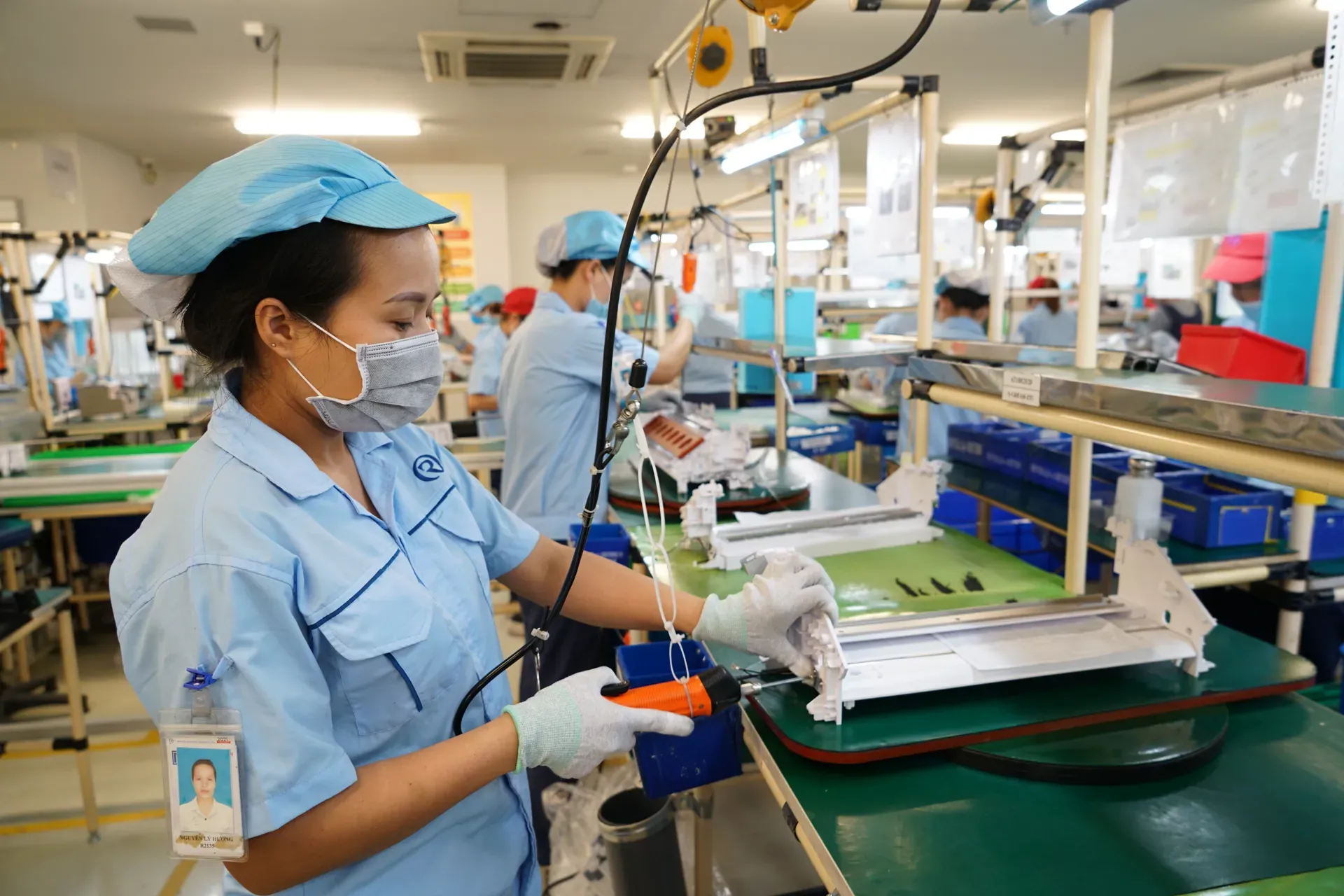
Production line operated by Rhythm Precision Vietnam, a Japanese company based at the Noi Bai Industrial Park in Hanoi's Soc Son Commune. Photo: Pham Hung/The Hanoi Times
To address the gap, Japan needs more foreign workers, especially from Vietnam, he said, calling for more flexible and innovative approaches.
Ishii also praised Vietnamese workers for their diligence and eagerness to learn while mentioning about 600,000 Vietnamese living and working in Japan. This is also Japan’s largest foreign community.
Huynh Quyet Thang, President of Hanoi University of Science and Technology, said universities should modernize training programs with a stronger focus on skills and Japanese-language education.
He said many graduates who worked in Japan later started businesses there.
University data show that about 1,200 alumni have built careers in Japan, including more than 20 companies with combined capital exceeding $10 million.
“This is a strong network that can support current students and key industries,” Thang said.
Prime Minister Chinh said Vietnam will meet Japan’s labor needs by strengthening training and urged universities to train engineers in fields Japan demands, with emphasis on technical skills, law, culture and language.
He said both sides should streamline visa and work permit procedures and improve labor quality for sectors such as semiconductors, artificial intelligence, climate action and green development.
He highlighted the role of universities such as Hanoi University of Science and Technology, Phenikaa University and FPT University in training talent for industries Japan prioritizes, including semiconductors, artificial intelligence and green growth.
|
About the Japan-Mekong Business Committee The Japan Chamber of Commerce and Industry represents more than 1.25 million member companies nationwide and plays a central role in policy advocacy, investment promotion, trade and international economic cooperation. Within the Japan Chamber of Commerce and Industry, the Japan-Mekong Business Cooperation Committee, established in 2013, promotes investment and business links between Japanese firms and Mekong countries, with Vietnam as a key partner. The committee regularly organizes economic missions to strengthen business connections, infrastructure development and regional economic cooperation. |







