Vietnam's taxi market to grow by 10.25% in 2022-2027
Passengers' preferences for taxi and ride-sharing services are expected to increase, likely prompting the development of options and expansion of operations in mobile applications to maintain their market shares.
Vietnam's taxi market is expected to grow by 10.25% between 2022 and 2027, reaching a market volume of US$790 million in 2027, according to consulting firm Mordor Intelligence.
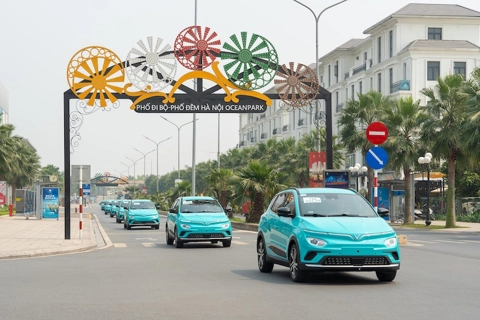
| Vietnam's taxi market is projected to grow in the coming time. Photo: Vingroup |

The consulting firm explained the market expansion for reduced taxi fares and easy booking through mobile applications.
"The Vietnamese taxi market is fragmented. Industry participants are likely to witness intense competition due to aggressive strategies, including acquisitions, pricing, mergers, and new product development," the report said.
Currently, there are more than 200 taxi companies operating in the Vietnamese market, of which domestic Vinasun and Mai Linh are the two largest. In particular, the penetration of ride-hailing companies such as Grab and Gojek has changed the landscape of this market in recent years.
In the medium term, passengers' preferences for taxi and ride-sharing services are expected to increase across the country, likely prompting the development of options and expansion of operations in mobile applications to maintain their market shares in a highly competitive market, the report noted.
The consulting firm added that Internet penetration, rising standard of living, and the emergence of local players are slowly changing the landscape. Over the forecast period, the rising demand and market scenario are expected to be graphically different and in favor of on-demand transportation services.
Moreover, vehicle booking through phone calls and street hailing continues to be a favorite option among popular taxi companies such as Mai Linh, Vinasun, Vinataxi, TaxiGroup, Hoang Long, and others.
The report highlighted that among the largest cities, Hanoi is likely to grow at a faster rate due to the launch of new ride-hailing services by companies such as Grab, FastGo, and Gojek, and such developments are expected to continue over the forecast period.
| G7 taxis stop at a local park in Hanoi. Photo: Tuan Anh/The Hanoi Times |

Recently, Hanoi-based taxi companies are seeking permission from the government and Hanoi authorities to operate electric cars. According to Nguyen Anh Quan, General Director of G7 Taxi Corporation, the traditional taxi company, the use of electric cars could help the city's taxi companies compete with technology-based ride-hailing service providers.
The city also witnessed the partnership between ride-hailing startup Be and Vingroup subsidiary - electric vehicle manufacturer VinFast - to establish the BeVinFast service, which will enter the taxi market this May.
In April, another Vingroup subsidiary, Green and Smart Mobility (GSM) JSC, launched its newly established electric taxi brand, Green SM Taxi, in Hanoi, providing passenger transportation services using only VinFast electric vehicles.
The Hanoi launch kicks off the company's plan to expand to at least five provinces and cities nationwide this year, according to GSM.
In another move that could add another player to the electric vehicle market, the largest Chinese manufacturer, BYD, plans to set up a production base for electric cars and parts in Vietnam. The manufacturer had also considered the Philippines and Indonesia, in addition to Vietnam, for a new plant, Bloomberg reported.
Revenue from the ride-hailing and taxi segment of the shared mobility market in Vietnam is expected to reach $4.2 billion in 2023, according to Statista. The revenue is estimated to reach $4.63 billion in 2027.