Vietnam to benefit from EU’s new carbon border tax
This incentive would ensure a sustainable future for Vietnam’s economy toward net-zero emissions by 2050.
The upcoming Carbon Border Adjustment Mechanism (CBAM) proposed by the EU is set to accelerate Vietnam’s efforts for energy transition and carbon emission reduction.
| ETP Director Sirpa Jarvenpaa. Photo: Hai Yen/The Hanoi Times |

Sirpa Jarvenpaa, Director of Southeast Asia Energy Transition Partnership (ETP), a multi-donor partnership implemented by the UN Office for Project Services (UNOPS), gave remarks at its consultation workshop discussing the impacts of CBAM on Vietnam today [April 14].
Sirpa added that the CBAM, considered one of the key tools for the European bloc to move toward the net carbon emission goal by 2050, would set a price on the carbon emissions associated with imports of certain goods into the EU.
“The CBAM is intended to address the issue of 'carbon leakage' where companies move their production outside the EU to countries with less stringent emissions regulations to avoid carbon pricing and gain a competitive advantage,” she noted.
In this regard, the CBAM would require importers to purchase carbon allowances, similar to the EU Emissions Trading System (ETS), estimated at a current US$65 per ton of CO2, to cover the emissions associated with the production of the imported goods, Sirpa said.
As the CBAM is set to take effect from October 1, 2023, with a three-year transitional phase and become fully operational in 2034, Sirpa noted it is time for Vietnam's industrial sectors to work on this mechanism and remain competitive in the EU – one of Vietnam’s key export markets.
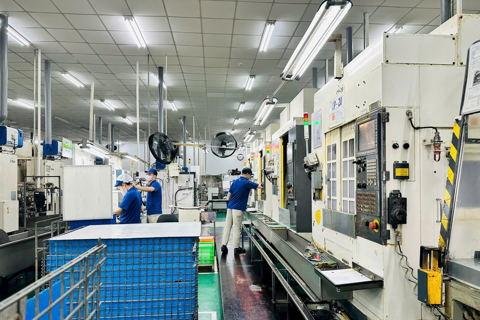
Chu Hoang Long, a consultant for the ETP, added as of March 2023, the CBAM would have direct impacts on four industrial sectors from Vietnam that emit CO2 and perfluorocarbons (PFC), namely iron and steel, cement, fertilizers, and aluminum.
| Delegates attending the event. Source: UNOPS |

Among those four, iron and steel, and aluminum are set to be affected the most, given their engagement with the EU market. During 2017-2021, the EU made up 12% of Vietnam’s total steel exports, or US$1.1 billion annually, followed by aluminum at $48 million, or 7%.
Once adopted, Long estimated the CBAM would cause a decline of US$100 million in export turnover from these sectors to the EU.
“For the immediate future, the economic impacts would not be significant due to the limited scope of the CBAM, but as the EU has not ruled out expanding the CBAM to other key export products, Vietnam should start preparing for the new changes to remain competitive. This is not to mention the fact that other key markets for Vietnam to adopt similar policies, such as the US, South Korea, or Japan,” Long added.
The consultant added that the ultimate goal of CBAM is to lower greenhouse gas emissions, and a quick adaptation to the regulation would further aid the country’s cause for green growth development.
Another incentive for Vietnam mentioned by Long is that once the country puts into use its carbon pricing mechanism, only the difference between CBAM and Vietnam’s pricing rate (the country’s nationally determined contribution estimates the lowest-cost mitigation option at $11 per ton of CO2) would be paid to the EU, instead of the full estimated $65 per ton.
“This is particularly important for Vietnam to realize the Government’s target of keeping the greenhouse gas emission in the energy industry below 457 million tons of CO2 by 2030,” Long said, noting the presence of CBAM and Vietnam’s carbon pricing would put the figure at 376 million tons by 2030.
“Embracing CMBA would help incentivize investments in low-carbon technologies, energy efficiency, and renewable energy usage,” Long said, expecting the move to catalyze innovation and promote sustainable production practice.
On the issue, the Director of the Economics and Climate Change Information Division under the Department of Climate Change at the Ministry of Natural Resources and Environment (MONRE), Nguyen Van Minh, noted the agency is working on strengthening institutional and technical capacity for adapting CBAM, particularly for the private sector.
“Starting 2023, the Vietnamese Government has required local firms to provide data on their greenhouse gas emission, which is part of the efforts to soon establish the carbon pricing mechanism,” Minh said.
Minh acknowledged early preparation for CBAM is an important step, noting the MONRE is set to work with related Government agencies to discuss with the EU their support for Vietnam in adapting the CBAM,” he added.
Minh also called for businesses to watch for CBAM’s development and start planning for the process, including emission reporting requirements and cooperating with government agencies in engaging in decarbonization policies.
“A robust monitoring, reporting, and verification system in Vietnam is key for the country to ensure smooth adaptation of the CBAM. This is to ensure a sustainable future for Vietnam’s industries and economy toward net-zero emission by 2050,” he concluded.