Log in
Social Affairs

Vietnam to launch pay reform for public employees from July 2022: NA Chairman

The basic salary is the reference for calculating salaries of State employees by multiplying it with their corresponding coefficient.

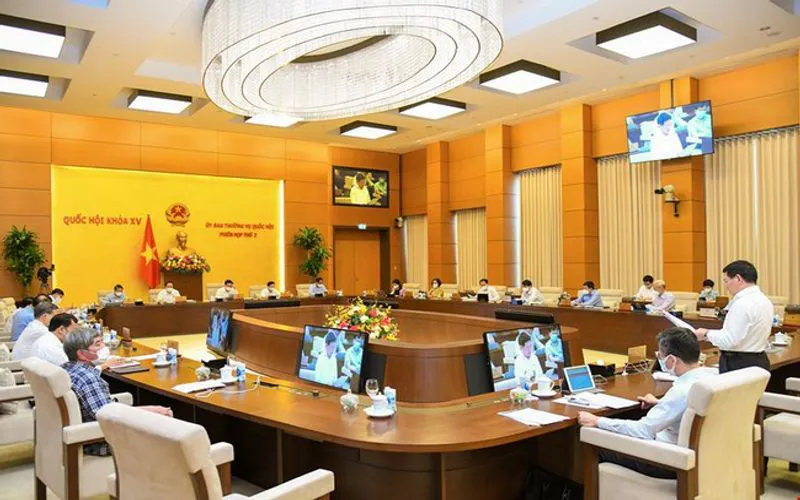
The minimum monthly salary of civil servants and public employees should be raised starting July 1, 2022, said National Assembly (NA) Chairman Vuong Dinh Hue at a recent meeting, which discussed on principles, criteria, and norms for the allocation of regular State expenditure estimates for 2022.

The Party Central Committee’s resolution has set July 1, 2022, as the date for salary reform, Hue said, adding that all special wage mechanisms must be removed.

The NA Standing Committee will review and ensure sufficient resources to carry out the salary reforms, Hue noted.

 An overview of the meeting. Photo: VGP

He stressed that many existing criteria and norms on public employee wage have become outdated while many new policies and mechanisms have been issued, thus requiring uniform standards in this regard.

“The Covid-19 pandemic may affect all fields, but I think if we are determined, we can do it because the budget still affords us some room for a minimum salary increase,” Hue said.

For his part, Minister of Finance Ho Duc Phoc said that the local under-spent budget currently stands at VND252 trillion (US$10.9 billion), which is sufficient to finance wage reform.

"The source for the salary increase from July 2022 is ready," said the finance minister.

Concluding the meeting, NA Vice Chairman Nguyen Duc Hai proposed the NA's Committee on Finance and Budget to evaluate the contents expressed in the Resolution on making certain sources to implement the norm standards and wage reform.

Besides, the Vietnamese Government will also need to adjust pensions, social insurance allowances, prescribed monthly allowances, and preferential allowances for people with meritorious services in accordance with the basic wage increase.

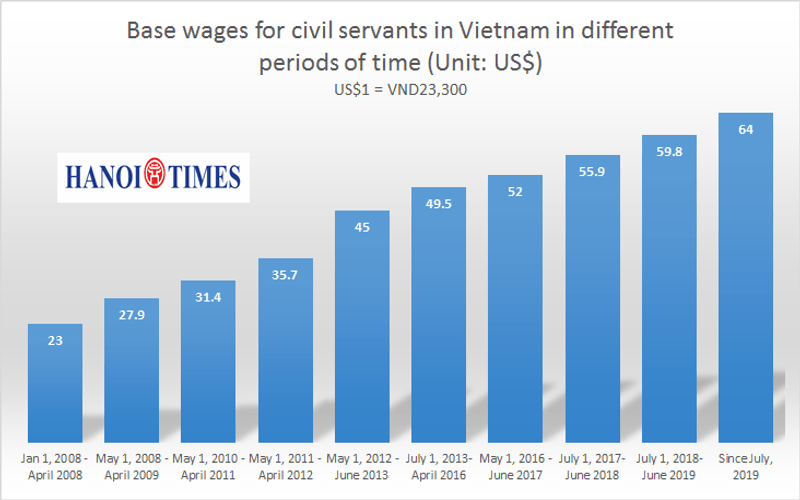
Base wages for civil servants in Vietnam in ten different periods. Source: luatvietnam.vn. Chart: Nguyen Ngan

The basic minimum salary in Vietnam is the reference for calculating the salaries of employees in the State-run sector by multiplying it with a corresponding coefficient.

Public sector employees have complained for years that their earnings are too low. The starting coefficient for a university graduate in the public sector is 2.34.

Currently, Vietnam’s minimum monthly salary is divided into four different levels, depending on location - VND4.18 million (US$179) for region 1 (big cities), VND3.71 million (US$159) for region 2 (provincial capital and towns), VND3.25 million (US$139) for region 3 (rural areas), and VND2.92 million (US$125) for region 4 (backward areas).

The four different minimum wage regions reflect the cost of living in each area. Region 1, including the major cities, including Hanoi, Ho Chi Minh City, Danang, Haiphong, and Cantho, has the highest minimum wage, while region 4 (rural areas) has the lowest.

Businesses will calculate their workers' salaries by multiplying the minimum wage with a coefficient determined by qualification and seniority.

Reactions:
Share:
Trending
Most Viewed
Related news
Increasing wages along with productivity

Increasing wages along with productivity

10 Aug, 10:48

This time every year, when National Wages Council (NWC) has a meeting on raising minimum wage, the media becomes a battlefield between those representing workers and the employers on how much the minimum wage should be raised. And the two sides tend to accept a number that does not satiate their concerns.

Vietnamese regulations on wages

Vietnamese regulations on wages

02 Jan, 10:31

Paying wages to employees is one of the most basic obligations of the employer. However in principle, forms of wage payment as well as payroll calculation methods in several cases still often confuse enterprises.

Nearly 80,000 public employees receive benefits after early retirement

Nearly 80,000 public employees receive benefits after early retirement

According to the Ministry of Home Affairs, around 100,000 public employees will leave public service due to restructuring, including about 85,000 early retirees, from 2025 to 2027,

Vietnam to implement first child-centered Juvenile Justice Law in 2026

Vietnam to implement first child-centered Juvenile Justice Law in 2026

Vietnam has taken a major step toward child-centered justice with the adoption of the Juvenile Justice Law, a landmark outcome of four years of international cooperation aimed at strengthening protections for children across the criminal justice system.

Vietnam marks 25 years of ILO Convention commitment in labor law enforcement

Vietnam marks 25 years of ILO Convention commitment in labor law enforcement

Marking 25 years since ratifying ILO Convention No. 182, Vietnam and its international partners reaffirmed their commitment to harness labor law enforcement, particularly ending child labor amid remaining challenges.

15-year campaign builds a safer, more responsible traffic culture across Hanoi

15-year campaign builds a safer, more responsible traffic culture across Hanoi

After 15 years, a long-running traffic safety campaign continues to shape safer behavior and shared responsibility on Hanoi’s streets.

Border soldiers walk alongside children on Lai Chau’s hardships to school

Border soldiers walk alongside children on Lai Chau’s hardships to school

In Vietnam’s northern border highlands, many children begin their school day hours before sunrise, walking dangerous mountain paths to reach class. Behind their perseverance stands quiet, long-term support from border soldiers, teachers and local authorities.

PM requests emergency in house rebuilding for flood-hit residents 

PM requests emergency in house rebuilding for flood-hit residents 

The Government leader has called the mission a mandate from the heart, urging all authorities to act as a moral commitment to the people.

Two-tier local government model strengthens Hanoi’s efforts to end urban flooding

Two-tier local government model strengthens Hanoi’s efforts to end urban flooding

Associate Professor Nguyen Hong Tien analyzes why Hanoi still faces chronic flooding, explains weaknesses in drainage planning and implementation and outlines how the two-tier local government model can support long-term solutions.

PetroVietnam advances nationwide STEM classrooms to drive innovation and future talent

PetroVietnam advances nationwide STEM classrooms to drive innovation and future talent

PetroVietnam expands its STEM Innovation program to develop high-quality classrooms and strengthen Vietnam’s future workforce in science, technology and innovation.