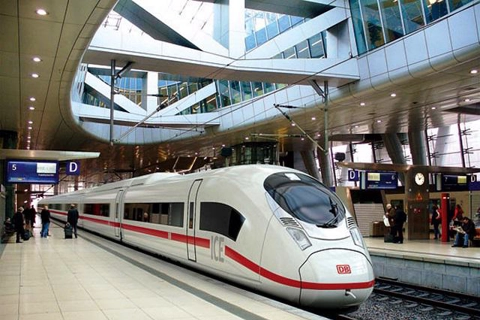
Vietnam to speed up US$59-billion high-speed train project
Upon completion, the rail link would significantly reduce travel time from Hanoi to Ho Chi Minh City to around six hours.
Prime Minister Pham Minh Chinh has issued a decision to create a Steering Committee tasked with overseeing the development and execution of the investment policy project for the high-speed railway on the North-South axis, estimated at US$58.7 billion, and other major national railway initiatives.
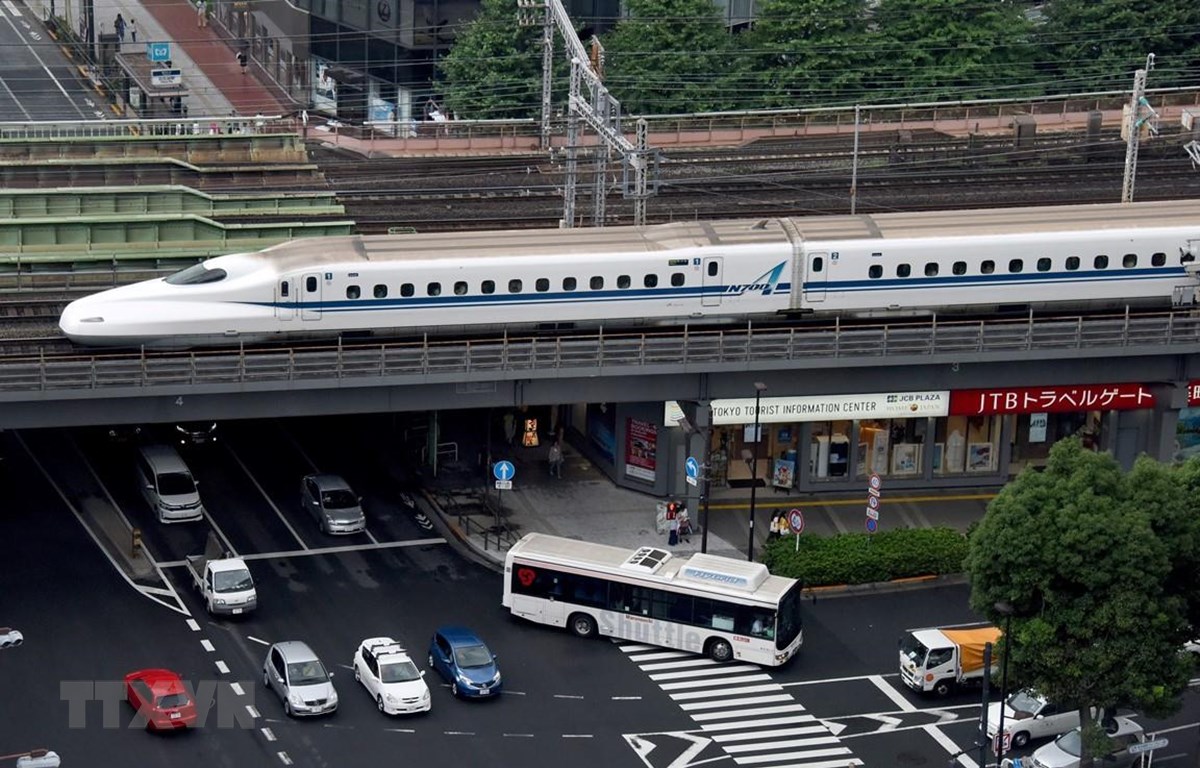
| A Japanese bullet train. Photo: AFP/VNA |
The main objective of the Steering Committee is to facilitate cross-sectoral coordination and provide direction to address critical tasks related to the development and implementation of nationally significant railway projects (excluding urban railway ones).
Deputy Prime Minister Tran Hong Ha has been appointed to head the committee, with Minister of Transport Nguyen Van Thang serving as the Permanent Deputy Head. Other deputy heads include Minister of Planning and Investment Nguyen Chi Dung, Minister of Finance Ho Duc Phoc, and Minister and Chairman of the Government Office Tran Van Son.
The Steering Committee is responsible for proposing mechanisms and policies to overcome obstacles, mobilize resources, accelerate progress, and ensure the successful execution of the investment policy project for such mentioned projects.
The committee is expected to involve organizations, experts, and scientists to provide advice throughout the implementation process.
The Ministry of Transport has been designated as the standing agency for the Steering Committee, with responsibilities such as developing the committee's operating rules and submitting them to the committee's head for approval, assisting in the development of plans and work programs related to the projects.
Between 2005 and 2010, the Government entrusted the Vietnam Railways Corporation (VNR) as the investor to conduct a feasibility study for the North-South high-speed railway project. This study was conducted in collaboration with the Vietnam-Japan Consulting Joint Venture.
The project envisages a double-track railway with a gauge of 1,435 mm, exclusively for passenger trains, designed to operate at a speed of 350 km/h. The line's total length of the line is 1,570 km, with 27 stations and 5 depots.
The high-speed line is expected to start at Hanoi railway station, pass through 20 provinces and cities, and end at Thu Thiem station in Ho Chi Minh City. The total investment is estimated at over $58 billion, to be financed from the national budget.
During a recent conference on the North–South high-speed railway project, VNR Chairman of Board Vu Anh Minh suggested that if the high-speed railway becomes a reality, the travel time from Hanoi to Ho Chi Minh City “would be reduced to just 6 hours, which is almost comparable to the time it currently takes to travel to the airport, complete check-in procedures, and board a flight to Ho Chi Minh City— a process that currently takes 5 hours”.
Despite more than a decade of development, numerous seminars, and debates among experts, the project has yet investment approval.
A significant breakthrough came recently when the Politburo issued a conclusion on the North-South high-speed railway project on February 8, setting a specific goal to seek approval of the investment policy for the project by 2025 and to commence construction of priority sections between 2026 and 2030, specifically from Hanoi to Vinh and from Ho Chi Minh City to Nha Trang.
Most recently, in August, the Ministry of Transport submitted a request to the Prime Minister, calling for a meeting with the Politburo on the North-South high-speed railway investment policy project by the end of this year.